
by Lucas Garcia
Last year, a new show aired on the Discovery channel called “Dino Hunters,” and it brought to my attention how some of the behind-the-scenes aspects of Paleontology work. The truth is, it’s not as simple as professional Paleontologists finding fossils and bringing them back to a lab where they can be studied. Private landowners actually find many fossils (at least in America). With even some of the most famous fossils being discovered by them (i.e., “Sue” the T. Rex, and the “Dueling Dinosaurs”).
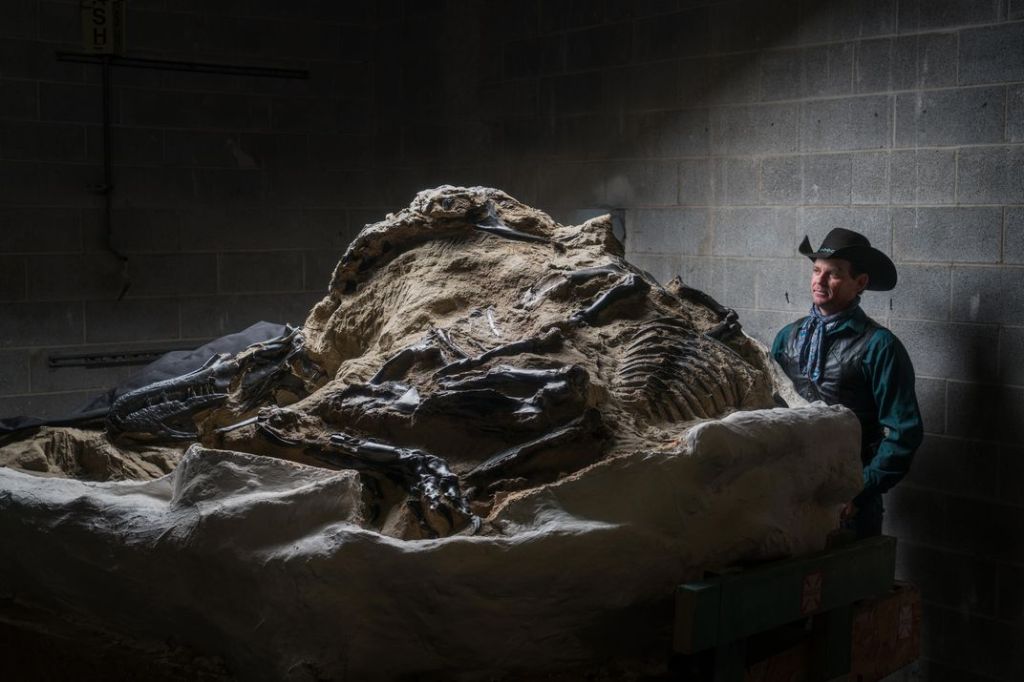
For me, this brings up the complicated question of ownership and whose rights should take priority — Science, Land Owners, or Dino Hunters? For example, the “Dueling Dinosaurs” fossil was found in 2006 by Clayton Phipps, Mark Eatman, and Chad O’Connor. This amazing scientific discovery of an adolescent Tyrannosaurus and a Triceratops presumably locked in combat at the time of their deaths was an incredibly unique find! Where the complication comes in is that the specimen was found on land owned by two different families, the Seversons (who held mineral rights on the land) and the Murrays (who owned the actual land). Due to ownership disputes, the fossil remained unstudied by Paleontologists for over 14 years. Fortunately, after the very long legal dispute, it was sold to the North Carolina Museum of Natural Sciences. However, it was offered to several other buyers, including private fossil collectors.
I believe private fossil collection can be detrimental to Paleontology. Private collectors have the right to do whatever they want with their property. They could potentially dismantle a fossil that they own and even sell each piece individually, resulting in a loss of control and access for scientific study. As I’ve stated in my previous articles, our understanding is constantly changing and growing due to intense study and new discoveries. Such as a fossil being an undiscovered species or having preserved pieces that other specimens of the same animal don’t. To optimize the potential growth of understanding, specimens have to stay accessible and remain relatively unaltered to be studied properly. If these specimens go into private hands, that results in an inability to study and therefore impedes growth.
But on the other side of the picture are the landowners and Dino Hunters. As highlighted in the “Dino Hunters” show, ranchers turn to fossil hunting as a way to support themselves and their families, as ranching isn’t as profitable as it used to be. Honestly, I can understand why they would try to get as much money as possible for their work. I can also appreciate how “Dino Hunters” has brought to the attention of the general public information regarding private fossil collection and the magic and work that goes into the process of discovering fossils.
As someone passionate about the field of Paleontology, I would love it if all fossil specimens were exclusively under the care of Scientists. Dinosaurs should be more than just trinkets and property of the extremely wealthy. For it’s through scientific study that we can understand and care about these magnificent creatures. So that we all have the privilege to own our planet’s history.
The opinions made in this article do not necessarily reflect that of The Lighthouse
 The Lighthouse