by Lucas Garcia
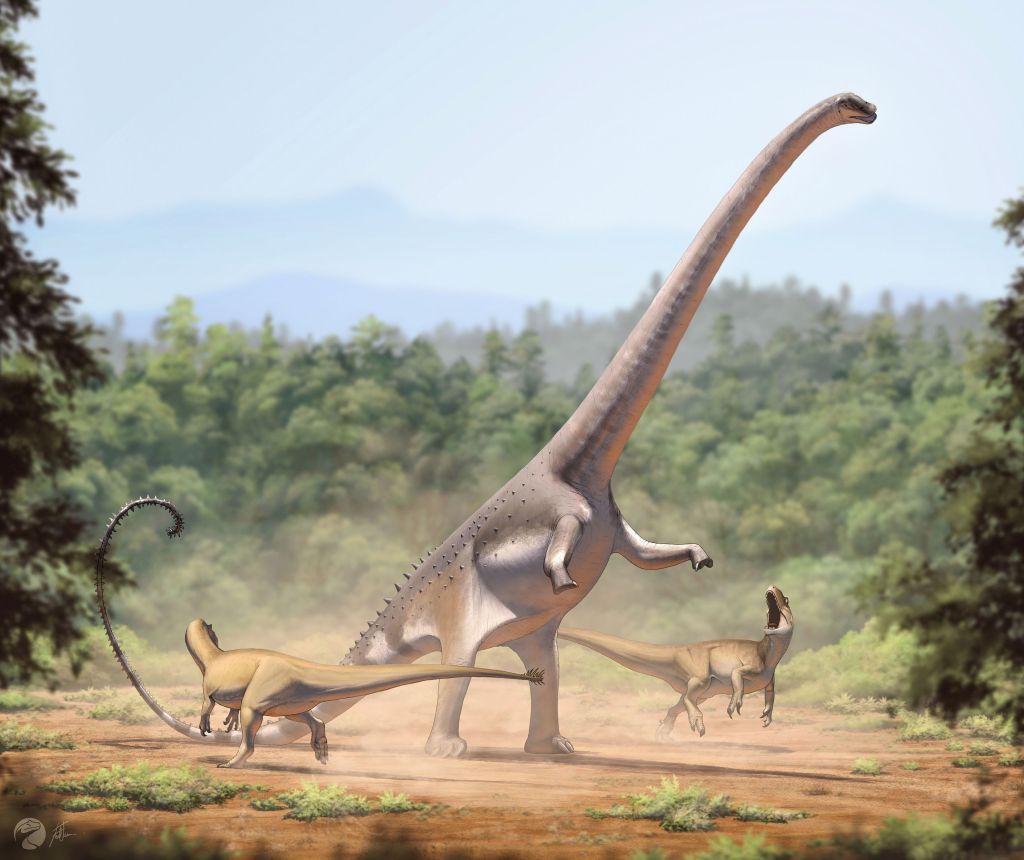
Most herbivorous dinosaurs kind of take a back seat when it comes to pop culture, especially sauropods. Sauropods often don’t get the spotlight they deserve, as they are usually dismissed as nothing more than gentle, long-necked giants.

But what some don’t realize is the largest animals to have ever lived on land were sauropods! For example, scientists estimate that adult Argentinosaurus and Mamenchisaurus could have weighed up to 175,000 pounds!! To put that into perspective, the largest living land animal, the African elephant, only weighs 13,000 pounds. Even one of the smallest sauropods, the Ohmdenosaurus, weighed almost 2,500 pounds, which is more than a horse.
The long necks of sauropods are easily their most well-known physical feature. The necks of all sauropods were made up of hollow bones. These hollow bones were not only essential in supporting their immense weight but also allowed for greater efficiency in both eating and breathing.
Generally, most types of sauropods looked very similar. However, some did develop a variety of unique adaptations. Most of these adaptations are hypothesized to have been used for defense. For example, the Saltasaurus had osteoderms or boney deposits all over its body, similar to the armor of ankylosaurs. Shunosaurus had a tail club which was most likely used to fend off predators.
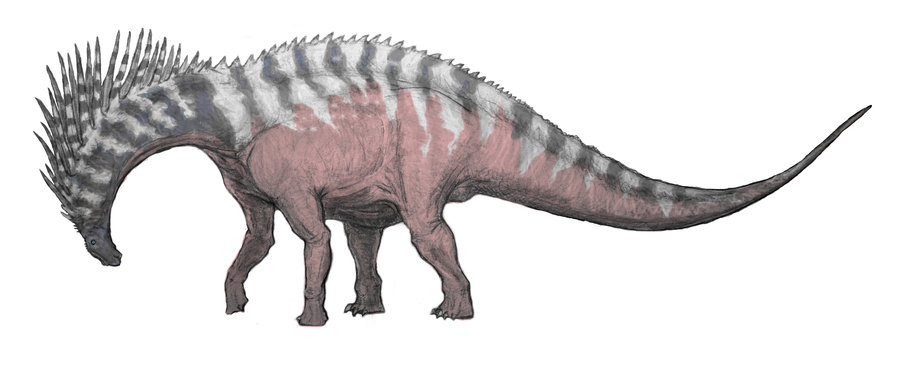
One of my favorite sauropods is the Amargasaurus. It was discovered in 1984 in Argentina, and the original fossil is one of the most complete sauropod skeletons ever found. What stands out about Amargasaurus are the two parallel rows of tall spines down its neck and back. These spines could have been used in display and/or defense. It is theorized that Amargasaurus could have bent its neck in order to point its spines forward. Although it was relatively small for a sauropod, it still reached lengths of 30 to 33 feet and could weigh over 5,700 pounds.
Although maybe not as exciting as other dinosaurs like Tyrannosaurus, from an evolutionary standpoint, sauropods were incredibly successful. They lasted longer than any other group of herbivorous dinosaurs. Sauropods were present from the Late Triassic all the way to the end of the Cretaceous with the extinction of the dinosaurs. That’s about 149 million years!
I’ve talked about the Jurassic Park and Jurassic World movies before because of my love for all things dinosaur. It’s always had an emotional impact on me to see dinosaurs brought to life like that. In fact, the first dinosaur we see in those movies is the Brachiosaurus, a sauropod. Even though the T. Rex and Velociraptors get so much more screen time, it’s like even the filmmakers had to acknowledge that nothing could beat the visual impact and majesty of a sauropod walking once more.

 The Lighthouse