
by Lucas Garcia
The T-Rex is without a doubt the most famous dinosaur in history, but there is much more to the Tyrant Lizard King than you might think.
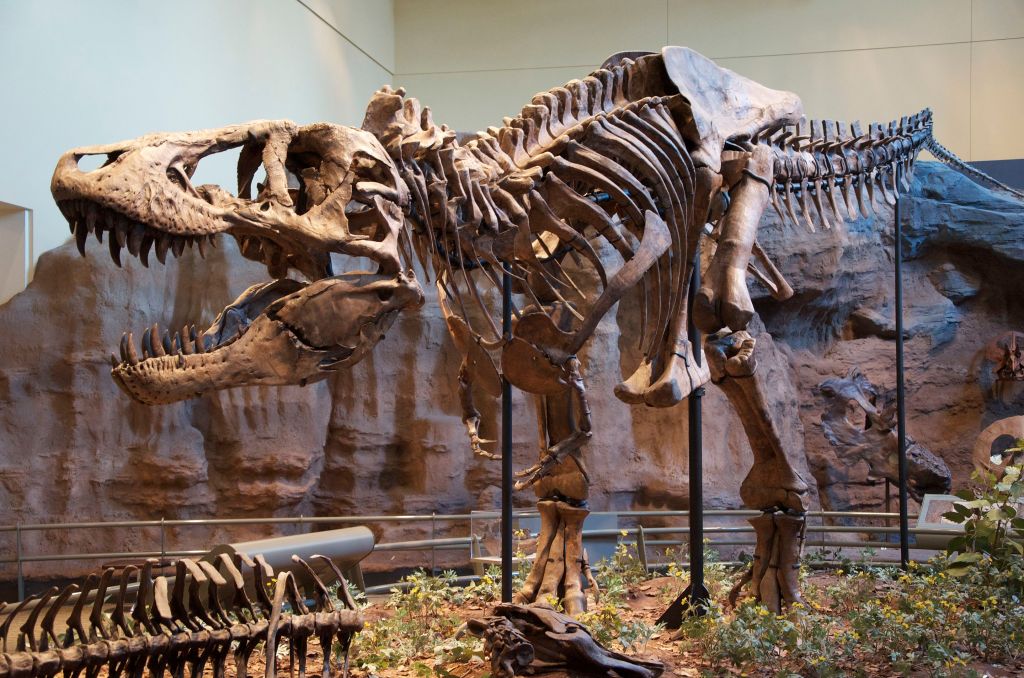
In the year 1900, assistant curator of the American Museum of Natural History, Barnum Brown, found the first partial skeleton of T-Rex; two years later, he found another partial skeleton, consisting of 34 fossilized bones. In 1905, Henry Fairfield Osborn, the president of the same museum, named the second skeleton Tyrannosaurus rex, and later that same year, the first specimen Dynamosaurus imperiosus. Though in 1906, Osborn recognized that the two skeletons were from the same species and chose Tyrannosaurus as the preferred name.
T-Rex is part of a group of theropod dinosaurs called Tyrannosaurids. A few features that differentiate Tyrannosaurids from other theropod dinosaurs are their massive skulls and large, banana-shaped teeth, and comparatively very small arms with only 2 functioning digits. The majority of Tyrannosaurids were the apex predators of their ecosystems, such as Albertosaurus, Tarbosaurus, and of course T-Rex, to name a few. Them being apex predators allowed them to prey upon a wide variety of animals such as hadrosaurs, ankylosaurs, ceratopsians, and possibly sauropods, as well as scavenging.

The incredibly small arms of Tyrannosaurids allowed their necks to be strong enough to carry their large and robust skulls, as arms and the neck compete for muscle attachments. This evolution allowed for T-Rex to have the most powerful bite of any land animal that has ever lived; it could have produced over 12,000 pounds of force, which allowed it to break the bones of its prey!
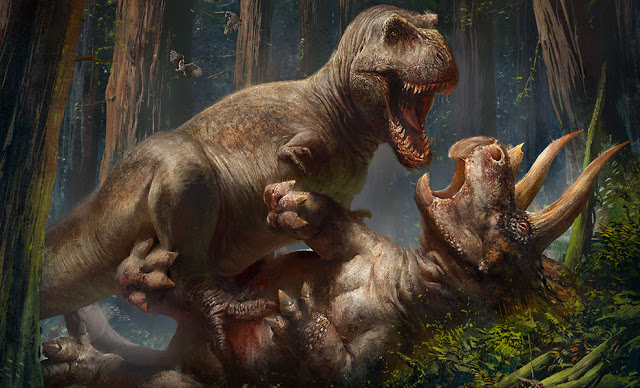
Tyrannosaurids likely hunted different prey at different ages, with juveniles and subadults having comparatively longer legs than adults. So juveniles were likely much faster and hunted smaller and faster animals, and the adults were stronger and better suited to hunt large, and even some armored, dinosaurs. An adult T-Rex could only run on average about 17 miles per hour, so a person could possibly outrun one. A juvenile, on the other hand, could easily overtake you if you tried to run away.
Some studies show that Tyrannosaurids went through huge growth spurts, with Tyrannosaurus specifically tripling in weight in 4 years. Going from roughly 3,000 pounds at about 14 years of age to over 9,000 pounds at around age 18!
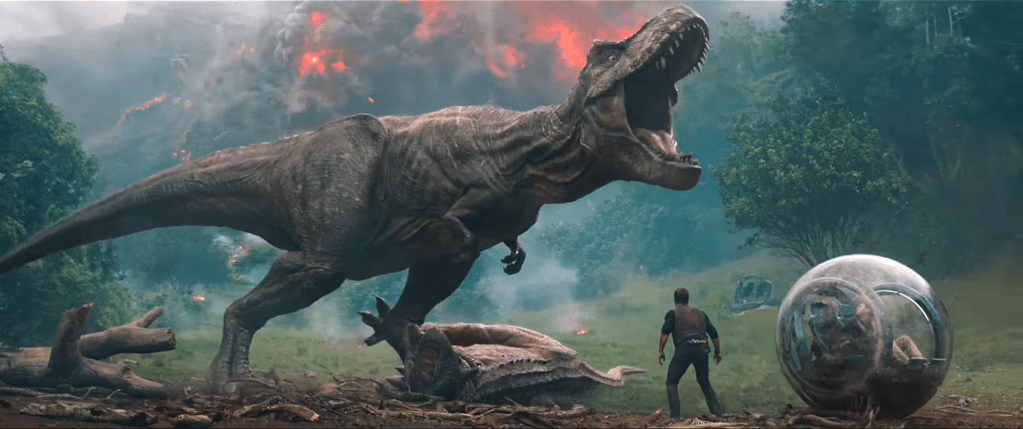
Several misconceptions about the T-Rex exist in pop culture, but none more prevalent than that about its vision. In Jurassic Park, the T-Rex couldn’t see you if you didn’t move. In reality, that was absolutely not the case. By applying perimetry to facial reconstructions of dinosaurs, including T-Rex, studies found that it had a binocular range of 55 degrees, which is more than that of a hawk. It is estimated that T-Rex had vision 13 times as sharp as humans, the farthest point at which it could visibly define objects is about 6 km or 3.7 miles away from its eyes!
Dinosaurs are truly fascinating animals, and Tyrannosaurs are no exception. For 30 million years leading up to the extinction of the Dinosaurs, Tyrannosaurids were the apex predators of the northern hemisphere. It’s no wonder that the King of the Tyrant Lizards is as famous as it is.
 The Lighthouse
So awesome! I am impressed by your knowledge and engaged by your enthusiasm.
LikeLike