Science

Let’s Help Solitary Bees – Part 2 –

by Ava Salado

Photo by Sheri Salado

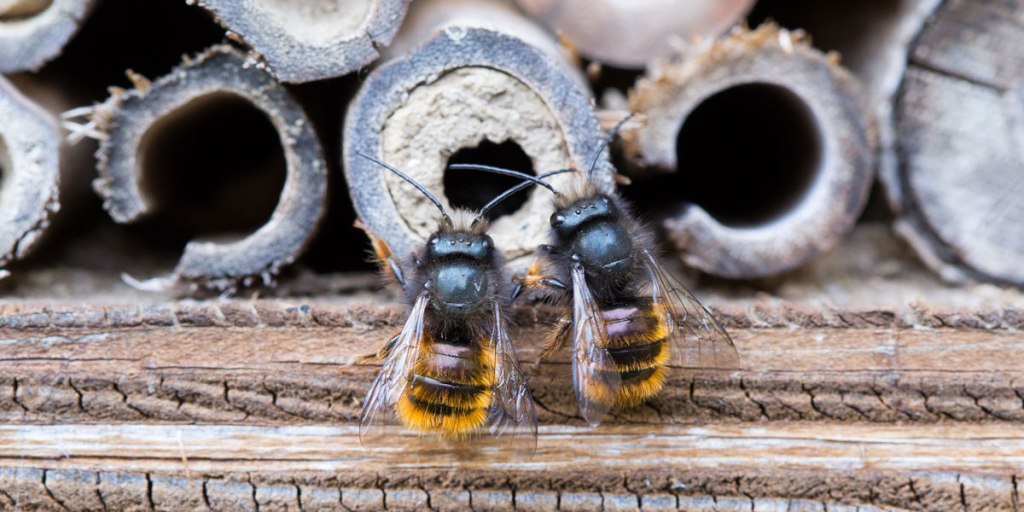
What is a bee hotel? Well, it’s basically a home where solitary bees can lay their eggs, these eggs can hatch into larvae, then emerge to pollinate your garden! Bee hotels are kind of a birdhouse but for bees.  Solitary bees need a small, hollow “cave” like place to lay their eggs which will develop into babies. In a natural environment, the mama bee would find this perfect spot in downed trees, reeds, or any hole, nook or cranny a bee can fit in (and is the size to safely house their eggs). This bee hotel provides an “artificial” place to lay. They can also be known as bee condos, bee houses, or even nest blocks. Unfortunately, in today’s modern times and as we talked about in our last article, many of these resources are being taken away. So how can we all help? Make a bee hotel for your backyard. You can make a difference in your local area. Plus, you will bring local pollinators to your garden!  

This sounds awesome but how do I make one? Well it is a simple, easy, and rewarding process and you don’t even need that many materials, let me show you. 

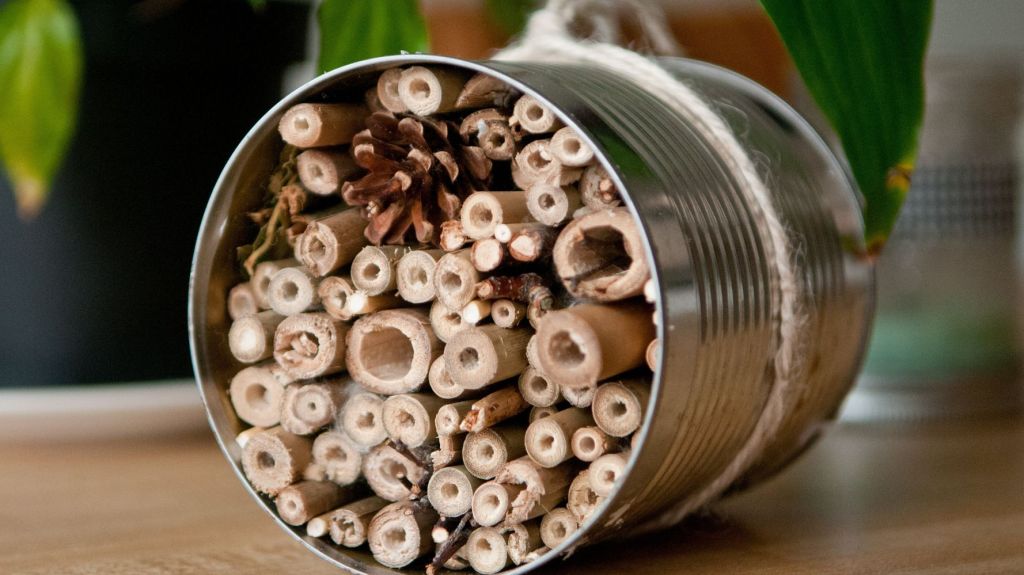
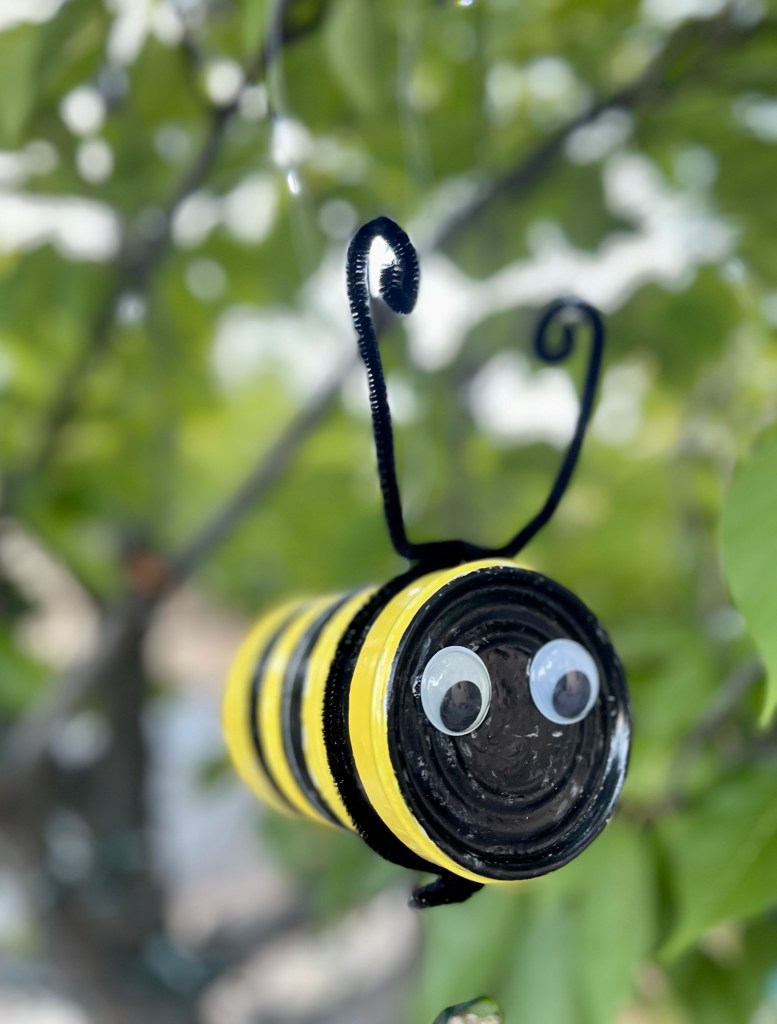
First you need a frame, you can use anything that is sturdy and waterproof. Such as a square wooden frame which can be easily created with some spare wood, or even (like the wonderful Larky parkday kids used) an empty, clean tin can. 

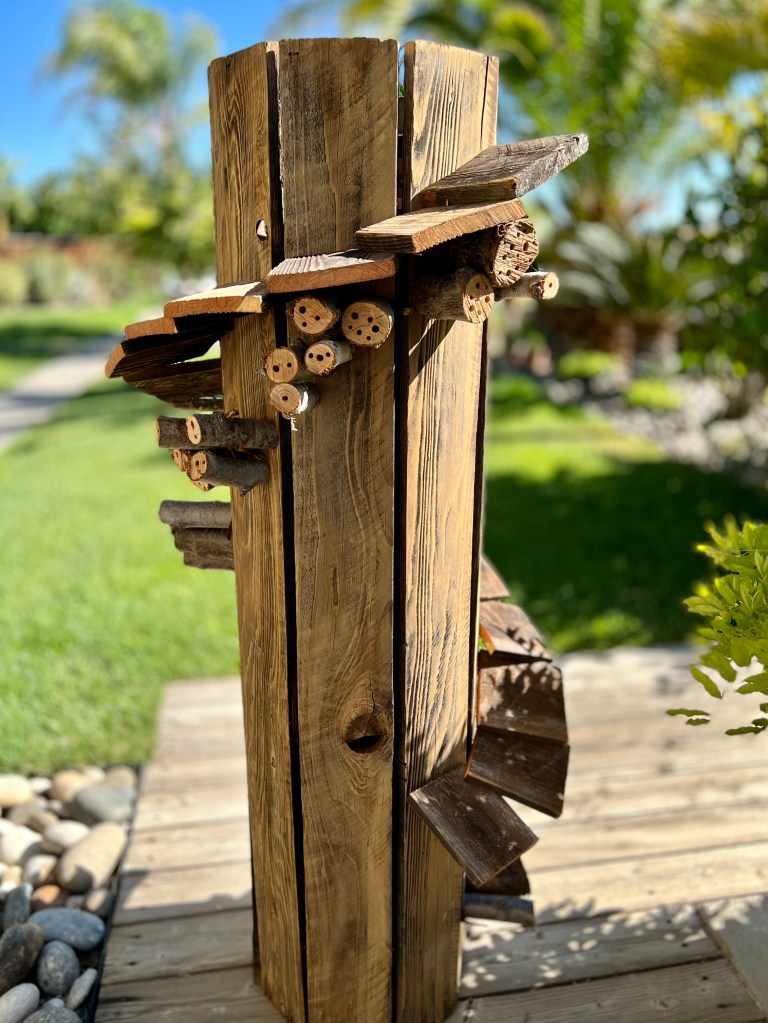
Photo by Sheri Salado. Bee Hotel made by student of UC Berkeley. Located at Blake Gardens, Kensington, California

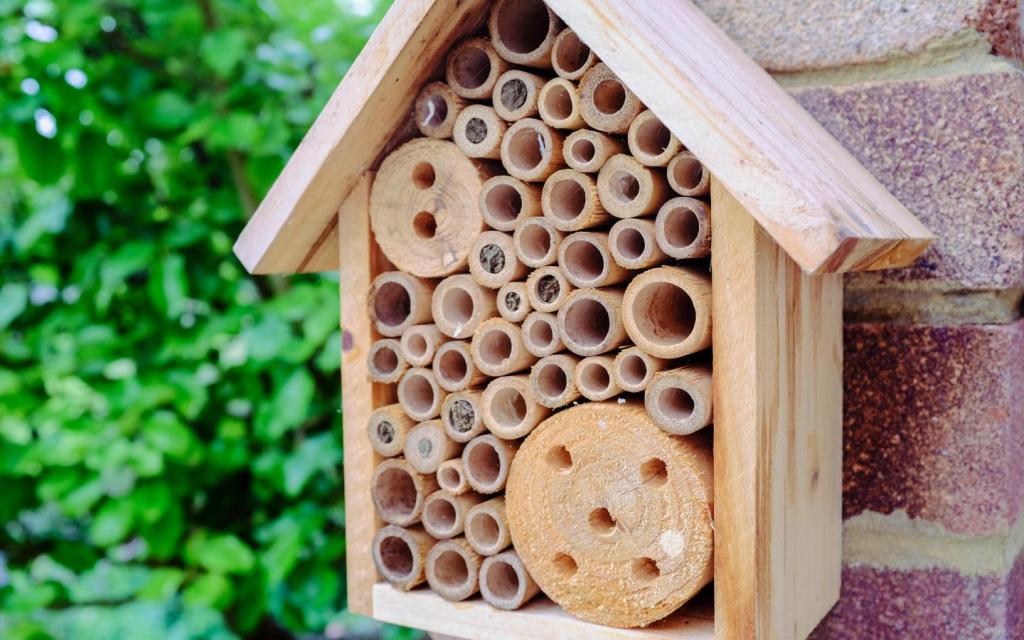
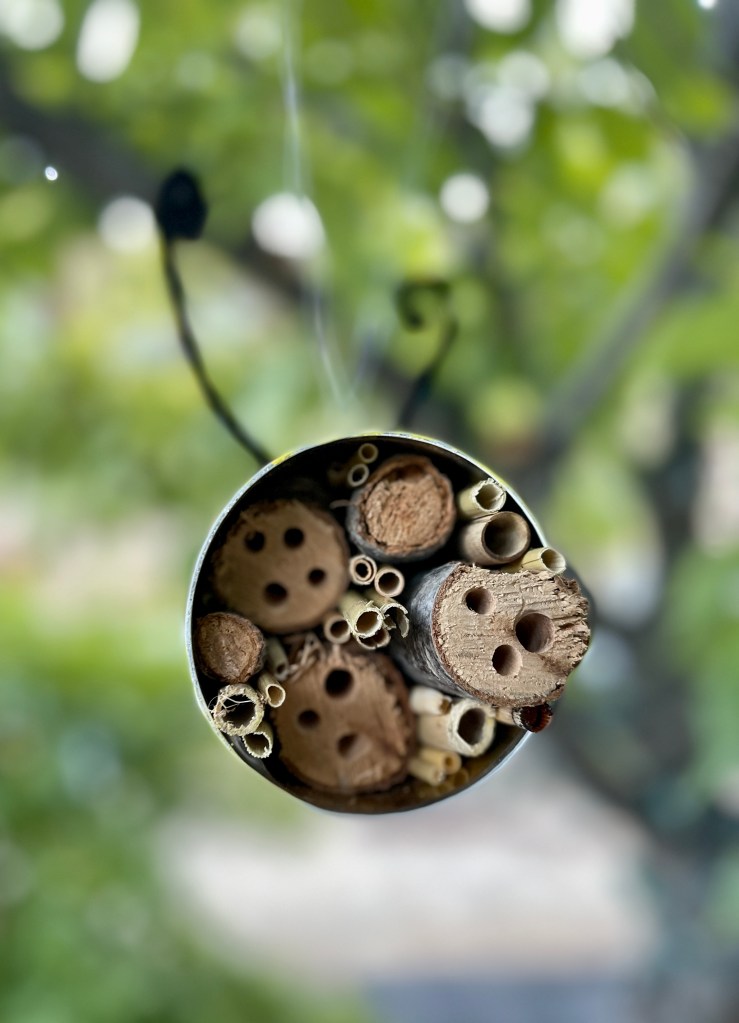
Now you need the insides (the actual place the bees will be staying). Bee hotels are supposed to mimic the natural nesting habitat of the bee, try giving a bundle of hollow reeds or stems, drill 2 mm to 10 mm diameter holes in a wooden block that are about 2 inches to 6 inches long, or even reusable paper straws. Keep in mind, if you choose using paper straws they can easily absorb moisture which is not good for the baby bee. So for their safety, retire the straws after each season once all of the babies have emerged. After that, get new straws for the next mama to find.) 

Then simply attach the insides to the frame making sure they are sturdy and will not fall out or shake.

Now you have your own bee hotel. Attach at least 3 feet above the ground so that no crazy creatures get curious. And if you are having trouble with birds swooping in and pecking at the holes, consider putting chicken wire on the outside/entrances of the caves. 

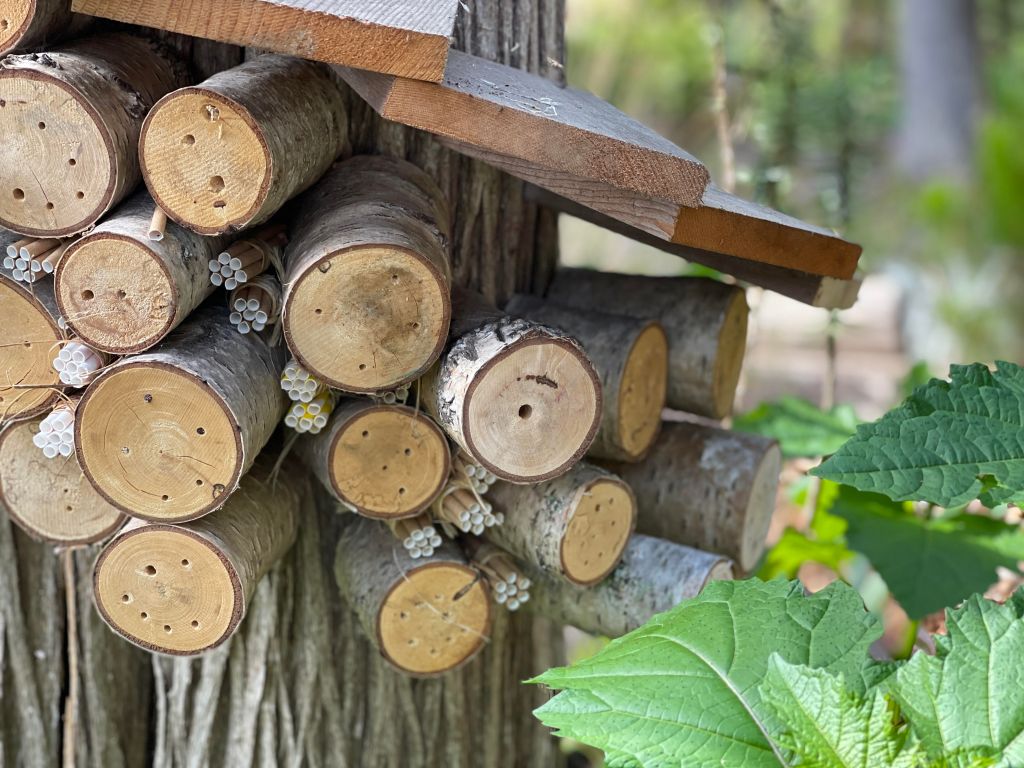
Photo by Beediverse

Here are some more essential tips:

Have a nice roof so that the entrances to the cave are protected from rain or dew. This is very important because, as I said before, if the cave is exposed to water or mass moisture, it could lead to mold, disease, and many other bad things. So, in the rainy months, I suggest storing it in the garage, patio, dungeon or any other cold dark spot. You don’t have to worry about them emerging until spring. 

Make sure your hotel is not swinging or swaying in the wind, this will lead to very uncomfortable baby bees. Keep it in a non-windy and stable place. 

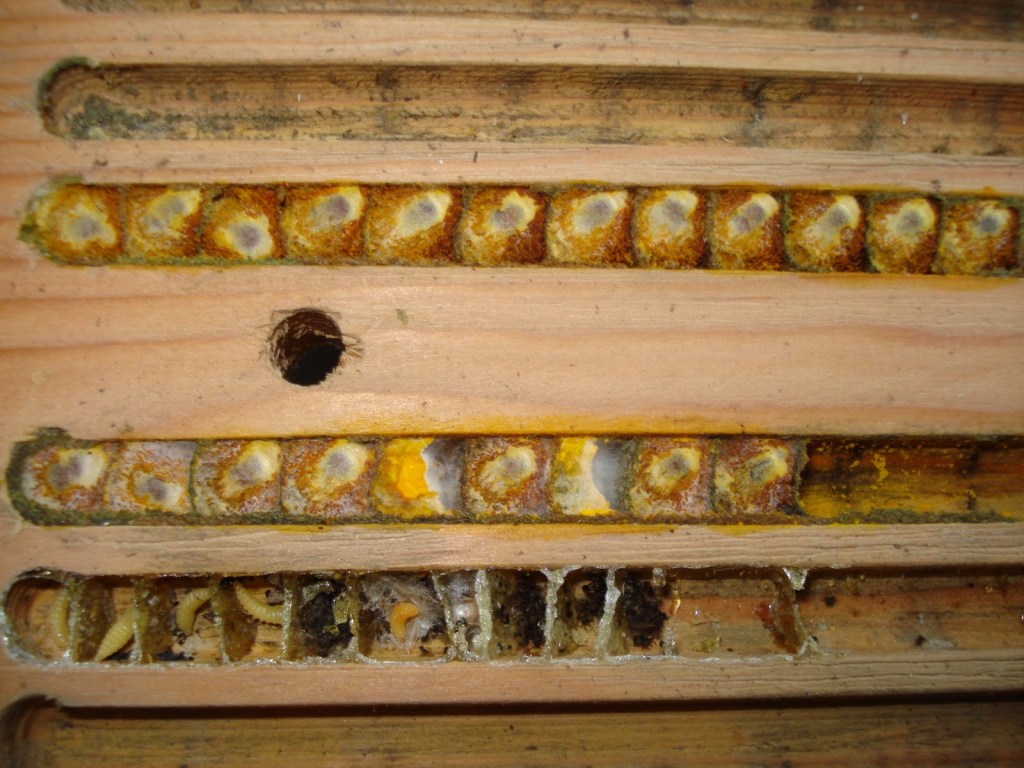
Photo by Woodland Trust

Always place your hotel in direct sunlight. Usually south or southeast facing. The babies like it warm in the spring and summertime. 

Put your hotel out in early April-ish, that’s when most mamas will be looking for a place to lay. Then, by the following spring, all the babies should have all moved on to the big wide world. After they leave, clean the empty hole with a pipe cleaner or remove and replace the holes entirely. 

Other than that, just be generally careful when placing and caring for your little friends. Share the care!

Photo by HuffPost

Now we must understand a few things. The answer for how to “Save the Bees” is much bigger and harder than just putting up bee hotels, this problem is much more complicated the world would assume. But don’t fear. By doing this you will be helping the bee population in your area. Especially if you live in a more urban space with few resources for their babies to be born. Plus, the hope that if we put bee hotels in public spaces, we could inspire anyone who sees it. The goal is to spark interest and curiosity, people will say “what is that thing?” This will inspire questions with important answers. The hope is that this fun project will inspire future generations to take further steps to save these wonderful creatures. My ask to whoever is reading this is to create as many bee hotels as possible using only recycled materials or things that you find in your backyard. Make it fun, art inspired, and creative. 

My greatest hope is that by having bee hotels spread across the Bay Area, it will both restore the pollinators’ habitat, inspire kids to protect nature and inspire others to support this great cause with action to help them in the future. What steps will you take?

Photos by Sheri Salado. Made by kids of Larky Parkday.
Science

Let’s Help Solitary Bees – Part 1 –

by Ava Salado

When you think of bees, most people think of hive dwelling, queen born, black and yellow little puff balls. But there’s actually much more than that! Not all bees live in hives, actually, out of 20,000 species, 90% are Solitary bees. 70% of all Solitary bees live underground, and only less than 10% of all species live in hives and make honey. You might be thinking “What in the world is solitary?”

Hive Bees ~ They live in hives, make honey, and are all born from one queen bee.

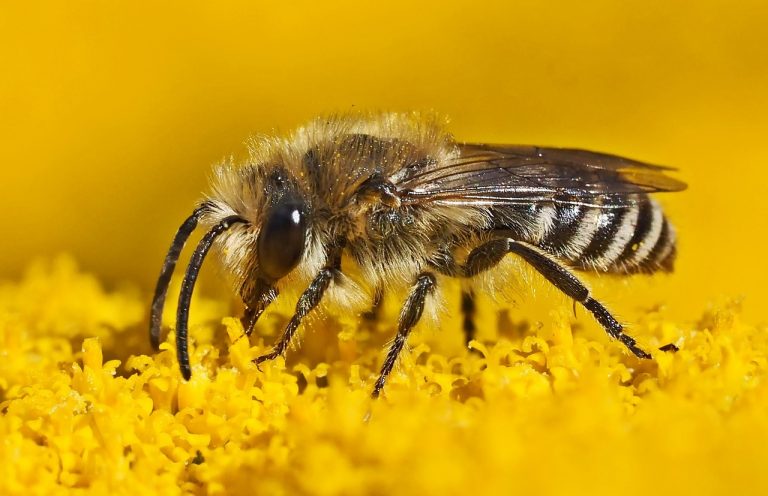
Solitary Bees ~ They do not live in a colony environment, they live as “solitary” creatures and have their own families. They are more efficient pollen gatherers, plus some live underground!  

Photo by Beegrateful

Of course, there is so much more to dig into than that but this is good for now. As with all of history, things happen and the world changes. Very sadly, we have seen a rapid decline in solitary bees in my area which can lead to insufficient pollination of our crops and gardens, and an over reliance on pesticides. “The plight of managed honeybees raised alarms that native bees might be facing similar challenges, says Neal Williams, a pollination ecologist at UC Davis. Although most native bees don’t live in colonies like honeybees do, they too are susceptible to poor diet and loss of habitat,” he says according to the California Native Plant Society article June 24, 2021. So what is leading to the decline? That’s what I wanted to find out and try my very hardest to stop. Over this two-part article, I will first explain why solitary bees are turning to the sad road of extinction, and second how we can stop it. 

Photo by Ark Wildlife

But first, in order to help we must learn the why of the matter. 

1. Pesticides

There was a study done by scientists in South Dakota to show if pesticides, like Neonicotinoids, could cause birth defects or even death in white-tailed deer. They laced the captive deer’s water with various amounts of this chemical. The study found what they expected, unfortunately and sad irregularities in the offspring and their parents. When the deer passed away, the scientists found scary amounts of Neonicotinoids. Some argued that because the deer were in captivity, the study was manipulated, so the scientists tried testing deceased deer born and raised in the wild and found more Neonicotinoids! My point is, if pesticides are affecting deer this horrifically, how do they affect other mammals, amphibians, humans and our precious pollinators? “Exposure to pesticides containing neonicotinoids and fipronil caused the deaths of more than 500 million bees in four Brazilian states between December 2018 and February 2019”, according to an investigation by Agência Pública. Keep in mind, this is just 4 states in just Brazil and in just 3 months. And this is just bees, what about the thousands of other pollinators? We have a state and country that has gained an over reliance on pesticides on our crops, especially in my community. I live in a farming community and have noticed many farms that no longer show a large “Organic” sign above their farm stands. “Beekeepers across the United States lost 48.2% of their managed honey bee colonies from April 2020 to April 2021” according to Auburn University. Pesticides are toxic to these little guys. Things like:

~Insecticides,

~Herbicides, 

~Rodenticides, 

~Fungicides,

~Neonicotinoids

These are examples of chemicals that are, unfortunately, contaminating the water and pollen that bees use to survive. Bees will (with some varieties) die immediately upon touch. This has led to the sad death of too many bees in my area. 

Photo by Crown Bees

2. Development 

Over many years in California, our landscape has changed due to drought, fire, and an increase in alternatives to the traditional way of farming. In my area, I have seen more and more unnecessary building and construction projects which have destroyed the solitary bees natural place for the mothers to lay their larvae. The bees need a hollow “cave like” place to lay their larvae, and because of these irresponsible building practices in my community (killing of things like marshlands, old historic trees, and forests, which these bees use for nurseries) have caused an inevitable decline in solitary pollinators. Another issue contributing to the reduction in suitable habitat is the basic landscaping practices. Most local homeowners remove all foliage, dried brush, wood, as well as having highly manicured yards, thus removing all of the potential natural living spaces for solitary bees. In addition, I asked some of my friends, local kids, and even adults in my community about this topic and there was little to no knowledge of this issue amongst these people. We all must strive to inspire and educate our community on how to take care of solitary bees. 

3. Climate Change 

Plus, many more factors like climate change, in which pollinators are forced to make drastic and unforeseen changes in their daily lives.

I hope that helped us have a better understanding of why we should stop this unfortunate fate of solitary bees? Check back next month to see how you and your family can help protect our truly life saving tiny friends. 

Further helpful information can be found here:

Science

A Day in the Life of a Peacock

by Lydia I. Martinov

Hello, there! My name is Johnathan, but you can call me Johnny. I am a peacock! Now, you might wonder: What exactly is a normal day in the life of a peacock? Well, lucky for you, I am about to tell you!

I just woke up in a tree. I live in Africa,  but a lot of peacocks live in India. I think it is about 7 o’clock. Yes, 7. That sounds about right. Time to sing my lovely morning tune. SCREECH! SCREECH! SQUACK! SCREECH! Doesn’t that sound wonderful? No? *sigh* I guess you’re right. Maybe I just need some practice. I can do that later. Anyways, I am an omnivore, so I eat everything including plants, insects and small creatures. For breakfast, I’m thinking of getting some fresh grasshoppers, perhaps, some tasty slugs or yummy worms. 

Photo courtesy of biologydictionary.net

Yum! That was a wonderful breakfast. I found a super juicy snail! Next, let me tell you a little about myself. I am a peacock, meaning that I am a male peafowl. Peafowls are both peahens, (girls), and peacocks, (boys)…like me! Peacocks are big, bright, and colorful, and peahens are brownish and very attractive, if you ask me. I have long iridescent (that means the color changes depending on the angle you look from) tailfeathers that have eye patterns on them. I have a big blue broad chest, and small fan shaped feathers on my head.

Now I want to…wait a minute. It’s mating season! I see a lovely peahen over there. Time to open up my stunning 5 foot long tail. Watch this. “Hello, darlin’ would you like to grab a bite with me this evening?” Hey, wait! Who’s that? Oh, you’re taken. *sigh*. Perhaps I will find someone else to accompany me…later. Hey, look! It’s time for lunch!

Photo courtesy of differencebetween.net


I think that I’m going to have some delicious grasshoppers. I see one right there! Just a little closer, and…got it! Yummy! Crunch, crunch…This is delicious!…Munch, munch…Want some?…Munch, crunch…No?..Crunch…Okay, more for me. Gulp! 

Photo courtesy of zoolity.com


I have an idea! Do you want me to tell you some fun facts about us peacocks? Okay. First, male peacocks, like myself, have 100 to 150 long tailfeathers. I have…um…I forgot. Give me a minute. One, two, skip a few, 132, 134. I have 134 long tailfeathers! Wanna know another fun fact? Our life span is 20 years in the wild! I am 10 years old. That means I am a middle aged man! I think we have time for 1 more fun fact before we go eat dinner. Ready? Okay. Did you know that peacocks are among the biggest birds who can fly? It’s true!

Photo courtesy of deccanherald.com


I want a big juicy dinner. Hmm. Hey, look! I’m just gonna fly to that very tasty looking snake over there! Wee! Gotcha! Yum! This is the tastiest snake I’ve ever had! It’s so good! Gulp! Why do you have that look on your face? Oh, I guess you’ve never tried a yummy snake before. You should! They are delicious.

Photo courtesy of birdfact.com


I’m really glad that you let me walk you through a day in the life of a peacock. I had a lot of fun with you! I guess I should probably get back to my party for the night. By the way, that’s what you call a group of peacocks. Before I go, I want to tell you one more fun fact. Did you know that peacocks are the national bird of India? That means I’m extra special there! 

Hey, look, it’s my favorite spot! I’m gonna go snuggle up there. Ahh, there we go…nice and comfy. Yawn. Good Night…Snore.

Photo courtesy of quora.com

Science

A Day in the Life of a Tasmanian Devil

by Lydia I. Martinov

Hi, I’m Taz. I am a Tasmanian Devil, and I can’t wait to tell you about my life!

First off, I look like a little black bear. I also have a white stripe across my chest. About the size of a large housecat, I am fast and ferocious, but we’ll get to that later. I have a long tail and excellent eyesight. I have a strong nose too. Us, devils, weigh 9 to 26 pounds, and we are mammals.

Photo by ThoughtCo

I woke up this morning (which for you is this evening), in my log that is located in Tasmania, which is an island right next to Australia. It is considered part of the continent Oceania, and it is pretty warm there. My friends and I live all over the island, not concentrating on any particular part. I live in a coastal woodland, and I sleep in my hollow log. Some of my friends live in dry forests in caves or burrows.

Photo by Climates to Travel 

Once I yawned and scratched my belly, I decided that I could go for a snack. I went hunting for my breakfast, and I am a nocturnal animal, which means that I come out during the night. I’m a carnivore, so I only eat meat. My very ferocious bite helps me eat all of my favorite meals. My favorite foods are frogs, fish, birds and insects. I also eat carrion (a fancy word for dead animal) that I find lying around, but some other devils in my area fight over the carrion, which makes it hard to get a bite. The reason we are called devils is because of our super strong bite. We have the strongest bite of any mammal on Earth. When I eat, I consume everything, that means that I eat the meat, hair, organs, bones and all other parts of my catch. Speaking of which, it’s now lunch time! I’ll be right back!

 Photo by Just Fun Facts

 That frog was delicious! Anyways, I am on the way to visit my friend, Sammy, who was pregnant for 3 weeks, and just had 26 babies! They are all hairless and raisin-sized cuties. They stay nice and warm in her pouch when they aren’t drinking her milk, just like our cousin: the kangaroo. Sadly, since she only has 4 nipples, only a handful of them will survive.

 Photo by ABC

 One of my neighbors, Dylan, who is walking by my house right now, is suffering from a disease called Devil Facial Tumor Disease, also known as DFTD. It is a type of cancer very popular among our kind. Because of this sickness, Tasmanian Devils are considered an endangered species. DFTD is a cancer where tumors grow all around Dylan’s face, and many other devils across Tasmania.  A tumor is a growth that takes place because of a disease. In this case, DFTD. He got it when fighting over food, so I make sure to be very careful not to end up like him.

Photo by EurekaAlert! 

Time for dinner! I am very loud. I communicate with others in a series of raspy screams, shrieks, growls, snorts and grunting calls, and I, normally, make these sounds when trying to scare off other animals to avoid a fight when finding food. 

 Photo by Wonderpolis

 Today was amazing, but now it is time for bed. Good Night! (Or in your case – Good Morning!)

Thank you so much for letting me tell you what a day in the life of a Tasmanian Devil is like! I had so much fun telling you about it! Now, where is my leftover bird from breakfast? I need my midnight feast. I could have sworn I left it here…

Science

CA Acadamy of Sciences vs Exploratorium

by Dominic Kauffman

The Academy of Sciences and the Exploratorium are both fascinating places to go in San Francisco. They both Include exhibits that teach and pique your curiosity. But they have several major differences that may influence your decision if you can visit only one or the other (please note this is by my experience, which may differ from yours).

The Academy is focused on life, mostly marine life with some terrestrial. The Academy has a huge glass sphere which houses a jungle. This area is hot and humid, but has a surprising lack of trees (you may be able to guess why. If you can’t, ask a docent). Inside, you climb up a ramp 1 story past hundreds of butterflies, and two macaws, before reaching an area housing several enclosed animals, such as snakes and frogs. Then go up 2 more stories with terrariums displaying more animals, before plunging with an elevator into the underwater section of the Academy ( brush off any and all butterflies ).

This area houses many fish, both large and small, and several glowing jellyfish. Much of the academy is below ground, displaying a water tube where you can walk with fish on three sides of you, and plenty of viewing areas. Their coral reef is astounding, with fish so brightly colored that one might assume they were in a picture book.

 Don’t miss the planetarium, a dome displaying several shows, with new ones all the time. Also, be sure to visit Claude, an albino alligator. They also have a great earthquake room ( you can guess what it does ). Please note I have visited The Academy many times. The Academy is a great place to visit with exhibits that let you sit down and watch life.

 The Exploratorium does not share the academy’s love of animals. Its variety of exhibits is astounding, with everything from a replica of the rover “Perseverance” to a man-made water vapor tornado, to a fluid dynamics model. It has a small section of electronics when compared to The Academy, but even that section roams from electrical fires ( contained, of course ) to using your body to complete a circuit. They even have a section on bubbles for some fun. They have lots of little tidbits such as a spinning plate. On which one can put balls and discs. There is a section on sound waves, with one exhibit being making sound waves visible. They have a small natural section with sensitive plants to touch, three geysers, and an interesting talk/discussion/exhibit on plankton from the bay (it might be gone by the time you arrive, but something will most likely replace it). 

If you like to tinker, then they have a section for building projects out of an assortment of things. Please note I have only visited the exploratorium once. There are many things that I have not mentioned, because I have not seen everything. The Exploratorium is a place visitable several times without getting bored.

Overall, I prefer the Exploratorium. I love how many different sections it has, and how interactive it is.

Home, Science

Itinerary: Mars

by Lydia I. Martinov

                            
Have you ever wondered what it would be like to hang out far, far away on Mars? Well, you are in luck, because this article has all you need to know about our red neighbor.

Photo by Creative Commons

Mars, (also known as The Red Planet) is a planet with a very thin atmosphere that is about 100 times thinner than Earth’s. If you were to live there, then you would have to wear a spacesuit every day. I like to have a different outfit all the time, so Mars might not be the best place for me. There is red dust all over, which is why they call Mars “The Red Planet”. The average temperature on Mars is minus 80 degrees Fahrenheit. That is colder than both the North and the South pole on Earth in the Winter. You would freeze your toes off in about 5 seconds! Mars is 4.5 billion years old, just like Earth! 

Photo by Universe Today

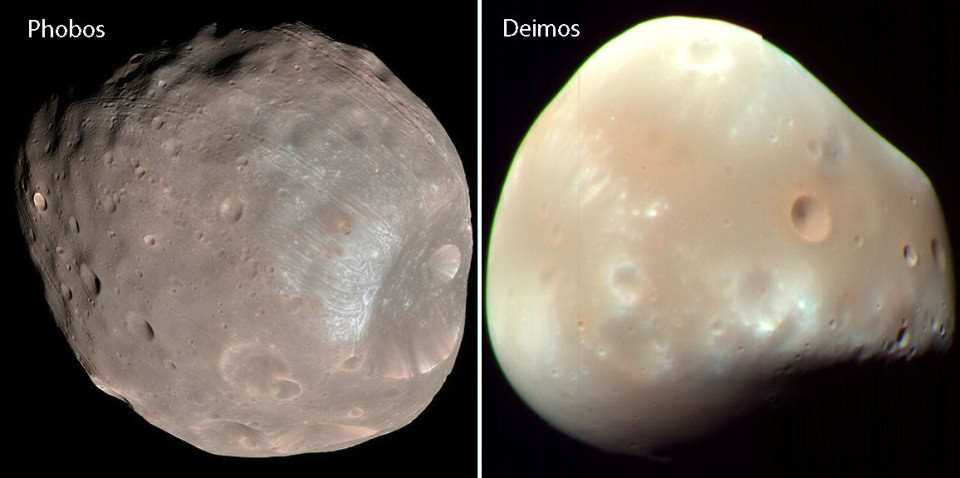
Mars has two moons called Deimos and Phobos. Deimos is in a bit of a wonky triangular shape, and Phobos is a kind of circular shape with lots of deep craters. Imagine stargazing on Mars and seeing 2 moons instead of 1 every night. That would be amazing! These moons were discovered by an astronomer named Asaph Hall in 1877.

It takes about 6 months to fly all the way from Earth to Mars. Imagine being the first astronaut to sit in a ship for over 6 months to get all the way to Mars. It is probably very boring, but at least, the astronauts get to explore a whole new planet after the trip. So far, no people have ever walked around on Mars, just rovers.

A day on Mars lasts 24 hours and 39 minutes (night and day). Here on Earth it lasts 24 hours (night and day). This is because Mars spins 2.7 percent slower than Earth. You know what that means, more sunshine!

Mars is smaller than Earth. It is about as wide as the continent of Africa. To be exact, Mars is 4,212.3 miles wide and Africa is 4,600 miles wide. Mars is a little more than half as big as Earth.

Photo by Open Access Government

Many people always wonder two things about Mars. First – is there life on Mars? Second – is there water on Mars? Well, I don’t know if there is life on Mars, but I can say that there is water there. It is in the form of polar ice caps, and can be processed to make water for astronauts. These polar ice caps are on the North and South poles of Mars.

Mars was named after the Roman god of war, and that’s because of its color. Red is the color of blood, so they named it after Mars. In fact, many planets and other objects in space were named after Roman gods. For example, Saturn was also named after a Roman god. It was named after Saturn, who was the king of all the gods.

Mars is a really cool planet, and (other than Earth) it is my favorite. What is your favorite planet?

Science

Flatufacts Farticle

Submission by Emmett Moala

You do it. I do it. We all do it. Yep, you know what I’m talking about. Farting! Did you know termites fart so much that it contributes 20 million tons of methane to the atmosphere every year? Birds on the other hand, do the opposite! They don’t fart at all because they lack the bacteria that creates gas. You’re probably wondering how gas is made in your body. A large portion of gas is made by swallowing air when we eat and drink. But we also create gas during the digestion process. First, you eat food (everybody knows that!) Then the food travels into your small intestine where some of it gets absorbed. What doesn’t get absorbed moves to your large intestine where bacteria from your colon breaks it down. During this process, gas is created. After that happens, the gas comes out and BAM! You have a fart. Isn’t that interesting? There are a lot of interesting facts about farts. Like, did you know coral snakes fart as a defense mechanism or that beaded lacewing larvae kill termites using their farts?  Thankfully, 99% of what makes up human farts is odorless. The small 1% of sulfur is what actually makes our farts stinky. And while I’ve never heard of anyone dying from a fart, ancient philosophers once believed you could actually fart out your soul! I did not make this stuff up! Well, I hope the next time you fart, you know why and how it happened and can appreciate the science of your fart. TOOT-daloo!

Photo Created to Liam P.

Science

What is Synesthesia?

by Olive Pea

I recently learned I had synesthesia. I was talking to my piano teacher about what the color C was on the piano. She thought it was the color yellow, and I thought it was blue. She said she used to have arguments with her brother (who is also a musician) on what color certain notes were. A few days later my mom said to me there was a Jeopardy contestant describing something called Synesthesia and it sounded similar to the conversation with my piano teacher, so we researched it.

So, what is synesthesia? Synesthesia is a scientifically studied neurological condition where two or more senses are blended together. Some researchers suggest that about one in 2,000 people have it, while others say that as many as one in 20 people have it. The most common form of synesthesia is hearing in color, which means that when a synesthete (a synesthete is a fancy word for someone that has synesthesia) hears a note played on a musical instrument, it makes them think of a color. For example, when a synesthete hears the note C played on an instrument, it might make them visualize the color yellow. Some people can physically see color when they hear music. This type of synesthesia is called Chromesthesia.

Another common form of synesthesia is when a synesthete sees a number or a letter, it makes them think of a color. This doesn’t necessarily mean that they see the letters any differently than a non-synesthete, in fact they can most likely see it the same way, it just makes them picture a color in their mind’s eye (this is the case for me). But some synesthetes can actually see a projection of a color. This is what all the letters in the alphabet look like to me:                 

For me this also happens with numbers:

It’s not just individual letters that I see in color, I see whole words as colors too. For example, the word synesthesia reminds me of the color yellow. This is not the same case with numbers, because when I see the number 86, the eight is a light green, and the six is still orange. This type of synesthesia is called graphemes.

Some synesthetes associate genders and personalities with letters or numbers. For example, they might see the letter R as a loud and bossy little girl with red hair.

You might be thinking “why does this happen to some people and not others?” Imagine a mind with tunnels that move information from place to place. For example, audio information follows the audio tunnels and visual information follows the visual tunnels. For a synesthete, there are shortcuts that connect these tunnels, allowing the information to pass between them.

I found it interesting that there are a lot of artists with synesthesia. Here are some famous synesthetes you may know:

·        Billie Eilish

Billie Eilish uses her synesthesia to help her create her music videos. Eilish explained it as “a thing in your brain where you associate random stuff to everything. So for instance, every day of the week has a color, a number, a shape. Sometimes things have a smell that I can think of or a temperature or a texture.”

·        Tori Amos

Tori Amos is a singer that sees songs as strings of color.

·        Duke Ellington

Duke Ellington was a jazz pianist that had an unusual version of Chromesthesia. He didn’t just think of colors when he heard notes, he also said that when different musicians played the same note, they each had a different color. He also didn’t just think of color. He described D as “dark blue burlap.”

·        Billy Joel

Billy Joel likes having synesthesia, claiming that it brings color into his life. Music makes him picture different hues of color.

·        Pharrell Williams

Pharrell Williams is one of the most well-known synesthetes of today. He uses his chromesthesia a lot to help him create his music.

·        Franz Liszt

Franz Liszt was a famous Hungarian composer that used his synesthesia to help him compose his music. When he used orchestras to improve the sound of his compositions, he would sometimes say to the musicians “a little bluer!” to get them to play the notes just how he heard them in his mind.

·        Vincent Van Gogh

Vincent Van Gogh was taught at an early age that his synesthesia was a disadvantage. When he was learning musical composition, his teacher realized he was connecting musical notes and colors, he thought he was going insane, and refused to teach him.

I have had a lot of fun learning about this fascinating phenomenon. I hope you have enjoyed this as much as I have enjoyed researching it.

Home, Science

King of the Tyrant Lizards

by Lucas Garcia

The T-Rex is without a doubt the most famous dinosaur in history, but there is much more to the Tyrant Lizard King than you might think.

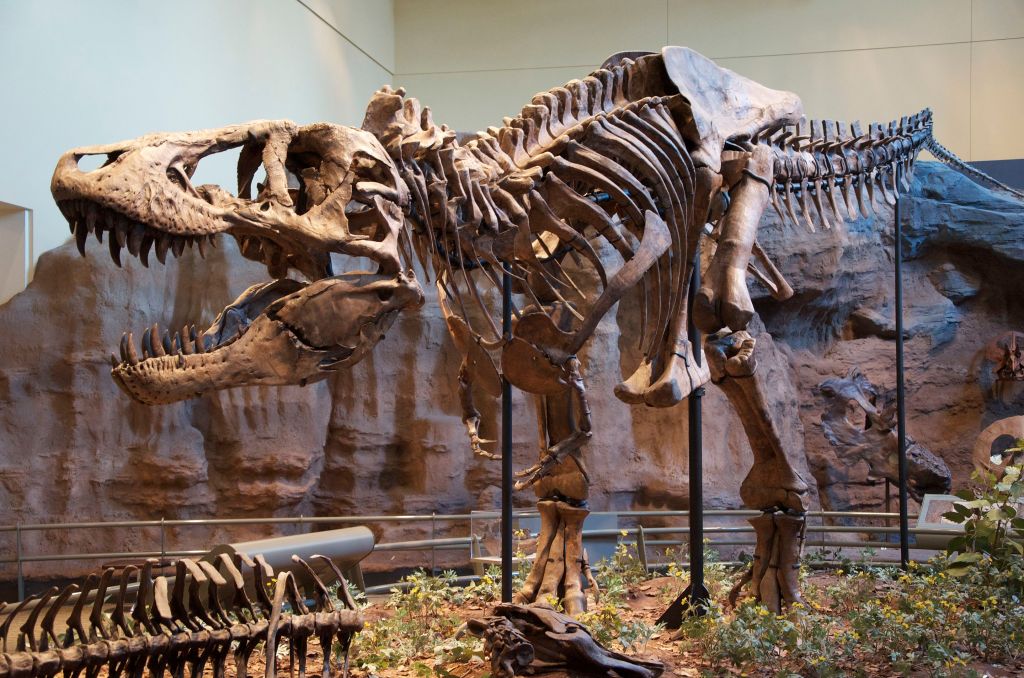
Reconstruction of T-Rex at the Carnegie Museum of Natural History

In the year 1900, assistant curator of the American Museum of Natural History, Barnum Brown, found the first partial skeleton of T-Rex; two years later, he found another partial skeleton, consisting of 34 fossilized bones.  In 1905, Henry Fairfield Osborn, the president of the same museum, named the second skeleton Tyrannosaurus rex, and later that same year, the first specimen Dynamosaurus imperiosus.  Though in 1906, Osborn recognized that the two skeletons were from the same species and chose Tyrannosaurus as the preferred name.

T-Rex is part of a group of theropod dinosaurs called Tyrannosaurids.  A few features that differentiate Tyrannosaurids from other theropod dinosaurs are their massive skulls and large, banana-shaped teeth, and comparatively very small arms with only 2 functioning digits.  The majority of Tyrannosaurids were the apex predators of their ecosystems, such as Albertosaurus, Tarbosaurus, and of course T-Rex, to name a few.  Them being apex predators allowed them to prey upon a wide variety of animals such as hadrosaurs, ankylosaurs, ceratopsians, and possibly sauropods, as well as scavenging.

T-Rex by Mark Witton

The incredibly small arms of Tyrannosaurids allowed their necks to be strong enough to carry their large and robust skulls, as arms and the neck compete for muscle attachments.  This evolution allowed for T-Rex to have the most powerful bite of any land animal that has ever lived; it could have produced over 12,000 pounds of force, which allowed it to break the bones of its prey!

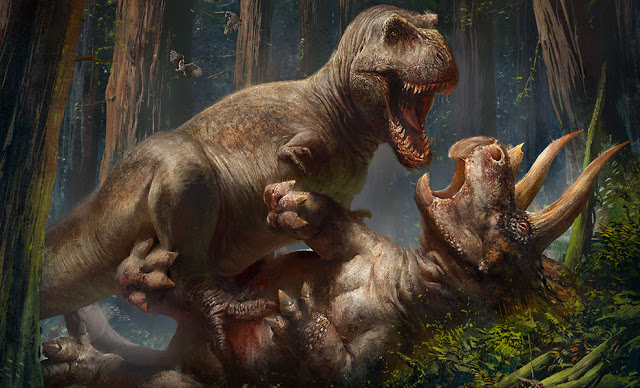
Tyrannosaurus and Triceratops

Tyrannosaurids likely hunted different prey at different ages, with juveniles and subadults having comparatively longer legs than adults.  So juveniles were likely much faster and hunted smaller and faster animals, and the adults were stronger and better suited to hunt large, and even some armored, dinosaurs.  An adult T-Rex could only run on average about 17 miles per hour, so a person could possibly outrun one. A juvenile, on the other hand, could easily overtake you if you tried to run away.

Some studies show that Tyrannosaurids went through huge growth spurts, with Tyrannosaurus specifically tripling in weight in 4 years.  Going from roughly 3,000 pounds at about 14 years of age to over 9,000 pounds at around age 18!

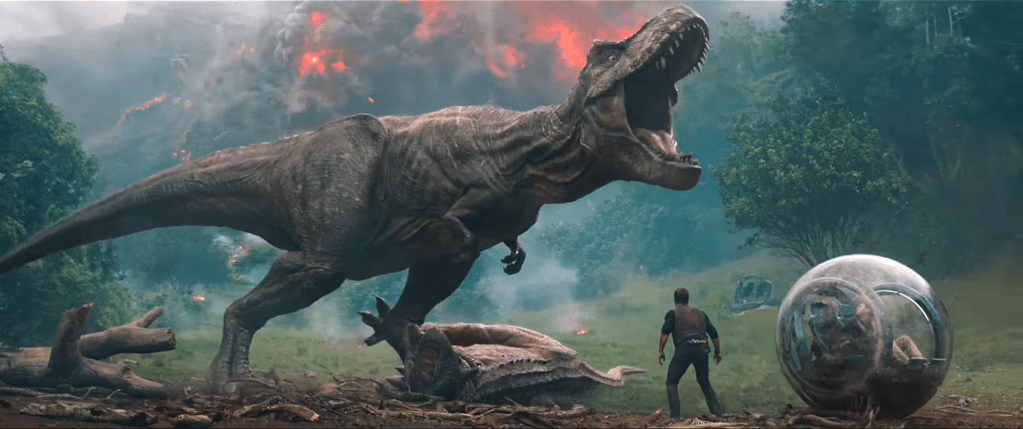
Several misconceptions about the T-Rex exist in pop culture, but none more prevalent than that about its vision.  In Jurassic Park, the T-Rex couldn’t see you if you didn’t move. In reality, that was absolutely not the case.  By applying perimetry to facial reconstructions of dinosaurs, including T-Rex, studies found that it had a binocular range of 55 degrees, which is more than that of a hawk.  It is estimated that T-Rex had vision 13 times as sharp as humans, the farthest point at which it could visibly define objects is about 6 km or 3.7 miles away from its eyes!

Dinosaurs are truly fascinating animals, and Tyrannosaurs are no exception.  For 30 million years leading up to the extinction of the Dinosaurs, Tyrannosaurids were the apex predators of the northern hemisphere.  It’s no wonder that the King of the Tyrant Lizards is as famous as it is.

T-Rex Jurassic World: Fallen Kingdom
Home, Science

Sauropods

by Lucas Garcia

Barosaurus – by Fred Wierum

Most herbivorous dinosaurs kind of take a back seat when it comes to pop culture, especially sauropods.  Sauropods often don’t get the spotlight they deserve, as they are usually dismissed as nothing more than gentle, long-necked giants.

Argentinosaurus

But what some don’t realize is the largest animals to have ever lived on land were sauropods!  For example, scientists estimate that adult Argentinosaurus and Mamenchisaurus could have weighed up to 175,000 pounds!!  To put that into perspective, the largest living land animal, the African elephant, only weighs 13,000 pounds.  Even one of the smallest sauropods, the Ohmdenosaurus, weighed almost 2,500 pounds, which is more than a horse.

The long necks of sauropods are easily their most well-known physical feature.  The necks of all sauropods were made up of hollow bones.  These hollow bones were not only essential in supporting their immense weight but also allowed for greater efficiency in both eating and breathing. 

Generally, most types of sauropods looked very similar. However, some did develop a variety of unique adaptations.  Most of these adaptations are hypothesized to have been used for defense.  For example, the Saltasaurus had osteoderms or boney deposits all over its body, similar to the armor of ankylosaurs.  Shunosaurus had a tail club which was most likely used to fend off predators.

Amargasaurus – by Ashere

One of my favorite sauropods is the Amargasaurus.  It was discovered in 1984 in Argentina, and the original fossil is one of the most complete sauropod skeletons ever found.  What stands out about Amargasaurus are the two parallel rows of tall spines down its neck and back.  These spines could have been used in display and/or defense.  It is theorized that Amargasaurus could have bent its neck in order to point its spines forward.  Although it was relatively small for a sauropod, it still reached lengths of 30 to 33 feet and could weigh over 5,700 pounds.

Although maybe not as exciting as other dinosaurs like Tyrannosaurus, from an evolutionary standpoint, sauropods were incredibly successful.  They lasted longer than any other group of herbivorous dinosaurs.  Sauropods were present from the Late Triassic all the way to the end of the Cretaceous with the extinction of the dinosaurs.  That’s about 149 million years!

I’ve talked about the Jurassic Park and Jurassic World movies before because of my love for all things dinosaur.  It’s always had an emotional impact on me to see dinosaurs brought to life like that.  In fact, the first dinosaur we see in those movies is the Brachiosaurus, a sauropod.  Even though the T. Rex and Velociraptors get so much more screen time, it’s like even the filmmakers had to acknowledge that nothing could beat the visual impact and majesty of a sauropod walking once more.

The scene from Jurassic Park recreated in the game Jurassic World: Evolution