
by Lucas Garcia
The field of Paleontology is fascinating to me. It allows us to study extinct plants and animals to hypothesize what they would’ve been like when they were still alive. It’s amazing how much our understanding of these wonderful organisms can change as we discover and learn more about them. One of my absolute favorite examples of this change is exhibited in a popular dinosaur called Spinosaurus.
When Paleontologist Ernst Stromer first described spinosaurus in 1915, little material had been uncovered. Only a few ribs, gastralia (belly ribs), vertebrae, and teeth, along with small parts of the upper and lower jaws, and of course, some of the large neural spines that inspired this dinosaur’s name. In its original reconstruction, it looked like a Carnosaur with a large sail on its back as opposed to what we know it to look like now.
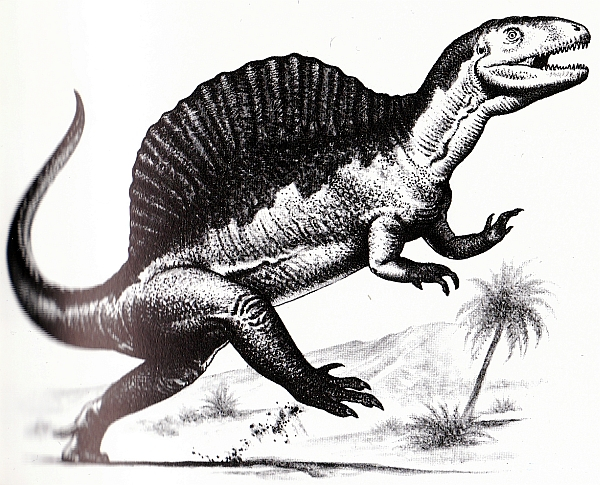
As if Spinosaurus wasn’t hard enough to study, what with the little fossil information that had been discovered, the original fossils were destroyed in a bombing raid on Munich, Germany, during WWII. All that was left were detailed drawings of the original fossils. Studying Spinosaurus proved very difficult, so for most of the 1900s, it was inaccurately depicted as a sail-backed Carnosaur.
Fortunately, almost 40 years later, newer fossil material, along with the important discoveries of two other Spinosaurids, helped to improve our understanding of Spinosaurus significantly. The first was a dinosaur called Baryonyx, which was discovered in 1983, and over a decade later, in 1998, another Spinosaurid named Suchomimus was discovered. When material from Spinosaurus was compared with these two, more complete dinosaurs, it was easy to see how similar they were. Because of their long, slender, crocodile-like skulls, Paleontologists were able to determine the shape of Spinosaurus’s head.
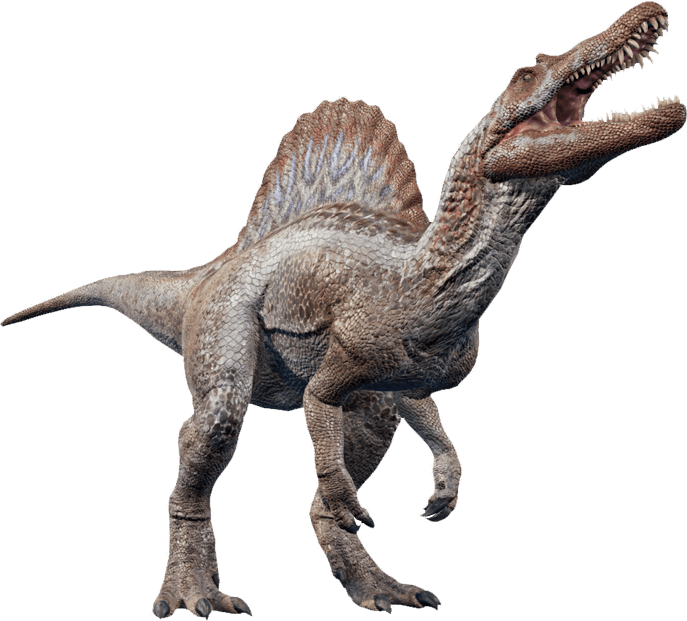
But our understanding of Spinosaurus wasn’t done changing just yet. In 2014, Paleontologist Nizar Ibrahim published a study featuring a full-size model reconstruction of a “new” Spinosaurus. It kept the crocodile-like skull and large sail on its back, but its body had drastically different proportions. For starters, the 2014 reconstruction has a smaller pelvis and much shorter legs than past reconstructions, and that because of these features, Spinosaurus was an obligatory quadruped. This study’s accuracy was highly questioned; the main issue that most people had was that this reconstruction was made up of several Spinosaurus individuals, along with gaps being filled in with closely related animals. This reconstruction can be proven accurate or inaccurate if more complete material of Spinosaurus is found.
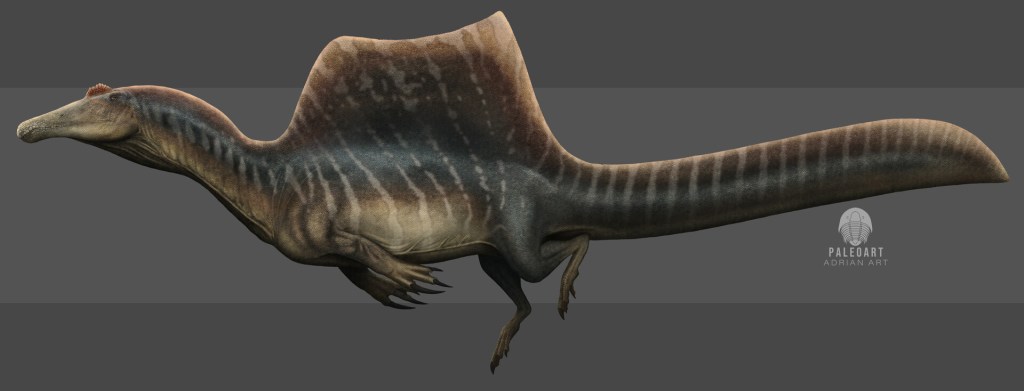
As recently as 2020, a new paper was published describing a nearly complete tail of Spinosaurus. It showed that neural spines continued along the vertebrae of Spinosaurus all the way to the tip of the tail. The vertebrae also had long chevrons on their undersides. Plus, it was surprisingly flexible, meaning that Spinosaurus could propel itself through the water using its tail as a paddle. I doubt this will be the last drastic change, but it does bring us closer to fully understanding this amazing animal.
Our understanding changes greatly as new discoveries are made. And that is why Paleontology is so fascinating to me. As much as I’d love to see a living dinosaur, I would not want them to be brought back to life because, for me at least, it would spoil the magic and mystery of them. I’ve loved dinosaurs for as long as I can remember, and even though most people outgrow their interest in them, I’ve never lost mine. It’s fantastic to me that these awe-inspiring animals once lived on the same planet as I do.


I love reading about my son’s interests which have reawakened my own childhood interest that laid dormant among my narrowly focused adult responsibilities. Your ability to express your fascination and imagination is a joy to watch and experience! Thank you for opening my mind to a greater reality.
LikeLike