
by Olive Pea
Have you ever wondered what your pet cat was trying to tell you? When your cat is rubbing on your legs, you probably have thought, “Does my little fur ball want food or pets?” It can be quite difficult to tell what they are trying to say, and sometimes misunderstandings can lead to a scratch or bite. For instance, if a cat rolls over and displays its belly to you, it kind of looks like it wants you to pet it. That fluffy belly is very tempting, but beware! If you try to even get close, you will probably end up putting bandages on your hand. It might be confusing to you, but to the cat, rolling over in front of you is a sign of friendship. Your cat is basically saying, “Hello! I’m sooo excited to see you!” It didn’t want you to pet its fluffy belly! Crazy, right?

Cats understand us better than we understand them. Sure, they don’t speak our language, but they are still constantly trying to tell us things. They can only communicate with a few sounds, but mostly they use body language. Imagine that! Dogs don’t speak our language either, but we understand them a lot more than we do cats. One reason for this is that dogs have lived with humans for 12,000 years, whereas cats have lived as pets with humans for only 4,000 years. Cats only joined forces with humans when people started farming, because the grain from the crops attracted rodents. Dogs became pets 8,000 years before cats, and helped humans hunt for animals. This was more helpful at the time because then, humans didn’t have crops that needed to be defended from hungry rodents. Humans mostly hunted for meat, with dogs (wolves back then) at their side ment that catching their game would be quite a bit easier. This means that dogs have had more time to practice communicating with humans. Cats became a part of human lives much later, so they are still more “wild” than dogs are.
Cats are harder to read (and train) than dogs in general. But cats are very expressive. Even though they are always using body language, it can be pretty easy to miss! When trying to read a cat, you have to pay attention to the slightest twitch of the tail, or even the direction the whiskers are pointed. To get you closer to speaking cat, here are a few signs to look for:
IDENTIFYING CAT EXPRESSIONS
EARS
When the ears are perked up, the cat is alert.
When the ears are rotated 90o or 180o, the cat is annoyed. Watch out!
When the ears are flattened back, the cat is angry and might attack!
EYES
When the pupils are wide, the cat is either frightened or zeroing in on its target. Beware, it might be looking at you!
When the pupils are narrow, the cat is experiencing bright light. Like ours, a cat’s pupils contract in the light.
When the eyelids droop, the cat is either sleepy or just resting its eyes.
TAIL
When the tail is thrashing, the cat is annoyed and/or frustrated with something. Most likely, it sees a bird or squirrel it can’t reach.
When the tail is pointing upwards, the cat is happy. An upwards pointing tail is like saying, “hello!” in cat language.
When the tail is all puffed-out and bushy, something just startled the cat. A cat puffs out its tail to make itself look bigger to its enemy.
WHISKERS
When the whiskers are pointed forward, the cat is excited. Either it’s about to get pet, or it’s about to pounce on its prey.
When the whiskers are loosely fanned out to the side, the cat is feeling friendly and stress free.
When the whiskers are pointed backwards and pressed against the cat’s cheek, the cat is angry and about to attack. You better back up!
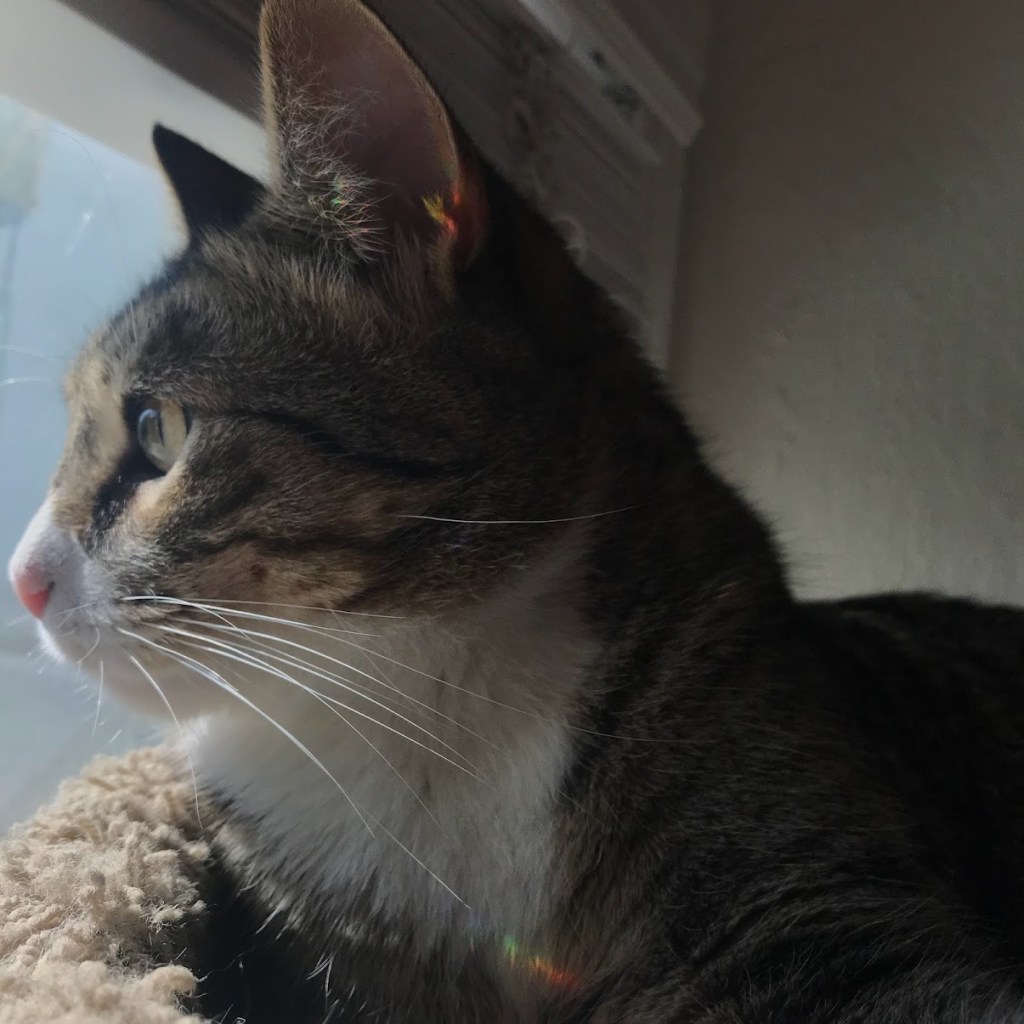
Even though cats mostly use body language to communicate, they also use a few sounds! Cats almost exclusively use their voices for their mothers and us humans, but they can become quite vocal if fighting with another cat. Sometimes they even talk to themselves when they are agitated! Here are some common cat sounds to listen for:
IDENTIFYING CAT SOUNDS
- HISS
A hiss lasts about one second. Snakes make this sound too, except a cat’s hiss is much harsher. A cat hisses to try and scare off predators. If a cat hisses at you, back up. The cat might feel scared and cornered.
- CHATTER
A chatter sounds like a string of high pitched “eh”s, along with clicking sounds. When a cat chatters, it is frustrated. Most likely it sees a bird outside it can’t reach. Even though you might want to sooth your frustrated cat by petting it, don’t even try. It might take its frustration out on you!
- MEOW
A meow literally sounds like “meow”. If your cat meows at you, it most likely is asking for something. Most likely the request is for food or to be let through some door, but sometimes the cat is just saying hello.
- PURR
A purr sounds like one long, deep, voicelessly rolled “R”. When a cat purrs, it typically means the cat is deeply content. But sometimes a cat purrs to soothe itself when it is anxious.
- CATERWAUL
A caterwaul sounds like “ahh-roo-ugh”. This sound either comes from two dueling cats that are about to attack, or a female cat in heat calling out for a potential mate.
- TRILL
A trill lasts about half a second, and basically sounds like a meow and purr combined. When a cat trills, it is feeling very happy and friendly. If a cat trills at you, it is happy to see you!
- GROWL
A growl varies in length, and sounds like a very low and almost inaudible “grrrrrrrrrrrrrrrrr”. When a cat growls it is very angry, and is warning that it will attack if its opponent gets any closer. If a cat is growling at you, back up and walk away.

Now that you are all up to date on cat language, it’s time for you to speak cat! Here are some ways to communicate with cats:
4 EASY WAYS TO COMMUNICATE WITH A CAT
- SLOW BLINK
When a cat blinks slowly at you, it is basically the cat version of kissing you on the cheek. Often they will do a slow blink and then look away from you. This might seem rude, but this is a sign of trust. If they look away, it means that they trust you won’t do anything to scare or hurt them. Next time you see a cat or are hanging around your own cat, try blinking slowly at them. Make sure that they are looking at you, then once you make eye contact try blinking slowly at them. If they blink back, then they basically said “I love you too!”
- CROUCH DOWN LOW
Before you pet a cat, especially an unfamiliar one, you should always crouch down first. If you are standing up, you might seem big and scary. Just imagine if a human the size of an oak tree reached down to touch you. Wouldn’t you jump out of the way? You probably would run screaming! Then imagine if that human was crouched down. They would seem a lot less intimidating because now it is closer to your size. If you crouch down, the cat will see that you are closer in size and might even walk over to you. Another reason why you shouldn’t be standing when you pet a cat is because in a cat’s mind, a hand reaching down from above is very similar to the talon of an eagle or hawk that is hoping to have cat for lunch.
- RUB A CAT’S NOSE WITH YOUR FINGER
Cats rub noses with each other to say hello. However, they don’t rub their noses with any cat, dog, or human. Cats only rub their nose with animals and humans that they consider family. A nose rub doesn’t just mean hello, it also spreads the cat’s scent onto the animal or human that they rub on. This makes the cat recognize you easier, just as if it gave you a label that reads “family” in it. Next time you see your pet cat or the well known cat that visits your porch, try crouching down and gently touching the back of your finger on the cat’s nose. If it works and the cat rubs its nose back, then congratulations! You just gave the cat a proper hello in cat language!
- PET BETWEEN THE EARS, BEHIND THE EARS, BY THE TAIL, AND UNDER THE CHIN
Start by gently scratching between the ears, then behind the ears. After that, rub one hand all the way down the back to the tail. Then, gently scratch under the chin. The cat will love this, and likely start to purr. The reason cats love being petted in these spots is because these spots have a special gland that releases a scent that only cats can smell. Cats use this to mark territory. When you pet a cat in one of these spots, it releases their scent and soothes them. Cats also have scent glands in between their toes and on their cheeks, but they don’t enjoy being pet there as much. It would tickle their toes and disturb their super sensitive whiskers.
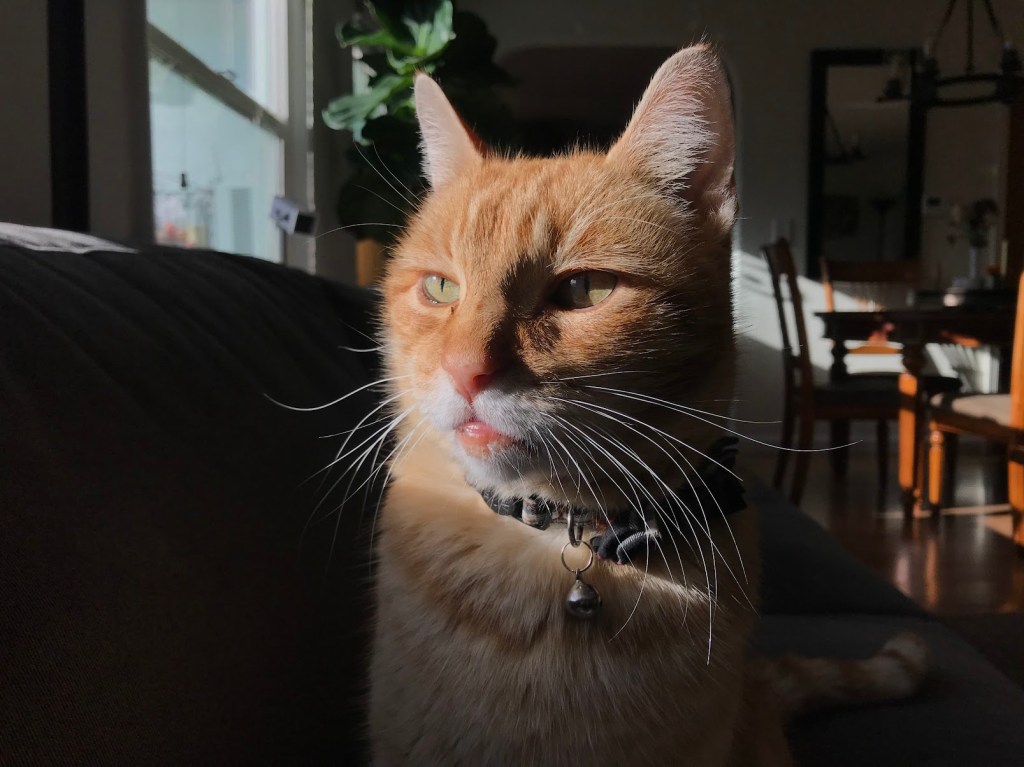
Now that you know these simple cat communications, try looking for them in the next cat you meet. It will be much easier to understand cats, and you might even be able to prevent a scratch or two! Cats are truly amazing creatures, and they are masters of communication. If you have a pet cat, let it know that the Lighthouse says hi!
 The Lighthouse