Do you know what causes your eye, hair and skin color, etc? Well, you can thank your DNA! DNA are molecules that make you, well, you!
DNA itself stands for deoxyribonucleic acid (ask your parents on how to pronounce that). The deoxy part means that DNA has one less (the de part stands for less) oxygen atom than RNA (Ribonucleic acid), which also carries genetic information. The ribo part stands for sugar ribose, which are chemical compounds.
DNA is built of nucleotide monomers (a molecule that can react with other monomers), hence the nucleic part. They are bound together with polynucleotides (Biopolymer molecules composed of nucleotide monomers).
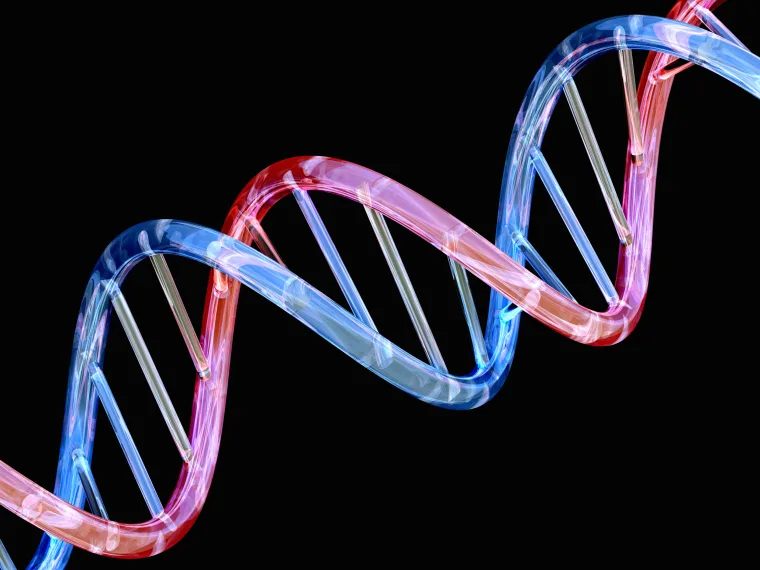
The role of discovering the shape of DNA, the double helix shape, goes to Rosalind Franklin, an aspiring woman scientist who discovered lots of new things about DNA. Rosalind Franklin was a British woman, born in 1920. She and her colleagues (but mostly her) discovered DNA at King’s college in London, 1951.
Franklin took her famous picture, Photo 51, using an x-ray. She used x-ray crystallography (when you use x-ray diffraction to find the shape of a crystalline structure) to take the picture, signifying a large milestone in the creation of modern science.

James Watson and Francis Crick figured out that Franklin had discovered DNA. They stole her ideas and published them as their own. Watson himself wrote a book, called The Double Helix, about the findings, and unfairly referred to Franklin as “autistic.”
After publishing The Double Helix, James Watson, along with Francis Crick and Maurice Wilkins, was awarded ⅓ of the Nobel Prize in Physiology and Medicine in 1962. They were awarded “for their discoveries concerning the molecular structure of nucleic acids and its significance for information transfer in living material,” as said by the Nobel Prize awards, when really, the prize should have gone to Rosalind Franklin.

There are two types of DNA bonds: AT/TA and GC/CG. Only T and A can connect, and only G and C can connect. If you put, let’s say, T and G together, it wouldn’t fit together. This is called a mutation. Think of when you put the wrong puzzle piece. It’s kind of like that. Mutations can be passed down, for example, cancer is a type of mutation caused by the wrong bonds going together.

DNA strands are wound around proteins, to make something called a chromosome. There are two types of chromosomes: X and Y. Chromosomes come in pairs, and the type of pairs determines your gender. Girls and women have XX pairs. Boys and men have XY pairs. The nitrogen bases that make up DNA (which then make up chromosomes), are A (adenine), T (thymine), C (cytosine) and G (guanine), as we said earlier.

I hope you’re as fascinated with DNA as I am! DNA strands really are like the building blocks of cells (which are the building blocks of YOU). It’s super cool to learn about and I hope that this article gives you a better understanding of DNA.
 The Lighthouse