
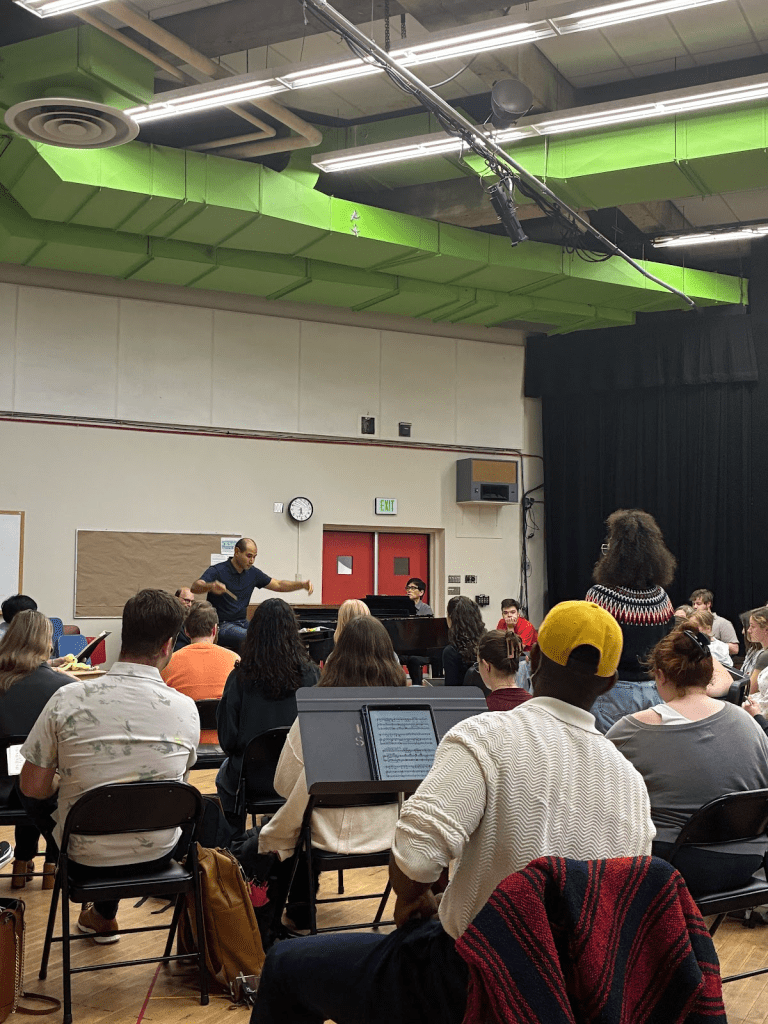
Recently, my father was invited to Indiana University (IU) Jacobs School of Music at Bloomington, Indiana, to conduct a production of Maurice Ravel’s opera, L’Enfant et les Sortilèges (The Child and the Spells). My dad went to IU from 2008-2009, where he completed his master’s degree in conducting. Now, he works as the Music Director of the Marin Symphony in Marin, California.
It has been an eye-opening experience for me, personally, to watch these rehearsals and see how an opera comes together, and I thought it would be amazing to share all about it!
So, without further ado, this is how an opera is made!
What is an opera?
An opera is a musical drama, where actors in costumes tell a story fully or mostly through singing, with sets and props. Opera means ‘work’ in Italian. Singers do not use microphones, and all of the music and singing is live.
About L’Enfant et les Sortilèges:
A one-act, fifty-minute French opera composed by Maurice Ravel. A naughty little boy causes mayhem and treats his toys and everything around him carelessly. Suddenly, all of the objects in his room come to life. He approaches the fire, who ‘burns the naughty and warms the polite’. He is taunted by cats, cups and armchairs. Over the course of the opera, he learns that his actions have an effect on others. The child becomes kind, treating the animals and objects well when they eventually try to attack him. All the animals and objects praise his new wisdom.
The Early Stages:
Every opera needs a cast. This opera, performed by a university-age cast (ranging from 18 to 27 years of age), has about eighteen characters aside from the chorus. I had the great privilege to speak to many people who are part of the two casts performing the same opera on different days.
The play will be performed on October 17th and 18th, and the two cast lists came out way back in May. The actors and actresses rehearsed for hours on ends, almost every day, practicing on their own for weeks before starting rehearsals together. They also managed to keep their grades up from the many other university classes they were taking. I was able to interview some of the cast, and here is a short conversation I had with Sarai Burgos, who plays the protagonist in one of the two casts. Even though the character is a boy, many child male roles are played by girls, because of how high pitched a child’s voice is.
Aleena Haimor: How old are you, and what year of university?
Sarai Burgos: I’m 23, and in my second year master’s.
AH: What was your reaction to getting cast as L’Enfant (The Child)?
SB: It was amongst a bunch of other crazy things. My voice teacher emailed me a bit before the cast list came out. I was really grateful and happy.
AH: Tell us a bit about L’Enfant and how you’re bringing him to life?
SB: My character is around 7 or 8, maybe a little older, maybe a little younger. He’s pretty complex. There are a lot of ways my imagination can bring him to life. To me, he really wants to be seen and understood by others, but it comes across as being naughty or mean. Deep down, he’s really sweet and cares about others.
AH: Any acting tips for young actors and actresses?
SB: Learn to put yourself to the side and fully embrace communicating to the audience.
Thank you so much, Sarai!

Learning French Lyrics:
L’Enfant et les Sortilèges is completely sung-through in French, and the actors and actresses had to start learning French lyrics for the opera. They worked with a French dictation coach, Elsa Quéron, to make sure they pronounced the beautiful words correctly.
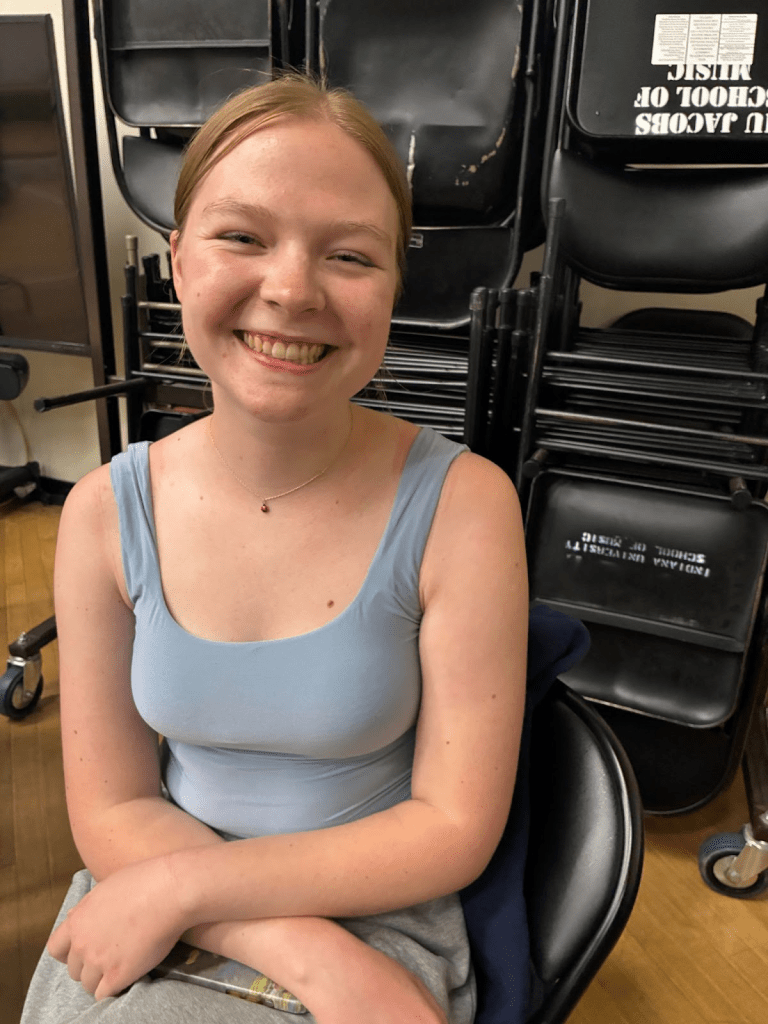
One of the actresses, Leah Nykaza, was luckily already familiar with the French language. She is playing L’Enfant in the second cast. She did an interview with me about how it was easier, yet still difficult, to pronounce words right.
Aleena Haimor: How old are you, and what year of university?
Leah Nykaza: I’m 21, and it’s my senior year of college.
AH: What character do you play, and what was your reaction to getting cast?
LN: I’m playing L’Enfant, and when I found out, I was excited and surprised. It’s my very first time being in a university production and an opera.
AH: Was it hard learning French for the opera?
LN: Luckily, I just finished taking two whole semesters of French last year. The two hardest things are the sounds we don’t have in English, and the difference between singing in French and speaking in French.
Thank you for speaking with me, Leah!
This is part one of a multi-part article! Part two is out next month. Thank you for reading The Lighthouse!
Thank you to these incredible people for enabling me to write this article!
Actors/Actresses: Sarai Burgos, Leah Nykaza, Chloe Hopson, Kathleen Simunek, Natalie Vong, Pelagia Pamel, Maggie Stall, Kathrine Barbour, Jisoo Choi, Morgan Feeney-Davies, Brynn Jacobs, Nate Paul, Jeremiah Angel, Evan Gunter, Cody Horne, Andreas Psillos, Molly Singer, Cathrine Tamayo, Ana Ambartsumian, Ambriehl Ivy, Nina Royston, Kirsten Tierney, Yixin Yang, and Langelihle Mngxati.
Chorus: Julianna Banfe, Emma DiSanto, Savanna Holley, Laura Looper, Ruby Miller, Sabrina Schubert, Lauren Smedberg, Brittany Weinstock, Issana Yaguda, Simo Brea, Tynan Butler, Robbie Erickson, Lane Harden, Gannon Hays, Xiang Li, Preston Rogers, Stephen Stavnicky, and Tyler Whitney.
Production: Fawzi Haimor, Omer Ben Seadia, Walter Huff, Lydia Spellman, Russell Long, Gina Cerimele-Mechley, Olivia Essebaggers, Virgil Fok, Katrina Keat, Rachel Rock, Jennifer Hong, Miles Swaminathan, Shuichi Umeyama, Chuck Prestinari, Janice Kim, and Elsa Quéron.
Sources:
https://www.eno.org/discover-opera/articles/the-beginners-guide-to-opera/
https://operaballet.indiana.edu/events/lenfant-et-les-sortileges.html
 The Lighthouse