
Sunset by Sienna Griffey
Songbird is visiting me today.
I couldn’t be more excited.
I close up things in the library (putting away any lingering books, cleaning up the front desk, and doing a quick sweep of the floor), then I brush off my hands and head up the secret staircase to my living quarters atop the library.
There wasn’t much to tidy up here, as I had already cleaned it this morning, so I just opened up my current read—one of the ones Songbird had recommended to me—sat before my window, and waited.
We loved to recommend books to each other, it was one of our oldest traditions. While I was slow to get to their suggestions, they never disappointed. They always found the best stories, and always knew which ones I would love.
After some time had passed, I paused my reading to open the window, something I had forgotten to do. Otherwise, they wouldn’t be able to get in. A cold autumn breeze swept into the room as I swung the window panes open. A shiver ran over me, but I was smiling, inhaling the crisp scent of evergreens and the tinge of brine from the nearby ocean.
This time of year also made me think of them: all warm reds and browns and golds, early sunsets, and honey-like sunlight—with cool and crisp breezes as invigorating and refreshing as their spirit.
Looking outside, I could see the clouds painted orange and pink, the sun beginning to fade on the horizon, coating the world in fiery orange and gold.
This was the time of day that reminded me most of them. Not just energetically, but we always called and met up at this time. Our schedules worked out best for this, for me to conjure a communication spell for us to be on calls well into the night, the moon high in the sky by the time we finished. Then, on the rare occasions I was able to visit their river town, my wagon always got me there late afternoon or dusk. In my mind, this was their time of day.
With the natural light fading more and more, I decided to light some candles. Slowly making my way around my room, I set alight each candle I came across around the space.
Fire, which burned bright and lively, like Songbird’s creativity and humor. Fire, the element of the Sun, whose warmth was that of their words of comfort and care when my worries and fears arose. Fire, which lit up my room like Songbird lit up my day whenever we called.
The candles were all burning when the sky developed to deep oranges and purples. The Moon was showing herself more, now, sharing the sky with the Sun for a few moments. I smiled.
Sun and Moon, the ancient opposites. Yet, they danced in tandem, stories of old depicting them as siblings or lovers, but always connected—always tied to each other in some way.
And in that moment, looking up at the two celestial bodies, flashes of our history flitted before my eyes, in my mind, and in my heart.
The very first time we met, we were young and both in a class of storytellers, you always making me laugh during those meetings, you reaching out first, our first message to each other outside of the group, two years of learning and talking excitedly through just our words on paper about our favorite books and shows and movies.
Our first confrontation, where I was so afraid of losing you but knowing we had to have that conversation or we could not move forward, things being even better than before after that, our first call after years of only messaging, feeling shy and nervous but oh so excited to talk with you—and before I knew it, a whole new door of our friendship was opened.
To where we went beyond knowing our favorite books and shows, to learning about our siblings and them learning about us. To learn of our other friends, crushes, analyzed our social groups and each other. Listened and comforted and offered words of encouragement through heartaches and heartbreaks. Laughed over butterfly clips breaking and candy being left in the wash, fell in love with each other’s characters, and cried over our fears and insecurities.
An ebb and flow, light and dark and everything in between. Never a friendship that was all-consuming or obsessive, but instead soft and sweet and gentle and loving and beautiful.
I smiled to myself, tears welling in my eyes as the last of the Sun’s rays faded from the sky, feeling so full of Songbird’s warmth and joy, so full of gratitude for them being in my life, so full of hope and excitement for whatever our futures held and knowing that, no matter what, we’d always have each other through it all.
It was then that a songbird flew up and landed on my windowsill. It looked to me, chirped once, then twice, before dissolving into golden sparkles. The sparkles blew into the room on a breeze and Songbird materialized in a sunburst of light in the middle of my room.
“Hi!” Songbird, you, grinned, your aura golden like the sun on grassy plains.
“Hi!” I crushed you in a hug, and it was the reunion of the day and night.
Thank you, Songbird, for being the best friend the Moon could ask for.
Strangers by Harper Smith
When I was eleven, my neighbor wrote me a poem.
It was early afternoon, and it also happened to be my birthday. My mother and I were on our way down the driveway to our car, while the neighbor was watering her flowers across the street. I don’t remember where we were going, but it must’ve been somewhere very important, because I was decked out in my finest attire and skipping around like I owned the place, because of, you know, birthday girl privileges. We waved; she and my mom chatted a bit. I remember shouting across the street that it was my birthday, and then we said bye and got in the car and left. It was a small moment, a simple one, and one I most certainly would have forgotten if not for the fact that when I came home, my dad handed me a small piece of paper.
Something I learned after that day is that my neighbor, the sweet old woman across the street always hunched over her garden, is actually a renowned local poet and creative. I’m serious, you can look her up, her name is Nina Serrano, and she’s one of the only people I know who has her own Wikipedia page. She’s an amazing writer and activist who’s published books, poetry collections, worked on films, and co-run a podcast, but I didn’t know any of that at the time. At the time, I was a child standing in my kitchen, clutching a piece of paper that read Poem for an eleventh birthday, and not realizing that this one small act of kindness would be the thing that carried me through many of my hardest moments.
‘Strangers’ is the name of my favorite song, and it is also the title I was instantly called to when I found out about this month’s collection. It may seem like an odd title for a story about love, and maybe it is–after all, I’m sure I’ll find the rest of my peers’ pages detailed with heartwarming stories about grandmothers and pets and girlfriends, connections and friendships, rather than random people met on the street. Which, obviously, is fair. Love is generally categorized by closeness and intimacy, something that’s impossible to achieve with someone you barely know–like, say, an across-the-street neighbor that you’ve spoken to once in five years. But what if it wasn’t? What if the closest connections are actually the ones you make in an instant?
Love is in the little things. It’s how they know your coffee order without having to ask, how they’ll wrap their coat around you when they see you shiver out of the corner of their eye. It’s your best friend’s nickname for you, it’s your mom making your bed for you every day of finals week, it’s your little brother letting you spoil the plot of shows that he hasn’t even seen long past his bedtime. It’s platonic and romantic, singular and plural, it’s intimate and expansive. It’s being seen by the people who love you most, and loving the people you know well. So yes, it’s those things, a hand in yours, a secret shared, but it’s also the even littler things. Like the weary nod of solidarity between early-morning commuters on the subway, the face of the store grocer when you make her laugh as she loads your bags, the kind smile of the boy who bent down and handed you the pen you dropped. Let me ask you, have you ever been in a room where somebody is butchering something so badly that you were united in long-suffering eye contact with somebody you’ve never spoken to before in your life? That is it. That is love. Thanks to Jimmy C’s terrible choir performance in the ninth grade, you and a person you know nothing about were, for one moment, connected by something powerful: mutual understanding.
In the world we live in today, it is so easy to forget that we are all the same, really. Well, okay, not really–I have blue eyes and you have brown, I can play guitar and you know piano, not to mention all the details and imprints of our psyches that will never resemble another’s in a thousand years, but you get what I mean. There’s so many labels and categories and different types of people you can be that it makes it seem like moments like the ones I described are meaningless in the flood of it all. But I don’t think it’s meaningless at all. In fact, I’d argue it means quite a lot. We all cry. We all feel alone. We all lie awake in our beds at night wishing someone would see us for who we really are, truly, and ignoring all the people who are right in front of us waiting to be seen as well. In the same vein, we all also smile. We all love someone deeply, with the depths of our hearts, and I’m willing to bet there’s not a person reading this who hasn’t laughed so hard they’ve cried at a funny cat video even once in their lives. Try me. We are all human, perfectly, imperfectly human. We blink and breathe and stare at the stars, and we are all so alike and so different at the same time, but when it comes down to it, we are one.
It’s so easy to feel so hopeless. It’s so easy to convince yourself that nothing really matters, that your existence has no mark on anything at all, that maybe it would even be better if you vanished completely. But it does matter. You matter. If you were not here, the girl who you gave your extra piece of gum to on the train when you were twelve wouldn’t have that memory to cling to when things get hard. The people that watched you trip into a geyser at Yellowstone wouldn’t have a story to pull out at every family dinner over the years (even if that was your most embarrassing moment. I get it, trust me.) You have made a million marks on a million people that don’t even know your name, and they’ve done the same to you. Take a second and think about all the people you’ve met in your life. Take a second and remember those people who you will never see again, but who brushed up against you for one second in time and in that way, added the smallest stroke of paint to the canvas of your life. Let yourself find the strangers, and remind yourself that you are not alone.
And sometimes, maybe your story isn’t over once you’ve exited someone’s life. I haven’t spoken to my neighbor Nina since probably 2021, after exchanging a few poems with her in an effort to repay her for the beautiful one she wrote to me. She told me I was an excellent writer–Nina, look at me now! I don’t remember what I wrote; I don’t even know if she still has them. But I still see her. I saw her yesterday, getting out of her car with her husband, and we waved. She’s about 92 now, and I’m about 16, and it’s been five years but I still have that paper in the same spot on my wall. Art has come and gone around it, even a whole loft bed has framed it at one point, but it is still there. A reminder to me that, no matter what, for one day I was what made someone write something beautiful. Do you understand how special that is? I haven’t ever told her all this, but tomorrow I’m going to print out this story and walk over to her house and give it to her, because she deserves to know. I have an amazing woman living right across my street, and I’ll be damned if I let my life go by without the chance to let her know how much she changed it.
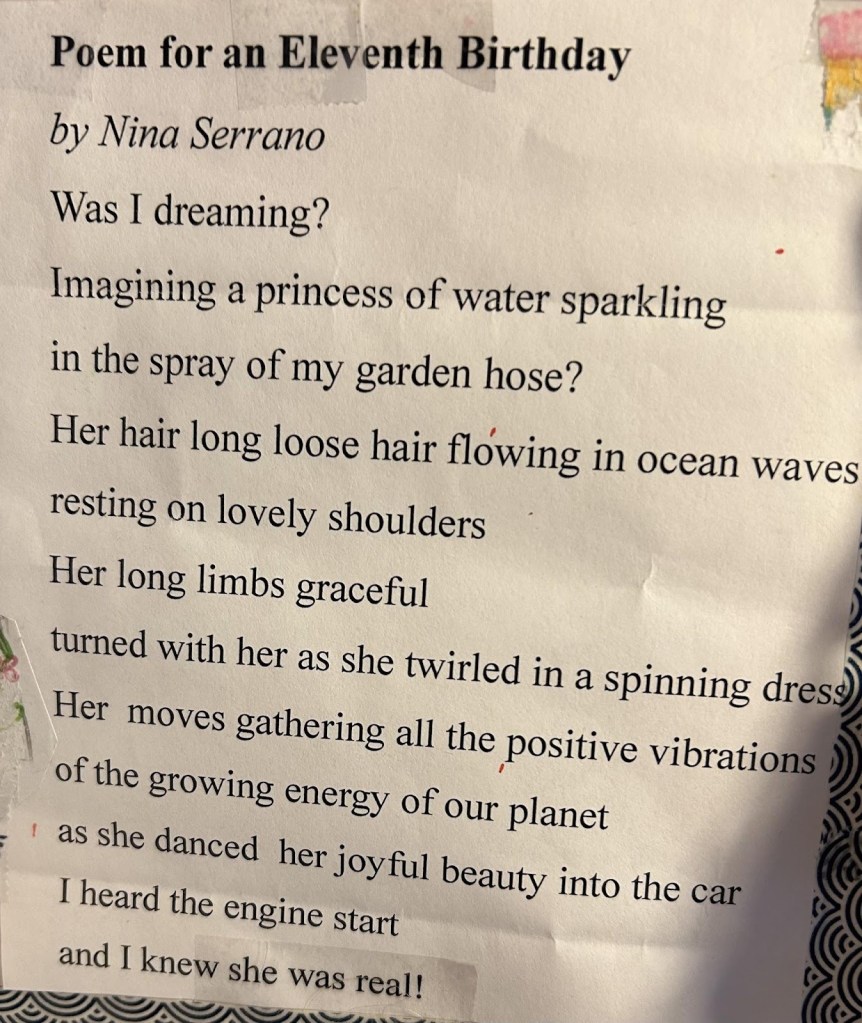
For Nina xoxo
The Cello – An Explanation By Iliana Kim
Did you know that before the endpin was invented, people had to hold their cello
between their legs? The cello is usually made out of wood and is shaped like a violin.
The thing is you could fit two or three violins in one cello. I was introduced to the cello
when my family started listening to the Bach cello suites. I was amazed by the deep,
mellow sound that it produced. I love the way the cello calms me down and I see that
other people are affected that way too. I like the several ways the cello is played, like in
solos, duets, and orchestras.
I think the sound of the cello can create a nice and calm environment for the
people who are listening. I really like the fullness of the sound and the level of volume
the cello has. The sound of a cello makes me feel like I’m floating and I think it’s very
relaxing. With certain songs people could feel happier, more energetic or stronger like I
sometimes do.
In the one and a half years I have practiced the cello, I have played in solos,
duets, and a few orchestras.The first time I played in an orchestra I felt it was easier
than doing a solo or a duet. Solos feel like one ant trying to make a rather large ant hill
all by itself with no one to help. But if you are doing a duet it’s easier because it’s like
making an ant hill with fifty ants. Then again it’s better to build with a hundred ants than
anything else.
I hope you and everyone who reads this will get to enjoy the magical sound of
the cello, whether in-person or online, as a solo, duet or orchestral performance.
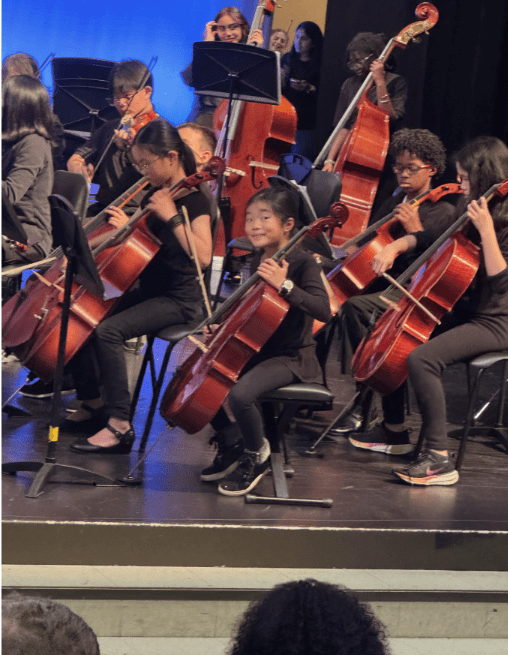
Links to music:
Grieg Holberg suite (Orchestra)
https://youtu.be/kJ6AaBArhRw?si=5ztDP-Ud733CGjmf
Bach Cello suites ( Solo played by Mischa Maisky)
https://youtu.be/mGQLXRTl3Z0?si=6QH-zEV5AGhp8AU5
Stray Kids by Sloan Correnti
Something I love is the band Stray Kids! Stray Kids is an eight member K-Pop boy group created by renowned music label JYP Entertainment! They were first discovered through a TV show called Stray Kids, on which many K-Pop trainees competed in teams for the chance to debut as JYP’s newest band. In 2017, Stray Kids won and released their debut ep I AM NOT, beginning their rise to stardom.
The Stray Kids members are split up into three main units aka rachas; 3Racha, Danceracha, and Vocalracha. 3racha consists of Han, Bang Chan, and Changbin, and is responsible for producing and writing most of the band’s music! Dancracha is made up of the three main dancers, Lee Know, Hyunjin, and Felix. They choreographed some of the group’s dances, and Lee Know was even a back up dancer for super famous K-pop group BTS! Vocalracha is I.N and Seungmin, the main vocalists! Stray Kids used to have nine members, but their old lead vocalist Woojin left the band in 2018 for personal reasons.
Since their debut, Stray Kids have released over 300 songs and have collaborated with many popular music artists like Charlie Puth, DJ Snake, and Troye Sivan! They have also won over 100 awards including the Billboard Music Award for top K-Pop album for their 2023 release 5-Star.
Their latest project is The dominATE Experience, a movie about their dominATE tour. It will be kind of like Taylor Swift’s Eras Tour movie, but with more behind-the-scenes footage. The movie premiers in theaters on February 6th, 2026! I’m going to watch it in theaters on the 7th, and I’m so excited!
Stray Kids is an awesome group, not only because of their fun and interesting music, but because of the members’ great personalities and kindness towards fans! I think they’re all amazing people, and I hope you do too. GO CHECK OUT SOME STRAY KIDS MUSIC!!!
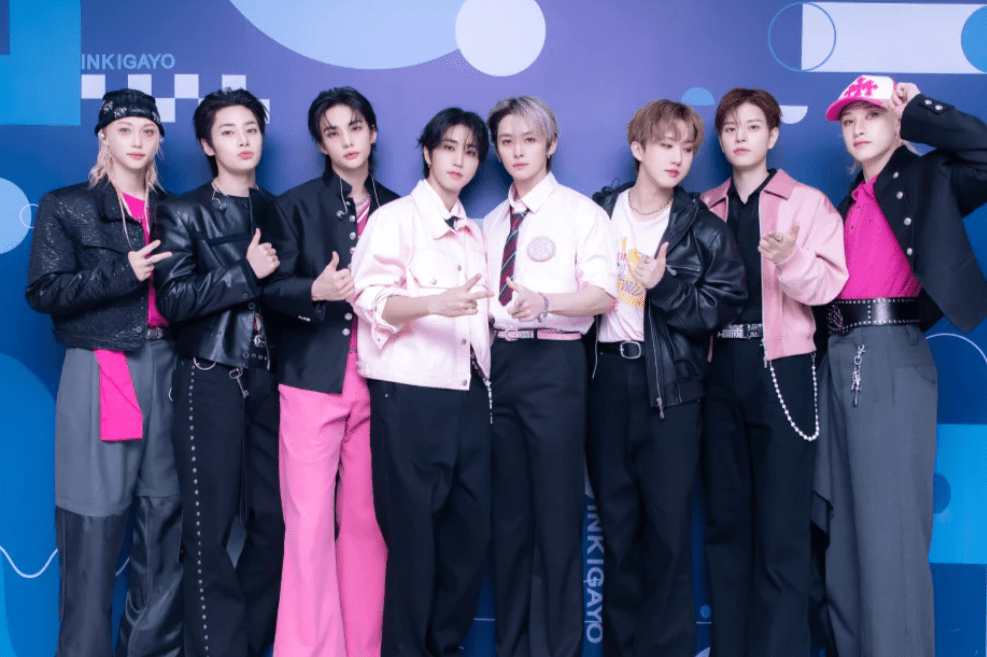
Han, Lee Know, Changbin,
Seungmin, Bang Chan.
Thank you for reading this beautiful collection of works by these incredible guest writers and Lighthouse staff alike. We hope that their work has brought you joy in this season of love. We challenge you to openly admire and appreciate the things you love in life. The people, the places, the adventures and moments. The things that make you…you. Because, at the end of the day, love is what makes us, all gathered together in this lovely yet messy world…us. And as for the world, we must remember that we can never have too much love, understanding, and empathy for the people around us; our triumphs, our small moments, our shortcomings, those are what make us so human and those are the things that should be celebrated. So finally, say “hi!” to your neighbor, pet your cat, and treat others with the love that I know our hearts so deeply crave each and everyday.
Sincerely,
The Lighthouse Staff
“And in the end, the love you take is equal to the love you make.”
The Beatles, 1969

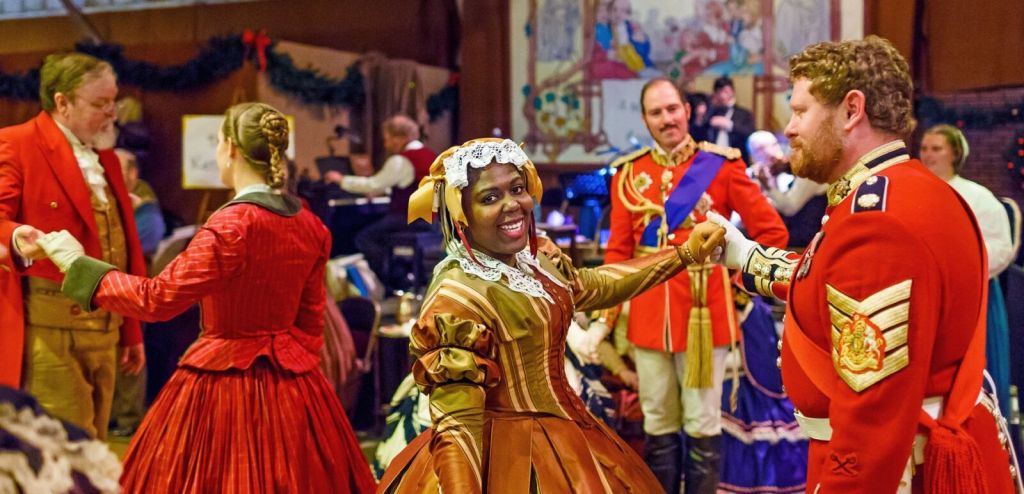



 The Lighthouse