News, Science

Oldest Active Astronaut Returns Home from 220-Day Mission

by guest author Jonathan David

Don Petit, the current oldest active astronaut, returned to Earth on his 70th birthday from
a 220-day mission on the International Space Station. He spent many hours on scientific
research in the areas of 3D printing in space, water sanitation, plant growth and fire behavior in
microgravity. This was his fourth mission, totaling 590 days of space time. His main job on the
team is flight engineer.
In an April 28th interview at Johnson Space Center he concluded by sharing, “ I could
look out the window and just enjoy the view. But, when I’m looking out the window just enjoying,
its like, ‘Oh, Wow. A meteor. Oh, wow, look at that. Man, there’s a flasher. What’s that? And, oh,
look at that. A volcano going off? It’s like, okay, where’s my camera? I got to record that. And
part of this drive for me is when your mission is over, it’s photographs and memories.’”
Thank you for reading this article. Stay tuned for more NASA news! Special thanks to
ABC News for interview information.

Home

Sabine B. – Staff Writer

Sabine is 15 and loves reading books and painting. Her favorite books are those about obscure mythologies. If you want, she would love to give you a two-hour long lecture about their erasure from history or about the attributes of some mysterious minor god. Oddly enough, her brother doesn’t seem to want to listen to her anymore. She loves sharing cool facts with people and uses her art as a way to do that. You can find her hiking in the regional parks, tending to her frankly terrifying number of succulents, or going down her newest rabbit hole (it’s not her fault everything she finds has several science-y questions tacked onto it that she absolutely has to research). 

Sabine has three chickens and, in a controversial decision, has decided she loves them more than her family’s dog. If asked about the cat vs dog debate she would answer birds, fish, reptiles, amphibians, and fungi in that order and would leave out any mention of felines or canines. She loves them all equally when she’s painting them though.   

Home

Harper Smith – Staff Writer

Once there was a child chosen in a great prophecy, destined for a life filled with faeries, witches, elves, and majestic quests galore. Unfortunately a mistake was made and they ended up in this universe, so as an alternative they spend their days writing about all those things instead. Harper Smith is 15 years old and has been homeschooled since fourth grade. They enjoy reading (never less than three books at a time), drawing or writing in their many notebooks, and anything to do with music, even if it includes torturing their fingertips while learning guitar. They have interests in acting and have been in several homemade films, in addition to publishing a script and featuring in a collection of short stories with other young authors. Their dream is to co-create animated or live-action films with their friends, and maybe publish a series or two, but will happily settle for child psychologist if necessary.

News, Student Life

Interview with DGC Director Ken Abrams

by Lydia I. Matinov

Lights? Check. Audience? Check. Voices? Check! Next is the conductor! I had the pleasure of interviewing Mr. Ken Abrams, the artistic director of the Danville Girls Chorus. Since 1992, Mr. Abrams has been conducting singers of all ages, and has won multiple awards, as well as, competitions. I am very excited to share his inspiring story.

Why did you choose choral conducting and performing arts as your career?

I didn’t choose it at first. I chose to be a music major, and then, after I graduated, somebody said, “Hey, you’ve worked with my high school choirs, and you did really well. You should consider being a teacher.” That’s when I said, “Maybe”. Right after college is when I made the choice to do that.

What is your favorite part about your job?

My favorite part is getting the students prepared and working through rehearsals. Then, watching them soar in a concert.

What challenges have you faced throughout your career?

Many challenges. Financial is the first one. Not getting any money for my program, or my accompanist, and having to sell candy, and do everything possible to have a choir to direct. That was one of the hardest things. There’s been a lot of cutbacks in the schools over the years. They’re facing more this year.  That was always difficult, when they were laying people off, or told me they do not have a job. And three, sometimes just having a rotten-egg student can be a real pain. It’s the good ones that make it all worthwhile.

What was the most valuable thing you learned while studying choral conducting?

One of the things somebody said was “Expect, and communicate, and you will not be disappointed.”, and I’ve always remembered that. If you give them the expectation; tell them what you want, how to do it, and what you’re expecting, more often than not, they will come through with flying colors.

What advice can you give to anyone who would like to pursue a career in musical arts?

Just make sure you have all the training you can get. Musical arts is a big field, but if you want to be a teacher, learning how to play piano helps a lot. If you’re in musical arts, then you must try singing the absolute best you can and learning to read music. And, if you’re going to be in musical theater, add dancing to that, as well.

You have received many prestigious awards, and your choirs have won numerous competitions. Can you comment on your incredible success and have you ever imagined that you would be such a highly sought after artistic director?

Never. Never imagined that. It just kind of happened, and I got better and better the older I got, and I got Teacher of the Year for California. Two years ago, my choirs won many-many awards and competitions, but they had to work really hard to do that.

Can you share a funny or interesting story that happened sometime during your career?

There were a lot of funny stories. We did musicals every other year, and there was lots of fun stuff that would happen: a lot of silly things with kids falling off the risers, or sneezing, or fainting in the middle of a song.

Is there anything else you would like people to know?

What’s wonderful about being in a choir is that singing is something you can do your whole life. It’s something that you don’t have to have an instrument for. You can just do it by virtue of your body helping you accomplish singing. I hope that my singers with Danville Girls Chorus and the ones that I had in high school use it, value it, and continue exercising it their whole life long.

For more information regarding the Danville Girls Chorus, visit danvillegirlschorus.org.

The Danville Girls Chorus

Arts and Culture, Science

California’s Special Species – Part 1

by Sabine B.

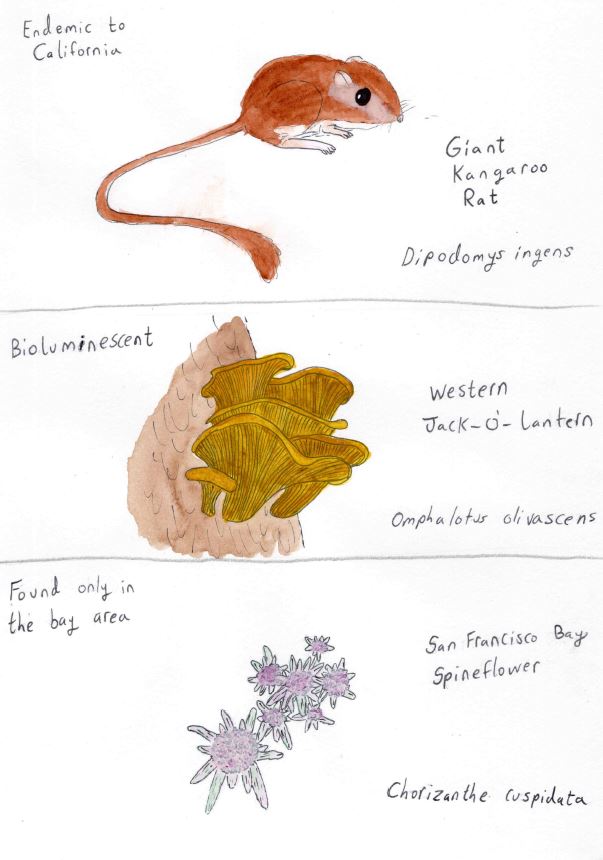
Why is California so diverse? One reason is the abundance of different biomes and environments. The wide beaches and rocky cliffs of the coast regions border groves of redwood trees, oak woodlands merge into stands of fir and pine that give way to alpine meadows, and sage flats sprawl into sandy deserts. We have both the highest place in the continental US, Mount Whitney, and the lowest place, Badwater Basin. There are many different habitats in California which means there are a lot of different species. 

There is another reason as well! The land along the coast of California is part of a biome known as the chaparral biome, and those oak woodlands I mentioned are part of it. This biome is one of the rarest biomes on earth and it provides the perfect environment for lots of unique species. It only exists on the western side of continents and only from 40 degrees to 30 degrees north and south on either side of the equator. It is found along the coasts of Chile in South America, along the coast of Australia, along part of the coast of Africa, along the coast of California, and, in probably its most famous occurrence, in the Mediterranean in Europe (the chaparral biome is the reason for that ideal ‘Mediterranean climate’). The chaparral has mild wet winters and long hot summers. Its rain cycle is one of the things that sets it apart from other biomes. 

Due to its weather patterns, the plants of the chaparral have evolved adaptations that prevent drying out during droughts, and are fire resistant to protect against fires. The animals have adapted along with the plants. Because the chaparral zones are so far apart, and have such favorable conditions, and are so rare, species that settle in them often specialize to fit them. This means that chaparral zones are biodiversity hotspots. Those are places where more of the species living there are biologically unique than in other places. Just like in other biodiversity hotspots, California has many, many endemic species. They are found nowhere else in the world. Some of the species I will be sharing with you are found in only one or two counties in California. 

Every installment is researched and illustrated by me and will feature a native Californian animal, fungus, and plant. I will include the scientific name and the common name if there is one. I will also note something special about them. Feel free to look them up for more about them!  

Science

Crash Course in 3D Printing

by Camden S.

How does one start 3D printing? In this article you’ll learn the basics of 3D printing, and where to start.

Picking the Printer

There are three main types of 3D printers: FDM (Fused Deposition Modeling) uses a spool of filament and prints molten plastic in layers, SLA (Stereolithography) uses a laser to cure resin for each layer, and SLS (Selective Laser Sintering) uses a laser to fuse powder together to create layers. We are talking about FDM printers as they are the most common desktop 3D printers and are the easiest to use. This is about FDM printers specifically, so information may differ if you are using another type of printer.

Types of 3D Filament

3D filament ranges in color, materials and uses. Some common materials are PLA, PETG and TPU.

PLA has a lower melting point and is easier to work with compared to other materials but is not ideal for outdoor conditions.

PETG is better suited for outdoors and has a higher melting point. It is also more suitable for bigger objects and mechanical parts but can be a little bit harder to work with.

TPU is a flexible material allowing you to make parts that need to deform but is a difficult filament to work with.

3D Models

The 3D printing process starts with a model. You can either make the model yourself or find one online on sites like printables.com or thingiverse.com. If you want to make a model yourself, there are multiple great programs to do it in.

Tinkercad is free and is used for 3D modeling electronics and coding well-being beginner friendly.

Blender is a free open-source program that has a wide range of uses from 3D modeling, video editing to even making movies though it has a steep learning curve.

Slicers

A slicer is a program that converts a 3D model into something a 3D printer can read called G-code. Slicers also allow you to adjust every aspect of your print from size to print speed, infill and supports. One great slicer is Prusa slicer which is free and open-source.

Infill is a trick that is added in the slicer and is used to save filament and reduce print time by making an object hollow and filling the inside with a support structure. There are many types of infill ranging in look and density depending on what is needed.

A 3D printer cannot print in midair so when an object has parts that cannot be printed because there’s nothing to print on, that’s where supports come in. Supports are plastic scaffolding added in the slicer designed to be removed after the print finishes. Supports are an essential part of 3D printing though if they are not necessary it’s better to not have them.

The Finished Product

Finally, you get to print the object. This is usually the final step as post processing is not common when using FDM printers. 3D printed objects usually are strong and can be used for a wide variety of uses. Examples of uses range from miniatures to parts for mechanical objects, but the sky is the limit when it comes to 3D printing.

Stories

Arctic Fox

by Harper Smith

Content warning for animal death and blood. 

The morning is cold. 

She creeps along quietly, soft paws pattering along the surface of the ice, slick with the same salt water that stains the air. 

She smells something, among the sharp biting wind and tang of the sea spray. Something warm, something sweet, something alive.

There are prints in the fine dusting on snow beneath her paws, small and stick-thin.
Bird.

That’ll do.

The fox runs. 

Wind ruffles her white fur as she speeds across the ice, turning her head this way and that. Searching. 

She has left her litter behind, on the dryer land where they will not run off. They are young, a week old, and they demand food. She will not deny them. They need their strength. 

The day is young, but so are they. A bird may be enough, it may not.
She will have to see. 

The ice is solid beneath her, but she can see, when she lifts her head, that some is not. Grease ice, little flakes of white, drifts along the surface of the ocean, watery and barely formed. Bigger chunks float past that, worn and smooth, liquid dripping off their sides. Melting. 

A lot has been melting, recently. 

The fox wonders what she’ll do if this one slips away as well, disappearing back into the sea water like it’d never been there at all. She can already see it starting, the rounded edges getting smoother and smaller with each passing day. She hopes it stays.
It has to stay. 

She keeps running. 

The ice she’s on is very thick, upturned a little. It doesn’t crack when she moves, but the clinking sounds of her claws echo. 

The bird is closer now. 

She slows.

It’s an arctic tern, back again from its long journey. It moves around the ice, pecking with its thin beak to find some sort of sustenance for its flight. 

It will never have the chance. 

She crouches, low, flattening her ears against her skull. Readying herself.

She pounces.
Feathers fly. 

She catches it with her teeth, first, sinking into the tern’s soft neck. It struggles–they always struggle–twisting this way and that beneath her small, strong form. 

She wins, eventually, blood staining her jaw and teeth as she carries the creature’s corpse back across the plains of sea ice, oceans spray flying around her, wind rushing. 

The fox thinks this will be enough. At least for the strong ones to eat. The strong ones will always eat. 

She holds her head high as she prances back to her litter, infused with the thrill of a successful hunt. 

I win. 

Her paws skate across the slick ice, and it doesn’t crack once. 

Stories

let the world burn – A Short Story

by Aleena Haimor

300 Years Ago:

My throat burns. 

It burns like fire. 

Slender tendrils of ruthless black smoke curl around my neck, slowly, softly, yet so powerful all the same. Surely they are taking my life. The tendrils grasp like long fingers, tighter and tighter still, until I can barely take a breath.

I try to scream, but cannot. I cannot move, cannot breathe. It seems I can do nothing but wait and hope for the sweet relief of death. 

But one thought tortures my mind. My daughter. Who shall watch over her? I hope that my child, my newborn daughter, will live to bore young of her own, who in turn will bear children. I know that they shall all suffer the same fate as me, but there must be a way. And I remember the spell. So long ago I heard it, yet it is fresh in my mind. I chant the spell to remove the curse from one girl, who will destroy the wretched one who cursed us, hundreds of years from now.

“Save my blood from the curse of death. Save her life, oh holy one, let her live.”

I feel peace. I have always been the one who was afraid of everything.

Yet death does not scare me as the world becomes dark.

<><><><><><><><><><><><><><><><><><><><><><><><><><><><><>

Present Day:

I run, run, run, as fast as my legs will carry me. My chest cramps and the air is getting thinner the higher up I go, yet still, I run. Away from my would-be grave, the only home I’ve ever known. A blood curse, in my family and village for generations, a slow but inevident poison spreading through my people. They died quietly, one after another, like dominoes falling over. I am the only one in my village who wasn’t affected, who didn’t have the curse, the only one left alive, but I need to get away. I don’t want to be alone in the remains of my village, among all the graves. But I know that the images of my family on their deathbeds will forever haunt my memories. 

I have always been the girl who fended for herself. My father was crippled and my mother died when I was an infant, so I had to learn to cope.

My vision blurs from the tears that came from the memories of my family. Our kind does not cry, we refuse to, and I dash around the trees, chanting a spell as I do. 

“Be gone,  dreadful sorrow, do not block my sight, be gone, not forgotten, let me see light,” I whisper. The words are almost second nature to me, as I have always had trouble with my emotions and couldn’t let anyone see me cry. My vision clears as the tears evaporate into thin air. I feel a bit happier as the spell seeps into my skin, touching my heart, bones, brain, making me stronger. Sadness and anger are—or were—seen as weaknesses to my people. But now I don’t know if I can fight my feelings for any longer. I’m more troubled than ever before.

I slow to a stop, my legs burning, and take a moment to look at the scenery surrounding me at the top of the hill. I breathe in the fresh air, crisp and sweet with the scent of jasmine flowers and salt water from the ocean on the other side of the mountain. I look behind me and see a vast blue mirror, calm, smooth, beautiful, stretching ahead of me. It is breathtaking.

I am the first in my family to see this ocean.

Again, the tears fall. But this time, I do not bother to wipe them away or clear them with a spell; it isn’t worth it where no one can see me.

I call to the great spirits of air, fire, water and earth, to help me with my grief. But the wind moans and the trees creak, the waves crash and the fire stays dormant. I seem to not possess the gift of voice, the ability to call the elements to my will. My father did. My mother did. My brother did. I seem to be the only one in my family who does not, other than my sister, who passed as a baby. Maybe it is because I am the one who was saved from death. I know that my mother left much too early, being only twenty when she died.

My mother. I do not know much about her, other than the fact that she was kind, selfless and beautiful. Father told me so many stories about her, how she always held me with care, singing lullabies even though the curse was slowly draining her life away. How she would always be the one to calm the crying of me and my twin sister, Alana. How the last words she spoke were our names, even though Alana had been taken a month before, as the curse had spread through my mother’s womb when she was pregnant with us, narrowly avoiding me. But Alana absorbed all of it, leading to her death. Mother seemed wonderful. I wish I remembered her.

Suddenly, a violent breeze rips through my hair, whipping it around my face. I am startled for a moment before I realize that I did it. I called the wind. And once I feel it touch my skin, I am filled with power. But a moment later, it feels like a tornado swirls in my mind, stripping all my happy memories away. I scream. 

And then I feel nothing.

<><><><><><><><><><><><><><><><><><><><><><><><><><><><><>

I wake up in a ring of fire and slowly lift my weary head. I see a dark figure standing before me, her features barely visible. A hood conceals most of her face, and she takes a step towards me.  

“Hello, young one,” she whispers, her voice a deadly purring drawl.

She lifts her hood to reveal a beautiful woman underneath, with eyes black as coal and skin unnaturally pale and smooth, not even the slightest hint of wrinkles, although she is thousands of years old. I know this because this woman is the woman from our village legend, the woman who cursed us. My hands ball into fists of hatred.

“You!” I screech, jumping to my feet, suddenly feeling…alive again. “You murderer!”

“Now child, we must not throw around assumptions, should we?” she smiles at me, a malicious glint in her eye. She reaches her right hand into the fire and seems to take out a ball of flame. She twines the flames around her fingers and all of a sudden hurls the ball at me. I duck just before it hits a tree, making it explode. 

“Tricky one, yes? I seem to remember very well, taking your mother’s life with my bare hands. She tasted so delicious, so sweet, I could not resist,” she says softly, reaching a skeletal hand out to me. As I back away, the woman transforms into a hideous demon, with horns of smoke and teeth sharp as daggers. She lets out a guttural roar that sends me flying back. 

Your village was insignificant, your people were animals that needed to be slaughtered. Your ancestor saved you in the hope that you would save your village. It is too late now.” The monster growls deeply, making me shiver. I get up again and close my eyes. I feel four different currents pulling me in different directions and realize that I did it. The elements have come to help me. Finally. I can feel myself rising, my hair flying, droplets of water touching my skin. 

I open my eyes and use my newfound powers to attack the demon. Her body crackles with the illusion of fire. I wrap strands of water around her, constricting her. She growls, roars as I wrap them tighter and hurl boulders at her.

She stares at me with hate before she explodes. 

 I have one moment to rejoice before I realize that all that is left is fire. It seems that the demon will get what it wished: my death. 

I don’t have the energy to put out the flames, so I let the world burn.