Science

Crash Course in 3D Printing

by Camden S.

How does one start 3D printing? In this article you’ll learn the basics of 3D printing, and where to start.

Picking the Printer

There are three main types of 3D printers: FDM (Fused Deposition Modeling) uses a spool of filament and prints molten plastic in layers, SLA (Stereolithography) uses a laser to cure resin for each layer, and SLS (Selective Laser Sintering) uses a laser to fuse powder together to create layers. We are talking about FDM printers as they are the most common desktop 3D printers and are the easiest to use. This is about FDM printers specifically, so information may differ if you are using another type of printer.

Types of 3D Filament

3D filament ranges in color, materials and uses. Some common materials are PLA, PETG and TPU.

PLA has a lower melting point and is easier to work with compared to other materials but is not ideal for outdoor conditions.

PETG is better suited for outdoors and has a higher melting point. It is also more suitable for bigger objects and mechanical parts but can be a little bit harder to work with.

TPU is a flexible material allowing you to make parts that need to deform but is a difficult filament to work with.

3D Models

The 3D printing process starts with a model. You can either make the model yourself or find one online on sites like printables.com or thingiverse.com. If you want to make a model yourself, there are multiple great programs to do it in.

Tinkercad is free and is used for 3D modeling electronics and coding well-being beginner friendly.

Blender is a free open-source program that has a wide range of uses from 3D modeling, video editing to even making movies though it has a steep learning curve.

Slicers

A slicer is a program that converts a 3D model into something a 3D printer can read called G-code. Slicers also allow you to adjust every aspect of your print from size to print speed, infill and supports. One great slicer is Prusa slicer which is free and open-source.

Infill is a trick that is added in the slicer and is used to save filament and reduce print time by making an object hollow and filling the inside with a support structure. There are many types of infill ranging in look and density depending on what is needed.

A 3D printer cannot print in midair so when an object has parts that cannot be printed because there’s nothing to print on, that’s where supports come in. Supports are plastic scaffolding added in the slicer designed to be removed after the print finishes. Supports are an essential part of 3D printing though if they are not necessary it’s better to not have them.

The Finished Product

Finally, you get to print the object. This is usually the final step as post processing is not common when using FDM printers. 3D printed objects usually are strong and can be used for a wide variety of uses. Examples of uses range from miniatures to parts for mechanical objects, but the sky is the limit when it comes to 3D printing.

Stories

Arctic Fox

by Harper Smith

Content warning for animal death and blood. 

The morning is cold. 

She creeps along quietly, soft paws pattering along the surface of the ice, slick with the same salt water that stains the air. 

She smells something, among the sharp biting wind and tang of the sea spray. Something warm, something sweet, something alive.

There are prints in the fine dusting on snow beneath her paws, small and stick-thin.
Bird.

That’ll do.

The fox runs. 

Wind ruffles her white fur as she speeds across the ice, turning her head this way and that. Searching. 

She has left her litter behind, on the dryer land where they will not run off. They are young, a week old, and they demand food. She will not deny them. They need their strength. 

The day is young, but so are they. A bird may be enough, it may not.
She will have to see. 

The ice is solid beneath her, but she can see, when she lifts her head, that some is not. Grease ice, little flakes of white, drifts along the surface of the ocean, watery and barely formed. Bigger chunks float past that, worn and smooth, liquid dripping off their sides. Melting. 

A lot has been melting, recently. 

The fox wonders what she’ll do if this one slips away as well, disappearing back into the sea water like it’d never been there at all. She can already see it starting, the rounded edges getting smoother and smaller with each passing day. She hopes it stays.
It has to stay. 

She keeps running. 

The ice she’s on is very thick, upturned a little. It doesn’t crack when she moves, but the clinking sounds of her claws echo. 

The bird is closer now. 

She slows.

It’s an arctic tern, back again from its long journey. It moves around the ice, pecking with its thin beak to find some sort of sustenance for its flight. 

It will never have the chance. 

She crouches, low, flattening her ears against her skull. Readying herself.

She pounces.
Feathers fly. 

She catches it with her teeth, first, sinking into the tern’s soft neck. It struggles–they always struggle–twisting this way and that beneath her small, strong form. 

She wins, eventually, blood staining her jaw and teeth as she carries the creature’s corpse back across the plains of sea ice, oceans spray flying around her, wind rushing. 

The fox thinks this will be enough. At least for the strong ones to eat. The strong ones will always eat. 

She holds her head high as she prances back to her litter, infused with the thrill of a successful hunt. 

I win. 

Her paws skate across the slick ice, and it doesn’t crack once. 

Stories

let the world burn – A Short Story

by Aleena Haimor

300 Years Ago:

My throat burns. 

It burns like fire. 

Slender tendrils of ruthless black smoke curl around my neck, slowly, softly, yet so powerful all the same. Surely they are taking my life. The tendrils grasp like long fingers, tighter and tighter still, until I can barely take a breath.

I try to scream, but cannot. I cannot move, cannot breathe. It seems I can do nothing but wait and hope for the sweet relief of death. 

But one thought tortures my mind. My daughter. Who shall watch over her? I hope that my child, my newborn daughter, will live to bore young of her own, who in turn will bear children. I know that they shall all suffer the same fate as me, but there must be a way. And I remember the spell. So long ago I heard it, yet it is fresh in my mind. I chant the spell to remove the curse from one girl, who will destroy the wretched one who cursed us, hundreds of years from now.

“Save my blood from the curse of death. Save her life, oh holy one, let her live.”

I feel peace. I have always been the one who was afraid of everything.

Yet death does not scare me as the world becomes dark.

<><><><><><><><><><><><><><><><><><><><><><><><><><><><><>

Present Day:

I run, run, run, as fast as my legs will carry me. My chest cramps and the air is getting thinner the higher up I go, yet still, I run. Away from my would-be grave, the only home I’ve ever known. A blood curse, in my family and village for generations, a slow but inevident poison spreading through my people. They died quietly, one after another, like dominoes falling over. I am the only one in my village who wasn’t affected, who didn’t have the curse, the only one left alive, but I need to get away. I don’t want to be alone in the remains of my village, among all the graves. But I know that the images of my family on their deathbeds will forever haunt my memories. 

I have always been the girl who fended for herself. My father was crippled and my mother died when I was an infant, so I had to learn to cope.

My vision blurs from the tears that came from the memories of my family. Our kind does not cry, we refuse to, and I dash around the trees, chanting a spell as I do. 

“Be gone,  dreadful sorrow, do not block my sight, be gone, not forgotten, let me see light,” I whisper. The words are almost second nature to me, as I have always had trouble with my emotions and couldn’t let anyone see me cry. My vision clears as the tears evaporate into thin air. I feel a bit happier as the spell seeps into my skin, touching my heart, bones, brain, making me stronger. Sadness and anger are—or were—seen as weaknesses to my people. But now I don’t know if I can fight my feelings for any longer. I’m more troubled than ever before.

I slow to a stop, my legs burning, and take a moment to look at the scenery surrounding me at the top of the hill. I breathe in the fresh air, crisp and sweet with the scent of jasmine flowers and salt water from the ocean on the other side of the mountain. I look behind me and see a vast blue mirror, calm, smooth, beautiful, stretching ahead of me. It is breathtaking.

I am the first in my family to see this ocean.

Again, the tears fall. But this time, I do not bother to wipe them away or clear them with a spell; it isn’t worth it where no one can see me.

I call to the great spirits of air, fire, water and earth, to help me with my grief. But the wind moans and the trees creak, the waves crash and the fire stays dormant. I seem to not possess the gift of voice, the ability to call the elements to my will. My father did. My mother did. My brother did. I seem to be the only one in my family who does not, other than my sister, who passed as a baby. Maybe it is because I am the one who was saved from death. I know that my mother left much too early, being only twenty when she died.

My mother. I do not know much about her, other than the fact that she was kind, selfless and beautiful. Father told me so many stories about her, how she always held me with care, singing lullabies even though the curse was slowly draining her life away. How she would always be the one to calm the crying of me and my twin sister, Alana. How the last words she spoke were our names, even though Alana had been taken a month before, as the curse had spread through my mother’s womb when she was pregnant with us, narrowly avoiding me. But Alana absorbed all of it, leading to her death. Mother seemed wonderful. I wish I remembered her.

Suddenly, a violent breeze rips through my hair, whipping it around my face. I am startled for a moment before I realize that I did it. I called the wind. And once I feel it touch my skin, I am filled with power. But a moment later, it feels like a tornado swirls in my mind, stripping all my happy memories away. I scream. 

And then I feel nothing.

<><><><><><><><><><><><><><><><><><><><><><><><><><><><><>

I wake up in a ring of fire and slowly lift my weary head. I see a dark figure standing before me, her features barely visible. A hood conceals most of her face, and she takes a step towards me.  

“Hello, young one,” she whispers, her voice a deadly purring drawl.

She lifts her hood to reveal a beautiful woman underneath, with eyes black as coal and skin unnaturally pale and smooth, not even the slightest hint of wrinkles, although she is thousands of years old. I know this because this woman is the woman from our village legend, the woman who cursed us. My hands ball into fists of hatred.

“You!” I screech, jumping to my feet, suddenly feeling…alive again. “You murderer!”

“Now child, we must not throw around assumptions, should we?” she smiles at me, a malicious glint in her eye. She reaches her right hand into the fire and seems to take out a ball of flame. She twines the flames around her fingers and all of a sudden hurls the ball at me. I duck just before it hits a tree, making it explode. 

“Tricky one, yes? I seem to remember very well, taking your mother’s life with my bare hands. She tasted so delicious, so sweet, I could not resist,” she says softly, reaching a skeletal hand out to me. As I back away, the woman transforms into a hideous demon, with horns of smoke and teeth sharp as daggers. She lets out a guttural roar that sends me flying back. 

Your village was insignificant, your people were animals that needed to be slaughtered. Your ancestor saved you in the hope that you would save your village. It is too late now.” The monster growls deeply, making me shiver. I get up again and close my eyes. I feel four different currents pulling me in different directions and realize that I did it. The elements have come to help me. Finally. I can feel myself rising, my hair flying, droplets of water touching my skin. 

I open my eyes and use my newfound powers to attack the demon. Her body crackles with the illusion of fire. I wrap strands of water around her, constricting her. She growls, roars as I wrap them tighter and hurl boulders at her.

She stares at me with hate before she explodes. 

 I have one moment to rejoice before I realize that all that is left is fire. It seems that the demon will get what it wished: my death. 

I don’t have the energy to put out the flames, so I let the world burn. 

News, Science

Yosemite’s Fall of Fire

by Layal Hilal

Have you ever seen a waterfall on fire? If you have, you’ve probably been to Yosemite and seen Horsetail Falls in February, where the waterfall “lights on fire” a few times every year. The illusion of it becoming a literal “river of lava” is caused by the sun setting at the right time in the right place, and it has attracted hundreds of visitors across the country, including me and my family! 

Facts about Yosemite’s Horsetail Waterfall Firefall:

  • Horsetail Falls, a waterfall on the eastern side of El Capitan, literally attracts thousands of visitors from all over the country coming to see the fake “volcano eruption”. Of course, the waterfall doesn’t actually light on fire; it’s just the sun’s rays hitting the falls from the perfect angle at the perfect time that causes the illusion. 
  • From mid to late February, this amazing phenomenon occurs in Yosemite National Park about ten minutes before sunset every day. 
  • It is known as the ‘firefall” and visitors travel thousands of miles to capture it on camera.  
  • The first person to ever take a picture of this was a man named Galen Rowell, who happened to be driving through Yosemite Valley in 1973, glanced up, and saw a lava waterfall.
    • Galen Rowell was born in 1940 and died in 2002.
    • He was a well-renowned American photographer, climber, and mountaineer and took the first shot of the firefall occuring, becoming the man who made it famous. 
  • For the firefall to happen, the water has to be rushing down the cliff, there has to be a clear or mostly clear sky with few clouds, the sun has to set at just the right angle, and, of course, it only takes place in about the last two weeks of February.
  •  If you decide to visit this waterfall in the last few days when you can (or you can just do it next year!), try to go on a weekday, since you need reservations on the weekend, get there really early, bring a lot of snacks, have a plan for what to do before sunset, bring a really good camera or your phone if you don’t have one, do your research to try and get the best viewing spot, and set up your blankets, chairs, and camera where you’re viewing the falls about two to three hours before it starts, because yes, people come that early
  • DISCLAIMER: No matter how many videos and photos you see, nothing will prepare you for a tiny, almost invisible waterfall to turn bright orange in the time before sunset. Your breath will still be taken away, you will still scream, ooh, and ahh, you will still take millions of photos in the hope at least one will do it justice, you will find yourself scared to blink, for fear that it will end in the moment you close your eyes, and you will be filled with a consuming disappointment as it returns to its normal color. 

Go to Horsetail Falls. Watch it turn orange. Take a million videos. Revisit the memory in your dreams. Wish it lasted longer. If you can’t go this year, go next year. Even if you watch it from your car, parked illegally on the side of the road because you came too late, starving because you forgot all your food, with trees and clouds partially blocking your view and your camera forgotten at home, you won’t regret it. And if you do…keep going until you don’t. 

Arts and Culture

“Spring” – A Shakespearean Sonnet

by Meru S.

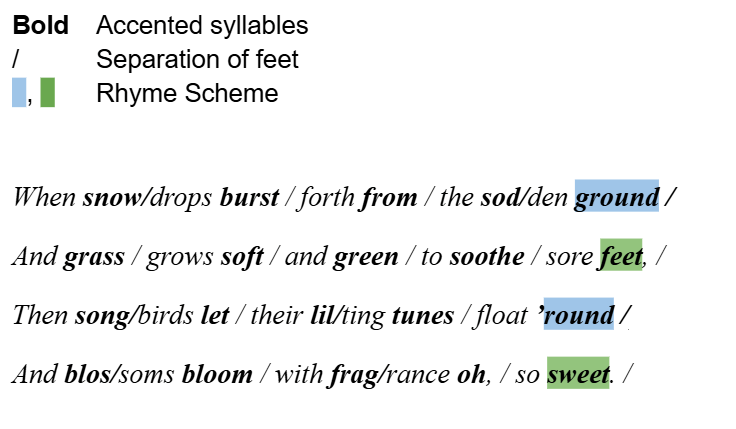
When snowdrops burst forth from the sodden ground

And grass grows soft and green to soothe sore feet,

Then songbirds let their lilting tunes float ’round

And blossoms bloom with fragrance oh, so sweet.

Then warm zephyrs bring hues of bright sapphire

To paint the somber skies aglow and clear,

And streams flow free, their sounds a distant lyre

To ease the rough, stiff banks of aged wear.

Yet, as the days pass by, the sky lours,

Remembering, ruminating upon

Those dreary spells of leaden, sunless hours,

Of bitter day and misty, weeping dawn.

But golden joy fails not to reappear,

Arousing souls, for each to her is dear.

~~~~~~~~~~~~

A Note on Shakespearean Sonnets 

Shakespearean sonnets consist of two quatrains (a verse of four lines) praising the subject. A third quatrain follows, portraying a different perspective, and the poem concludes with a couplet (a verse of two lines) displaying the poet’s final thought on the subject. These sonnets are composed in iambic tetrameter—five feet per line, each containing one unstressed syllable and one accented syllable, and have a rhyme scheme of ababcdcdefefgg. Every other line of each quatrain rhymes and so do the two lines of the couplet.

Stories

The Pilot Who Became an Ace in One Battle

by Emery Pugh

It was all fun and games playing poker with my fellow pilots until the alarms blared and I heard, “General Quarters! All hands to battle stations! Pilots, be ready to take off at a moment’s notice.” loud and clear on the speakers. I bolted from the pilots’ ready room onto the deck as the poker chips clattered to the floor.

It’s a perfectly clear day on February 5th, 1945, in the rolling Pacific, near the Solomon Islands. It seemed like just an ordinary day, but in war, anything could happen.

Guns blazed away at the sky. I squinted and followed the line of tracers (bullets) and sighted four objects dart between the clouds. I raised my eyebrows in surprise and my heart skipped a beat. Four Japanese kamikazes were headed straight towards our ship, the aircraft carrier USS Liberty Belle. The Japanese fighters were Mitsubishi Zeroes – fast, maneuverable, and deadly. However, the maneuverability of the Zero fighter had a caveat – its armor was little better than paper against the American F4U Corsairs, and the hundreds of pounds of bombs the Japanese planes were carrying nullified the advantage it had in maneuverability. The kamikazes intended to slam right into the ship, which would likely send the Liberty Belle to its watery grave.

However, the USS Liberty Belle was not an easy aircraft carrier to take down. At 850 feet long and 150 feet wide, it was a beast so large that it was sometimes mistaken as part of the skyline. The massive boilers and engine powered the bronze propellers, which had a diameter of an NBA basketball hoop, to push its gargantuan displacement of 25,000 tons of seawater. The massive aircraft carrier contained a variety of supplies (like fuel), weapons (bombs, torpedoes, and ammunition), personnel (over 2,500 total pilots, officers, and other crew), and planes (around 100) to function optimally.

One Japanese aircraft was hit by a bullet from a 5-inch turret, the largest gun of them all on the Liberty Belle with the farthest range. The doomed kamikaze spiraled into the sea, leaving a trail of smoke behind it. The Rising Sun on its left wing was the last thing to come to my eyes.

I quickly ascended the ladder to board my Corsair and slid the canopy closed above my head, strapped myself into the seat, and tuned the radio. I anxiously watched the enemy fighters hurtling towards the ship as the gunners put up a wall of lead bullets.

My plane, an F4U Corsair, is a sturdy propeller powered fighter-bomber with 6 wrathful machine guns (3 on each wing), capable of tearing through the armor of a Zero like butter. The Corsair was often recognized by its iconic wings – the inverted gull shape. It was almost like someone had smashed the wings with a long blade – the wing was bent downwards at halfway between the midway point of the wing and the fuselage (main body of the aircraft).

The radio crackled to life. I awaited orders.

“Attention, Corsair pilots. The enemy kamikazes are coming in hot, but the gunners should be able to take care of them. More bogeys [unidentified contacts on the radar] have been detected. Be ready to take off at a moment’s notice to intercept.”

A colossal explosion shook the sky. Shrapnel from the decimated enemy rained down and splashed into the ocean. Two down, two to go.

The remaining Japanese fighters started their ascent in preparation for a steep dive. The 40 mm cannons on the USS Liberty Belle started banging away. Another Zero was hit by a shell and exploded in midair.

“212, 213, 214, 215, launch now.” My number, 212, was abruptly called by the radio. “Five more confirmed enemies 30 miles distant, bearing 280 [horizontal direction: 0 is due north, 90 is due east, etc.].”

“Roger. Launching now.” I called into the speaker.

The catapults on the runway sprung forward, thrusting the wheels of my Corsair with tremendous force. My plane flew so fast that I was blind for a few moments after liftoff – all my blood had flowed to the back of my head. I experienced tons of G-forces, almost enough to render me unconscious. As soon as my vision was restored, I gently eased the control stick backwards (the control stick, often called just the “stick”, controls the aircraft’s tilt (up-down) and bank (right-left)). The plane turned slightly upward and I gained altitude alongside the other three Corsairs that had taken off with me.

Craning my neck to look behind me, I glimpsed the final kamikaze, ablaze like a bonfire, crash into the sea. I smiled, proud of the celebrating gunners on the ship.

Another command came through the radio. “Gain 10,000 feet of altitude as soon as possible. Engage at will.”

After cruising for a few minutes at around 200 miles an hour, I sighted an enemy Japanese kamikaze dart through the thin, gray clouds to my front-left. Immediately, I radioed back to command: “One kamikaze sighted.” The response was simple: “Copy that. Keep us updated.”

Soon after the first Zero, four more whizzed by. For a moment, everything seemed to fly in slow motion. We were flying parallel and in opposite directions, within two city blocks of each other. I could even see details like wear marks, bullet holes, and stains on the Zero.

Time resumed its normal pace. We raced past each other at breakneck speed.

I maneuvered behind the enemies and fired a burst of bullets from my machine guns. It was a hit – my target burst into flames and dived towards the ocean below. The pilot ejected and the parachute blossomed.

There were still four more kamikazes in front of me. I picked another target and squeezed the trigger, the machine guns roaring to life. To my frustration, I missed slightly high.

The enemy attempted to scramble away, but I fired again just in time. Several bullets struck the fuselage of the plane and went clean through. The Zero, however, continued to fly on. The pilot maneuvered sharply to the right, desperately trying to evade my shots, but I stayed on his tail through every twist and turn, continually firing a stream of .50 caliber bullets. One scored a lucky hit and exploded against one of his bombs, tearing the plane into shreds. I pulled backward on the stick hard, just enough to evade the shrapnel of the wrecked Zero.

It was my second victory today, but there was no time to celebrate. Bullets streamed right over my canopy – an enemy was on my tail.

I yanked the stick all the way to the left and held it there, causing my aircraft to barrel roll a full 360 degrees. The Zero’s inexperienced pilot dived downward, wrongly guessing my next move. Instead, my aircraft continued to veer to the left and climb at a slight angle, losing speed. The Japanese pilot realized his mistake and attempted to loop back around onto my tail, but he had overshot me and I had turned the tables– I was now on his tail. I pressed the trigger and more deadly rounds fired from my machine guns, several scoring hits. The pilot was forced to eject as his plane erupted into flames, spiraling down into the ocean.

The excitement was over – all five enemies had been destroyed by either myself or my comrades. I took the time to radio back to base: “Five confirmed kills total. I shot down three.”

“Good work. But be on the lookout, several more bogeys have been detected 50 miles out, 20 miles from your location.”

“Copy that. Low on ammo, but I will engage with all I’ve got.” I responded.

“Turn to heading [aka bearing] 350.” was the instruction. “We’re scrambling additional fighters to assist.”

“Roger, turning to 350.” I adjusted the radio and conversed with my wingmen: “Everyone, turn 350. More bogeys coming our way.”

In what felt like seconds, three Japanese enemies came into view in the distance to my left. Like last time, I maneuvered behind them and started peppering the planes with bullets. They immediately jerked into evasive maneuvers, but my aim was impeccable – one had been hit in the engine and the propeller had stopped spinning. The doomed fighter plummeted through the clouds into the sea.

My fellow Corsairs flew to my left and immediately started targeting the Zero on the left. The other kamikaze desperately attempted to escape by banking hard to the right, but I was one step ahead of him. I cut off his path and fired a burst of bullets that slammed into the tail rudder of the plane, shredding it and crippling the aircraft’s ability to swiftly swing side to side. Now, he was an easy target. I fired the rest of my ammunition at him as he slewed back and forth with his tattered rudder. I took the plane down with several shots to the fuselage, transforming it into a wreath of flames.

Out of the corner of my eye, I sighted the final Japanese kamikaze tumble uncontrollably towards the earth. Grinning with pride, I radioed back to the USS Liberty Belle: “All eight enemies destroyed… I’ve killed five. My wingmen took down the other three.”

“Congrats, you’re an ace now. Excellent work.”

As I turned back to the USS Liberty Belle, I suddenly began to feel exhausted as the adrenaline began to wear off. I realized what I had just done. In one battle, I had become an ace (5 enemy kills are required to earn the status of an ace).

I landed without trouble back onto the aircraft carrier. After later inspection, I found out that my plane had received no damage in that battle – not even one shot!

Science, Student Life

The Psychology of Stress

by Lucas David

Understanding stress is very important for a number of reasons, especially for teens, who experience comparatively high amounts of stress in their daily lives. For one, stress has a direct impact on your mental wellbeing, as it can cause you to feel overwhelmed or anxious, as well as causing difficulty concentrating, memory problems, and sleep changes. For another, it can affect your physical health by damaging your heart’s functionality, causing digestive issues, weakening your immune system, making it more difficult to sleep, and much more. It is also important to understand stress because it helps allow you to identify stressors in your life, recognize your bodies reactions to them, and develop methods to cope with them and manage your stress levels before they begin to affect your physical and mental health. Recognizing stress early on can help prevent you from developing health issues, and make them significantly easier to manage if they arise. This can lead to improved mental wellbeing, enhanced decision making, healthier relationships, greater productivity, and an increase in happiness overall.

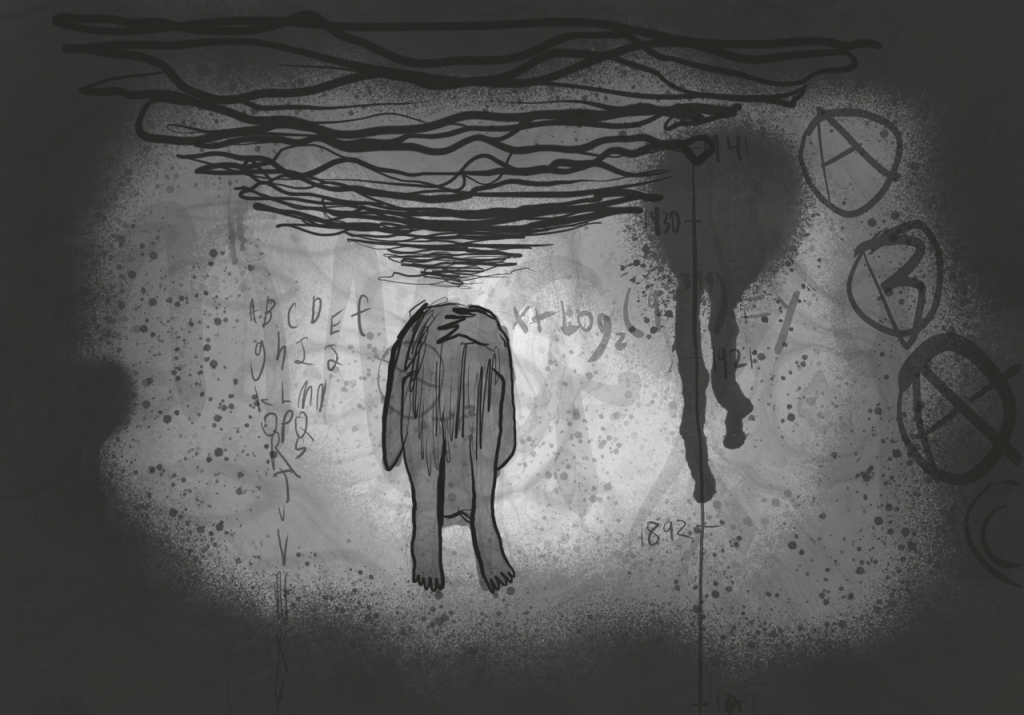
Image made by Lucas David

So far we’ve talked a lot about what stress does, but what is stress, anyways? Stress is a natural response to threats or challenges that involves both the mind and the body. It can help prepare you for the future, but too much of it can negatively affect your health. Stress is caused by significant events such as moving to a new home, beginning a new job, going through trauma or an onslaught of homework or illness. Very often, it is helped along by a perceived lack of control, a feeling of social isolation, negative thoughts or beliefs or poor coping mechanisms.

However, not all stress is bad for you. Good stress, or eustress, is a short term challenge that can motivate you to succeed and help you develop as a person by building resilience, developing life skills, helping to focus your energy, improving your performance and enhancing your sense of accomplishment. Bad stress, also called distress, is long term and can damage your health by creating anxiety, confusion, worsening your concentration and lessening your performance. To help monitor your stress to make sure that the majority of it starts with an eu, we need to talk about stressors. Simply put, stressors are stimuli that trigger a stress response in an organism. By monitoring which stressors cause distress, and which cause eustress, we can develop coping mechanisms to help alter our stimuli to suit our needs.

Coping mechanisms are behaviors or strategies individuals use to manage the negative effects of spending time in stressful situations. Some common examples of coping mechanisms include exercise, relaxation techniques such as deep breaths or meditation, social support, positive thinking, journaling, and focusing on what you can control. Most types of coping mechanisms can be sorted into one of two categories: Problem based coping, which involves trying to sort out the real-life source of the stressor, and emotion based coping, which involves focusing on dealing with the emotions that spring from the situation. Perceived control can also have a huge impact on a person’s ability to cope with stress because when a person believes they have agency, or the ability to affect a situation, their ability to cope with stress from that situation increases significantly.

Managing our stress is one way that we, as humans, attempt to chase happiness. What is happiness? Happiness is a feeling of joy, contentedness, satisfaction or well being. It is a complex, multi-faceted emotion that is influenced by many factors, including social and cultural norms, and is highly subjective, meaning that what makes one person happy may not make another person happy. Flow, and whether or not a person regularly enters what could be considered flow, can also have an influence on a person’s happiness because it is a state of mind in which a person is fully immersed in an activity, and highly focused and enjoyable.

For teens, Psychology Today offers some tips to keep stress levels low. For one, it states that having smooth communication with parents can make a large difference. That means being open and honest with your parents about your life and emotions. It’s also important to set realistic expectations for yourself, knowing that not only is it ok to fail at things, but it in fact provides opportunity for growth. Personally, I suggest setting and enforcing your personal boundaries with yourself and others, to help keep you from being pushed too far from your comfort zone.s

In conclusion, we covered a range of topics relating to stress and mental wellbeing, including stress itself, good stress versus bad stress, flow and the pursuit of happiness. We also learned that managing stress and understanding your stressors can be vital to helping to keep from becoming overwhelmed, as well as how our use of various coping mechanisms can have a significant impact on our daily lives. Many of us, as teens, are often heavily exposed to all kinds of stressors, from social situations to academics to family issues, and we must be self-aware to stay happy and healthy.

News

Julie Packard Retires

by guest author Jonathan David

Julie Packard, head of the Monterey Bay Aquarium in Monterey, California, has
announced her retirement. She is now a head on the board of trustees, so she continues
contributing to the Monterey Aquarium, while she “hands over the reins” as CEO. Here are a
few facts about Ms. Packard: Her favorite organism in the ocean is Giant Kelp. The reason for
this is that she researched seaweed ecology for her Master’s degree. She and the aquarium are
famous for taking care of orphaned sea otter pups.


“Early on, we got involved in rescuing and caring for orphaned sea otter pups, but it was
very difficult to keep them alive,” she shared with New York Times journalist, Franz Lidz. Under
Ms. Packard’s leadership, the aquarium is famous for allowing fully grown surrogate mom otters
to teach the pups. Ms. Packard further explained, “This was a breakthrough because, no
surprise, the female otter is a much better mom than a human trying to show an otter what to
do.”

As I wrap up this discussion, I will suggest that you be sure to watch the movie at the
aquarium theater, Luna: A Sea Otter’s Story. It will teach you all about the rescue of the orphan
pup otter, Luna. Please visit the aquarium and see its wondrous displays, from jellyfish that float
around the surface, to mysterious creatures that haven’t even been named yet! I’m thankful for
Ms. Packard’s work to conserve our oceans.

Stories

Life and Death – A Short Story

by Aleena Haimor

*For ages 10-18, for brief mentions of a kiss, and also death.

When I finally, finally muster the courage to even try to remember the past few days, I immediately regret the action as it hits me. No one is coming. I’m no more than a thin, sallow girl dying alone in the cold. How hard it was already, to survive with the raw ache of loneliness after he died, like a tender wound bleeding in my heart. And now, I have the deadly arctic snow and gale to bear through, the storm that rips and tears at my bare limbs like a blade. I have no will to live.

I’m nothing.

I never lead a happy life. Well, before, at least. I was left alone as a newborn, abandoned in a rickety structure near the sea. My powerful mind was too strange, and wrong, for my people. Although, I shouldn’t call them my people when they deserted me as they did.

Anyway, difference was not accepted. Even my family agreed, giving me over willingly to the elders, who then left me to die. Even though I never really knew those ruthless people, I somehow comprehended what my name was, only after hearing it a few times as an infant. It was Amara, and it means “grace.” Why did my family give me a name with such a meaning when they threw me away days later? They didn’t want me alive. I don’t even know how a helpless baby survived the wrath of nature. Yet, I did survive.

I grew up learning how to fend for myself. I watched the lions and rattlesnakes hunting. I remember thinking about how graceful they looked, catching their prey with ease. It was magical to me. I imitated their movements, killing with a spear instead of claws, with nightshade berries instead of venom. I killed my first buck at the age of ten, months, years, after living off plants. At the age of twelve, I already had the mind strength of an adult. 

Nevertheless, although I had powerful hunting skills and defense, and I had been alone all my life, I wanted someone to hold me. Someone to keep this lonely girl safe as she slept in peace for the night.

I was thirteen when I met the one person who had ever made me happy. It was a warm spring day and I had decided to take a break from my scavenging. The warm sun beat down on my face as I lay in an open field of violets, inhaling their fragrant scent. My eyes slowly closed as my tense body relaxed.

“Who are you?” an angry voice said.

I opened my eyes again. A boy in tattered shorts and no shirt on, maybe two years older than I was at the time, stood over me. He was glaring, with a dead doe slung over his shoulder. The first thing I noticed was how perfect he was. He was strong and well built, with a tan darkening his body slightly. I stared at his flawless form, shocked.

I was speechless for a moment before he repeated his question.

“Who are you?”

I mentally scolded myself and broke out of the trance. I answered in a soft voice.

“Amara.”

“Amara who?”

I closed my mouth and tried to ignore the pain in my heart. I didn’t have a family, least of all a family name.

“Just Amara.”

The boy, or should I say man, shook his head and rolled his eyes. He lay the doe on the ground and held the tip of his spear to my chest.

“What are you doing on my grounds?”

I put my hands above my head and sat up.

Sorry, but I need to eat too. And I had no idea that these were your grounds. What did you think? I’m all alone,” I said sarcastically, quickly getting annoyed with the tall boy I had just met. He threw the spear on the ground and held a hand out.

“Sorry. I’m Emmett,” he said, his voice taking on a softer tone. “I’m alone too.”

“It’s fine,” I said, taking his hand. He pulled me up. I noticed how beautiful his deep blue eyes were and my breath caught in my throat.

         “So…um…?”

“Wanna hunt?” he asked uncertainly. Well, that was quick, I thought.

“Sure?”

Emmett nodded and motioned for me to follow him. He lay the slain doe from earlier in a small hut he had built. Then we set off. He showed me all his best hiding spots, the places he would conceal himself from the animals, so they didn’t see that he was there.

         From then on, as we grew to know each other better, Emmett and I quickly became best friends. We relied on each other to survive and even thrive. I still remember how we used to laugh by the riverbank as we fished. He knew all the best jokes and for once, I was happy.

I didn’t think that life could get any better, but it did.

<><><><><><><><><><><><><><><><><><><><><><><><><><><><><><><><><><><><>

The snowstorm had just begun.  It wasn’t as brutal of a winter as it is right now, but it was close. 

Emmett and I huddled together in our cave shelter, trying to stay warm. I was fifteen by then. Emmett and I had known each other for two years, and we were just like siblings. Or so I thought.

He looked at me and I turned up to look back at him from his arms. Something switched between us, and I found him leaning in. His perfect face came closer and closer to mine. Before I knew it, his lips were on my own and his arms were wrapped around me. I blinked, then kissed him back. It was blissful oblivion for God-knows-how-long, just me and him, kissing. I never knew about kissing before he did it to me, but it felt so natural. So peaceful. That was the best moment of my life. 

Of course, because everything good in the world will end one day, my luck had to stop. A few months later, we were out hunting. A mountain lion prowled around us as we held our spears. Quickly, it cornered us against the mountain and pounced, aiming for me. Emmett yelled and jumped in front of me before I could be killed, losing his life in the process. As I watched his lifeblood spill onto the ground, anger overtook me and I stabbed the lion with my spear. After it was dead, I ran over to Emmett’s limp form and took his head into my lap. I held his hand as he made an effort to speak.

“Amara…”

His hand slipped from mine and I knew he was gone. 

I could not bring myself to get up for hours after. Fierce sobs wracked my body and made breathing almost impossible. But I knew after I had mourned for some time that I had to bury him.

I laid him to rest where we had first met, in the violet field. The grave was messy, but it had to do. I couldn’t let his body be ravaged by nature. I had to give him a proper goodbye. So I brought his body to the grave and said a prayer for his soul.

Oddly, I feel peace. And I realize why.

The pain is going away. I can feel myself slipping in the present, and my consciousness is dimming rapidly. I am ready. Nevertheless, I want to remember one thing before I die. One memory. Well, two, I guess. That blissful kiss, and my Emmett himself.

I close my eyes and fall.