by Sabine B.

by Sabine B.
by Sabine B.
Why is California so diverse? One reason is the abundance of different biomes and environments. The wide beaches and rocky cliffs of the coast regions border groves of redwood trees, oak woodlands merge into stands of fir and pine that give way to alpine meadows, and sage flats sprawl into sandy deserts. We have both the highest place in the continental US, Mount Whitney, and the lowest place, Badwater Basin. There are many different habitats in California which means there are a lot of different species.
There is another reason as well! The land along the coast of California is part of a biome known as the chaparral biome, and those oak woodlands I mentioned are part of it. This biome is one of the rarest biomes on earth and it provides the perfect environment for lots of unique species. It only exists on the western side of continents and only from 40 degrees to 30 degrees north and south on either side of the equator. It is found along the coasts of Chile in South America, along the coast of Australia, along part of the coast of Africa, along the coast of California, and, in probably its most famous occurrence, in the Mediterranean in Europe (the chaparral biome is the reason for that ideal ‘Mediterranean climate’). The chaparral has mild wet winters and long hot summers. Its rain cycle is one of the things that sets it apart from other biomes.
Due to its weather patterns, the plants of the chaparral have evolved adaptations that prevent drying out during droughts, and are fire resistant to protect against fires. The animals have adapted along with the plants. Because the chaparral zones are so far apart, and have such favorable conditions, and are so rare, species that settle in them often specialize to fit them. This means that chaparral zones are biodiversity hotspots. Those are places where more of the species living there are biologically unique than in other places. Just like in other biodiversity hotspots, California has many, many endemic species. They are found nowhere else in the world. Some of the species I will be sharing with you are found in only one or two counties in California.
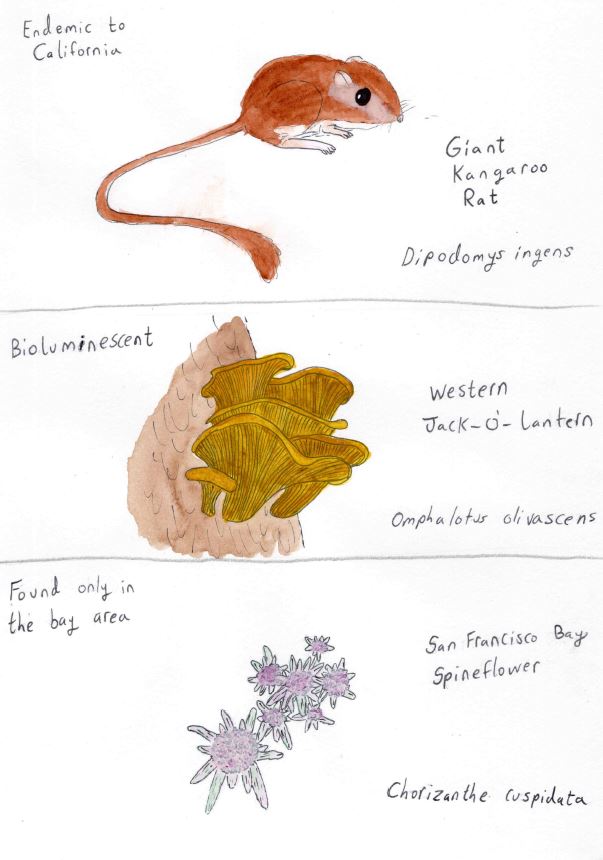
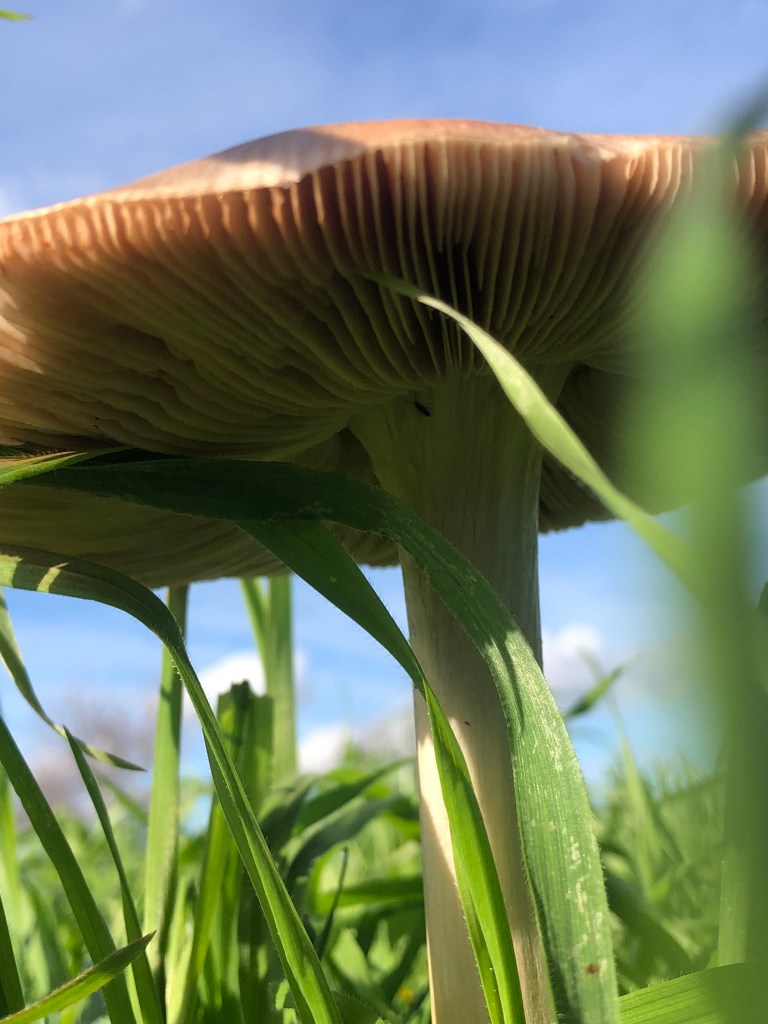
Every installment is researched and illustrated by me and will feature a native Californian animal, fungus, and plant. I will include the scientific name and the common name if there is one. I will also note something special about them. Feel free to look them up for more about them!
by Meru S.
When snowdrops burst forth from the sodden ground
And grass grows soft and green to soothe sore feet,
Then songbirds let their lilting tunes float ’round
And blossoms bloom with fragrance oh, so sweet.
Then warm zephyrs bring hues of bright sapphire
To paint the somber skies aglow and clear,
And streams flow free, their sounds a distant lyre
To ease the rough, stiff banks of aged wear.
Yet, as the days pass by, the sky lours,
Remembering, ruminating upon
Those dreary spells of leaden, sunless hours,
Of bitter day and misty, weeping dawn.
But golden joy fails not to reappear,
Arousing souls, for each to her is dear.
~~~~~~~~~~~~
A Note on Shakespearean Sonnets
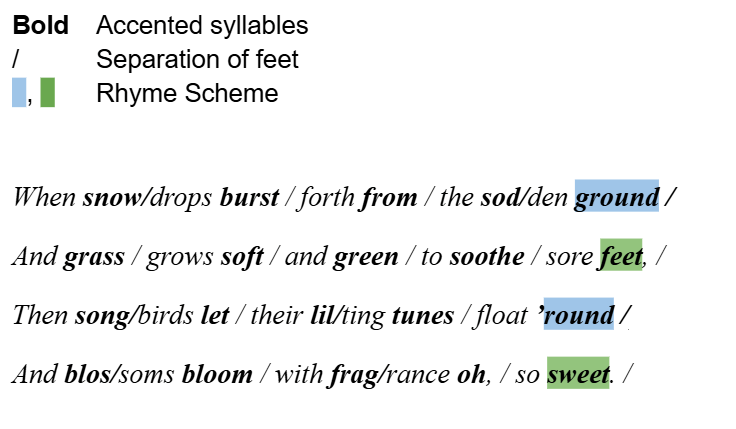
Shakespearean sonnets consist of two quatrains (a verse of four lines) praising the subject. A third quatrain follows, portraying a different perspective, and the poem concludes with a couplet (a verse of two lines) displaying the poet’s final thought on the subject. These sonnets are composed in iambic tetrameter—five feet per line, each containing one unstressed syllable and one accented syllable, and have a rhyme scheme of ababcdcdefefgg. Every other line of each quatrain rhymes and so do the two lines of the couplet.
By Hudson Ebach
The Concorde was a supersonic jet airliner, manufactured by Aérospatiale, British Aircraft Corporation, Sud Aviation, and British Aerospace. It was made in 1976 and was retired in 2003.
About The Concorde.
The Concorde went speeds up to Mach 2 (over 1500 MPH), making it the fastest airliner to have ever been built. It was so fast that if you left London in the afternoon and flew to New York, the passengers would see the sun rising again! It flew faster than the earth’s rotation!
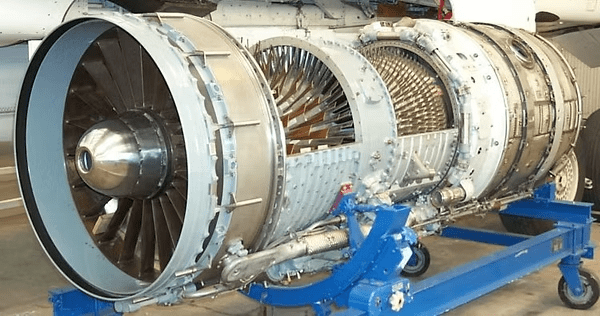
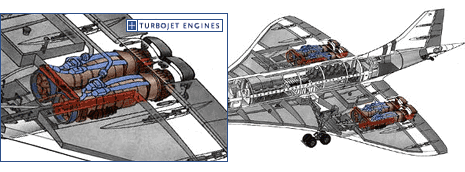
The engines, Rolls-Royce/Snecma Olympus 593 (Thanks google!) were turbojet engines. These engines (turbojet type) would eject a high energy gas stream from the engines exhaust nozzle. They were placed on the back of the Concorde’s wings.
The Concorde’s wings were different from the ones you would see today. Most airliner wings don’t connect through the whole fuselage, however “…the Concorde’s wings were triangular. And there was no space between the fuselage and the wing of the Concorde as there was in a standard passenger airliner. The Concorde’s wing was called a ‘delta-wing’ design and did the following: Reduces drag by being thin and swept back (55 degrees with the fuselage) [and] provides sufficient lift for takeoff and landing at subsonic speeds.” (courtesy of HowStuffWorks). So, just like any other plane, while unique, the Delta Wings were an important part of the Concorde.
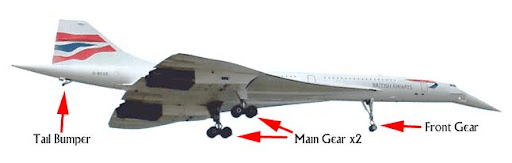
Another thing that made the Concorde unique was its landing gear. The landing gear was standard, similar to other airliners which only have three landing gear parts that come down. However, on the Concorde, there were four separate parts, two on the side, one on the front, and one on the tail. The reason for the “Bumper” landing gear was because the Concorde landed at an 11-degree angle, caused by the Delta Wings.
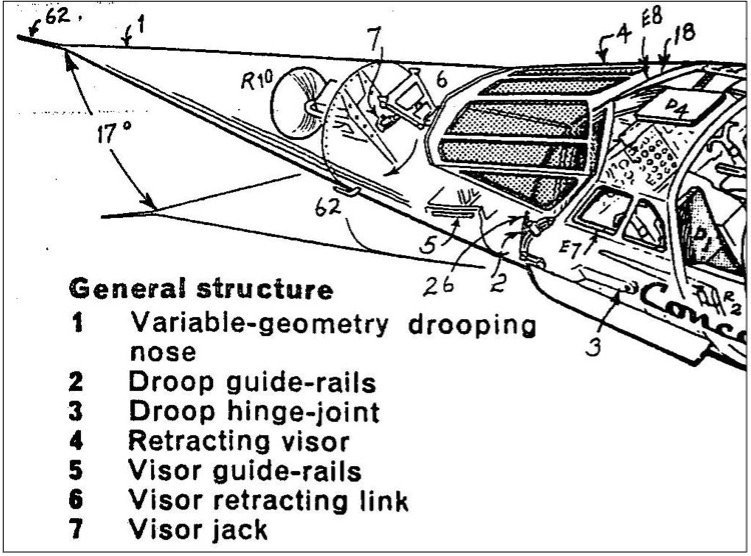
With the Concorde landing at an 11-degree angle, the pilots couldn’t see the runway while taking off and landing. To fix this issue, the nose of the Concorde would move down at a 5-degree angle during takeoff and a 12.5-degree angle while landing. This movable nose (Called the Droop Snoot) was one of the most well-known things about the Concorde. The Droop Snoot is one of the things that make Concorde one of the most well-known airliners today.
The Downfall of the Concorde.
Remember how I said, “the Concorde went to speeds up to Mach 2.”? Well, a plane that goes Mach 2 is expensive. Not that expensive, only about ONE BILLION DOLLARS. A standard A320 Is only about $10,000,000. But not this beast, you could probably fill a whole Olympic swimming pool full of Peanut Butter with One Billion Dollars. Maybe 2 pools. But the big whammy was a thing that would guarantee it shutting down.
The End of the Concorde (and Hôtelissimo Les Relais Bleus)
It’s July 25, 2000 and Air France flight 4590 is about to taxi onto Runway 26 from Paris Charles de Gaulle airport. Just before that, a Continental jet had just taken off or landed, and during that process it lost a titanium alloy strip, leaving it on the tarmac. Flight 4590 lined up on the runway with 2645.55 pounds of taxi fuel left, which was supposed to be burned off before takeoff. At this point, there were lots of red flags but ATC gave Flight 4590 the clearance for takeoff and started taking off. Everything was going fine, until one of the Concorde’s tires ran over the titanium alloy strip. The tire then exploded, shooting a piece of rubber into a fuel tank. Unfortunately at this point the leftover taxi fuel exploded in a fiery mess. The landing gear got stuck and being past the takeoff bail mark, the pilots had to take off with a fireball on the rear of the plane.
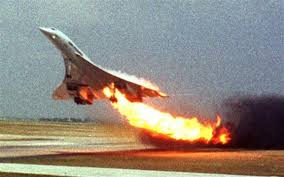
So, at this point the flight is in bad shape and unfortunately it is going to get worse. Flight 4590 then tried to get to a high enough altitude to land the plane. They only got so high and then started descending, right into Hôtelissimo Les Relais Bleus. 103 people died in the plane. Four died in the hotel. This was a major cause of the downfall of the Concorde.
The Concorde had its last flight on November 26, 2003.
Should they bring back the Concorde?
In my opinion as an Avgeek, yes. But as a person who thinks “normally”, no.
The Concorde cost way too much and was a ticking time bomb. Any plane that needs a nose that moves to see the runway seems like a bad idea.
With that said, the Concorde was just a glimpse of what aviation is. Just to show what humans can do. In closing, I, Hudson, want to state, bring it back! We can make it safer and better!
by Hudson Ebach
BeamNG.Drive is the best driving game I have ever played in my 7 years of playing games. It is my go-to car game for many different reasons that I will talk about here.
I first found out about BeamNG.Drive when I was just 4 years old and came across a YouTuber playing the game. He was smashing cars and doing police chases with the AI. At that moment, watching him playing it, I felt a spark. Like a voice telling me, “Yeah, you need this game.” Fast forward to a couple of years later and I had it to enjoy myself!
The game was originally a website that you would visit and could drive a truck in a Gridmap (that is simply the name of the map). The developers posted their first video on YouTube showing their website. It was HUGE. Everyone was so impressed by the realistic Soft Body and driving physics of a website. Eventually, BeamNG.Drive started to make some big changes, including adding cars, maps and more. This was exciting for the community of players. Next, it became a downloadable game you could purchase.
The game play for BeamNG.Drive is unique to other car games that I have played and is one of many reasons why it is my favorite. The first time playing the game it might seem like a standard sandbox style car game. You spawn into a world, and you see a simple truck. Well, the truck itself is more complicated than you would think. Inside the truck is a bunch of J Beam Nodes (Nodes are masspoints and the core of the BeamNG physics, according to their website) that make the truck act like a standard truck would. The truck has a normal interior: seat, steering wheel, pedals, etc. The only thing missing is a driver which makes smashing into the side of a building safer and more fun. Also, it is not just one truck you can drive; what makes BeamNG.drive so enjoyable is a wide selection of cars, trucks, trailers and many variations of these vehicles.
Along with the vehicle options, maps are another part of BeamNG.drive that makes it special. West Coast USA is a city map based on California cities and highways, just to give one example. Their map files are smaller, so it runs smoothly while playing.
The AI is a standout feature of the game that helps make it feel immersive. You can feel as if you are actually chasing a Gravil-H series (one of many car options) with a Police Package Gravil Grand Marshal. The AI continues to enhance the game experience, if you are getting bored driving by yourself. There are multiple ways to use AI and bust that boredom!
As if that is not enough, there are mods. The mods are a big part of the BeamNG.Drive community. Mods can include cars, maps, accessories, and much more. It keeps the game exciting with new features.
BeamNG.drive is the perfect way to experience a car game with good crash physics which is unlike other racing games. The work that the developers put into making this game, along with mods from the community of players, is so impressive and fun. I highly recommend BeamNG.Drive to anyone interested in car games or gaming in general.
Howl’s Moving Castle is a book by Diana Wynn Jones, which was turned into an animated movie by Studio Ghibli. It has many philosophical sub-themes, and hidden meanings. It is not your average kids movie. When you first watch this masterpiece, you will probably find it unusual, strange, or even insane. Nobody knows exactly what the author of the book, Diana Wynn Jones, or the director of the movie, Hayao Miyazaki, were going for with these hidden meanings, but many have come up with some very interesting theories.
The Castle:
A popular theory about the castle is that it symbolizes Howl’s unwillingness to settle down. It’s a bit strange, but the castle and Howl are kind of the same. It is powerful, but it appears to be disorganized and on the verge of falling apart, a lot like how Howl is crushed by the weight of his burdens, and can collapse at any moment. The state of the castle changes near the end of the movie, and stabilizes, mirroring Howl’s change.
The Curse:
In the beginning, Sophie is a young girl working all day, not having fun like other girls her age, and overall acting like an old lady. Because she is the eldest of three, she feels the need to work all day, and every day in her father’s hat shop, and one day take over. She has no life outside of the shop. When she was put under the spell, she didn’t fight it. She just accepted it. I believe that the curse reflected the age of her soul. The more she fell in love, and felt young, the younger she became. In other words, the curse is a metaphor to how Sophie feels on the inside. Whenever she would feel confident and passionate, you could see a glimpse of her youth. That’s why her age kept changing throughout the movie. In the beginning, she enjoyed a quieter, slower life. It was only after she became an old woman that she realized that life is too precious to waste.
Sophie’s Hair:
Why did Sophie’s hair remain grey? A common theory is that the curse never truly went away. Maybe a hint of the magic from the curse made it the color of “starlight”. On the other hand, it could represent her life experience. Maybe the wisdom that she gained on her journey caused the grey in her hair to remain. Her entire personality did not change. Just her experiences.
Time Travel:
Sophie went back in time and saw young Howl and Calcifer. She said “Find me in the future”. Howl, as a child, remembered and began a journey to find her. He recalled her as the most beautiful girl in the world. In order to find her, he began searching, and decided that he had to look “beautiful” himself in order to seduce beautiful girls so he could eventually find Sophie. This is why he was so sad during his hair crisis. He thought he was not attractive enough for his questionable methods. Furthermore, he seduced the Witch of the Waste because he thought she was beautiful, but left her when he found out she used spells to keep herself looking pretty.
Howl’s Curse:
Howl’s curse was the contract he made when he traded his heart to Calcifer so he could gain power. Without a heart, he slowly becomes emotionless and inhumane. Sophie was the only one who could break the curse, which is what happened after he fell in love with her. Since Calcifer is technically Howl’s heart, when Sophie came into the castle it was as if Howl was letting her into his heart. Also, many rumors stated that Howl “ate” women’s hearts. In reality, he didn’t “eat” them. He broke them.
If you haven’t already read the book (or seen the movie), it is highly recommended that you do. Prepare yourself for the adventure of a lifetime as you travel with Sophie Hatter to a moving castle with a handsome wizard, and a “scary”, powerful fire demon.

As we walk through the woods,
we try with all our might
to make memory of this beautiful night.
For we stand under the stars of the sky.
We talk til day has come,
and sun has risen.
As we walk through the woods,
I can’t help but grieve.
For it is a time of sorrow,
a time of loss,
a time of death,
a time to mourn with what’s left.
But the war is over,
the war is won.
We have battled the last battle
and we have won!
Peace has fallen, ground is regained.
Plants regrown,
buildings rebuilt,
as we walk through the woods
By guest author Jonathan David
by Lucas David
The book, The Martian, by Andy Weir, is packed with many kinds of science, but psychology is one of the less explored sciences of the book. However, though the author does not emphasize psychological processing as a theme, it is clear that he did put time into thinking of the psychological aspects of the book. One example of this is how the protagonist, Mark Watney, behaves as he traverses Maslow’s Hierarchy of Needs.
For those unfamiliar with Maslow’s Hierarchy of Needs, it is an idea proposed by Maslow of the five levels of human needs that humans usually pursue in order. Near the bottom of the hierarchy, so the first in the order, are physiological needs, such as food, water, shelter, and sleep, followed by safety needs, like employment, health, and property. Next are emotional needs, such as friendship, family, intimacy, and a sense of belonging. The last two levels are esteem, meaning respect, freedom, and accomplishment; and self actualization, which is the desire to reach one’s full potential in life.
Before the storm comes and Watney is struck by the satellite dish, he is attempting to achieve historical and scientific accomplishment. The moment that he wakes up after he was struck by the satellite dish, the first things he thinks about are his physiological and security needs. Once he is back inside the shelter with access to oxygen and has treated his wound, he then begins thinking about food and water.
Watney spends a great deal of his time focused on attaining food and water. Once he has figured that out, we see him psychologically begin to move back up the pyramid of needs in his desire to reach out to humanity. While technically he needs people to maintain his physiological needs, we also see that he has moved up a rung on the hierarchy of needs in that he is motivated to be in contact with other humans and to be reunited with his family.
Near the end of the book, I believe that Mark Watney begins demonstrating signs of desiring accomplishment and fulfillment, even though his focus is on returning to his family and staying alive. We are seeing hints of him wanting to accomplish something significant and memorable, even though he hasn’t yet completely returned to safety. Despite the possibility of him not surviving the journey home, he is still wanting to connect with and reassure his loved ones. We see this with the note that he leaves for his family via a colleague.
Immediately after his space launch home, he ends up floating through space, trying to stay alive again. It seems that just as he was finally returning to his peak psychological status, he has dropped all the way back to the bottom of the hierarchy again, as he desperately fights to stay alive.
Overall, Mark Watney experiences a psychological roller coaster ride throughout his extended stay on Mars that reflects Maslow’s established Hierarchy of Needs.

 The Lighthouse