

Subscribe to continue reading
Subscribe to get access to the rest of this post and other subscriber-only content.
Subscribe to get access to the rest of this post and other subscriber-only content.

May the 4th be with you! Today, May 4th, is the official, annual Star Wars day! Star Wars is a popular movie series, and, personally, one of my favorites. There are three movie trilogies: The original, the prequel and the sequel.
Here are synopses of the three trilogies:
1. The Original Trilogy
The original trilogy follows the story of young Luke Skywalker, his twin, Leia Organa, and a scoundrel, Han Solo. Obi-Wan Kenobi, a Jedi Master, tells Luke about his destiny. Luke and Leia’s father, Darth Vader, became an evil Sith Lord when he was drawn to the dark side of the force. The trilogy is about how Luke finds his place, and finding out that Leia is his twin, telling her she was gifted with the force.

2. The Prequel Trilogy
The prequel trilogy is set before the original trilogy, even though it was released after. It is the tale of how Darth Vader, who was once Anakin Skywalker, became evil. Anakin’s wife, Padme, dies while giving birth to Luke and Leia, and Anakin is blinded by grief. He turns to the whisper of the dark side, trying to keep Padme with him.
3. The Sequel Trilogy
The sequel trilogy takes place after the prequel and original trilogies. Years after the events of the original trilogy, Luke goes into hiding, for he blames himself for Leia and Han’s son Ben, also known as Kylo Ren, turning to the dark side. Rey, a scavenger and the main character, ends up with the Resistance, a small force trying to defend against the First Order, a dark group with evil intentions.

This Star Wars Day, there are many fun things you can do to celebrate all things Star Wars! Here is a short list:
1. STAR WARS MOVIE MARATHON!
Why don’t you take the time to relax with your family, and have a Star Wars movie marathon! You can sit back and relax on the couch, all while enjoying the Star Wars movies!
2. MAKE SOMETHING!
Whether you make, bake or create it, a fun craft goes a long way. Try making a Star Wars Cake or a paper banner. You could even make a diorama and recreate your favorite scenes!
3. DRESS UP!
Third and final, you can simply dress up! No matter if it’s already made or DIY, costumes help to show your spirit. Try doing your hair like a character, or using a black sheet as Darth Vader’s cape!
These are all great options for celebrating Star Wars Day! I hope you take some of these suggestions to make your day amazing! Remember, you don’t have to be a certain age to love these movies, because they’re for everyone! Happy Star Wars Day, and May the 4th be With You. Always!

by Guest Author – Mila Martinov
I wrote this article because, as you know, I love sea creatures. They are so cool! I hope you like this article and enjoy the fun learning. Last time, I wrote about jellyfish. Today, I want to tell you about the coolest mammals in the sea.
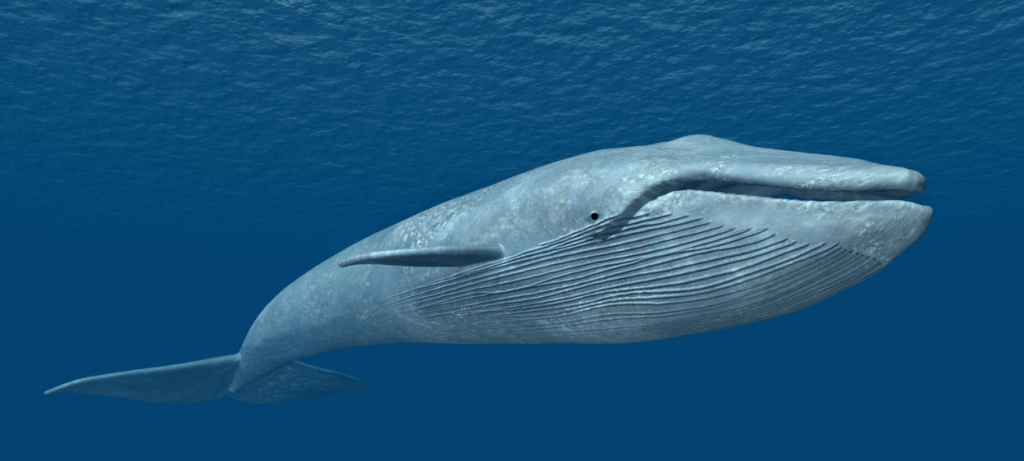
1. Blue whale (prettiest of them all)
This whale is the biggest animal ever. A Blue Whale is about the length of a medium-sized airplane. Despite its size, the whale eats tiny krill (krill is a small shrimp-like animal that is incredibly tiny). A Blue Whale eats millions of them per day. To catch its food, the Blue Whale goes through a large group of krill with its mouth open. The krill flows into it. As the whale closes it’s mouth, the water flows back out to the sea through the gills, but the krill stays inside.
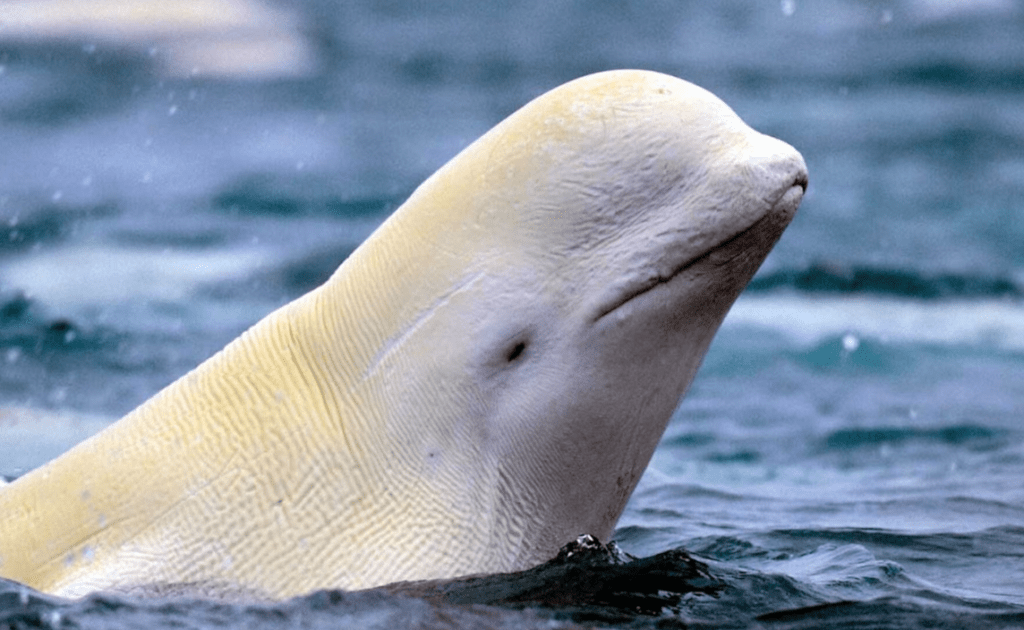
2. Beluga whale (my personal favorite)
Beluga calves (babies) are born gray in color. Belugas don’t turn white until they are a few years old. Beluga whales live in the Arctic (the coldest place on earth). Large pods of beluga whales travel south until they find open water. Since Belugas are mammals, and breathe air, they swim to the surface to take a breath. They can’t stay under the ice for too long, or they will drown. The Beluga whale is the length of two twin beds. They eat fish, crabs, squid, octopus and mussels.
3. Narwhal (the unicorn of the sea)
A Narwhal sucks its food into its mouth. Since the narwhal has only two teeth, it can’t chew. One of those teeth is a long tusk that sticks out of the upper lip. It looks like a unicorn horn. A female narwhal can grow a tusk, but it is not very long. A male’s tusk is as long as three baseball bats put together. Two male narwhals sometimes use their tusks to “sword fight”. Some scientists think this helps narwhals find out who is the strongest.

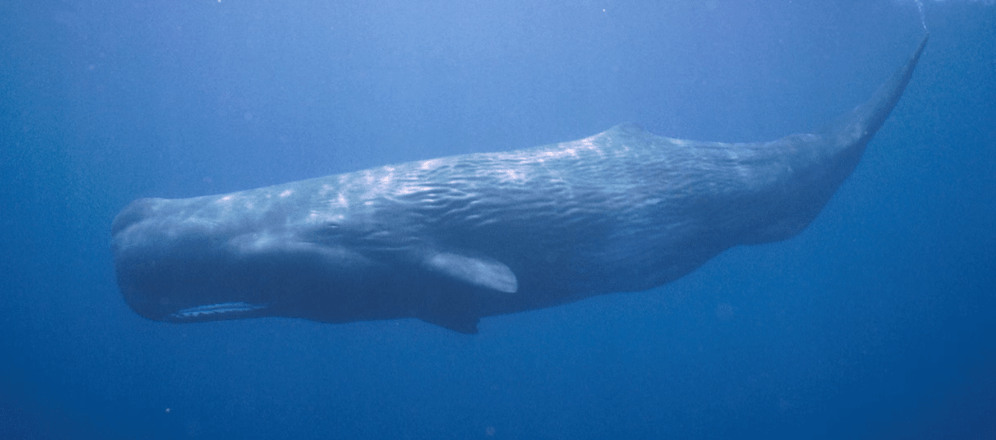
4. Sperm whale (the funny looking one)
Sperm whales live everywhere, except the freezing north and south poles. They are 65 feet long. With their very large teeth, sperm whales eat squid, sharks, and fish. They have very wrinkled skin too. Sperm whales can swim up to 9,800 feet deep below sea-level to find food. In fact, their habitat is located in deep water. A male sperm whale is longer than a female, and they have huge heads shaped like squares.
5. Humpback whale (the bumpy one)
Humpback whales do not have teeth. They have baleen instead (baleen are little fluffy things that hang over the whale’s mouth). A humpback whale opens it’s mouth and small creatures flow in with the water. When the whale closes it’s mouth, Baleen blocks the exit. The humpback whale uses its tongue to push water out through the baleen. The baleen pulls the water out and the food stays inside. Then, the whale swallows.

I love sea creatures, and am very happy to have shared these facts with you. I hope you enjoyed reading this. You should go whale watching someday. It’s very fun.
Sources:
“Ocean. The Definitive Visual Guide”, Fabien Cousteau, Rob Dunn, Isobel Comley
“National Geographic Kids: First Big Book of the Ocean”, Catherine D. Hughes
“National Geographic Kids: Little Kids First Big Book of Animals”, Catering D. Hughes
by Olive Pea
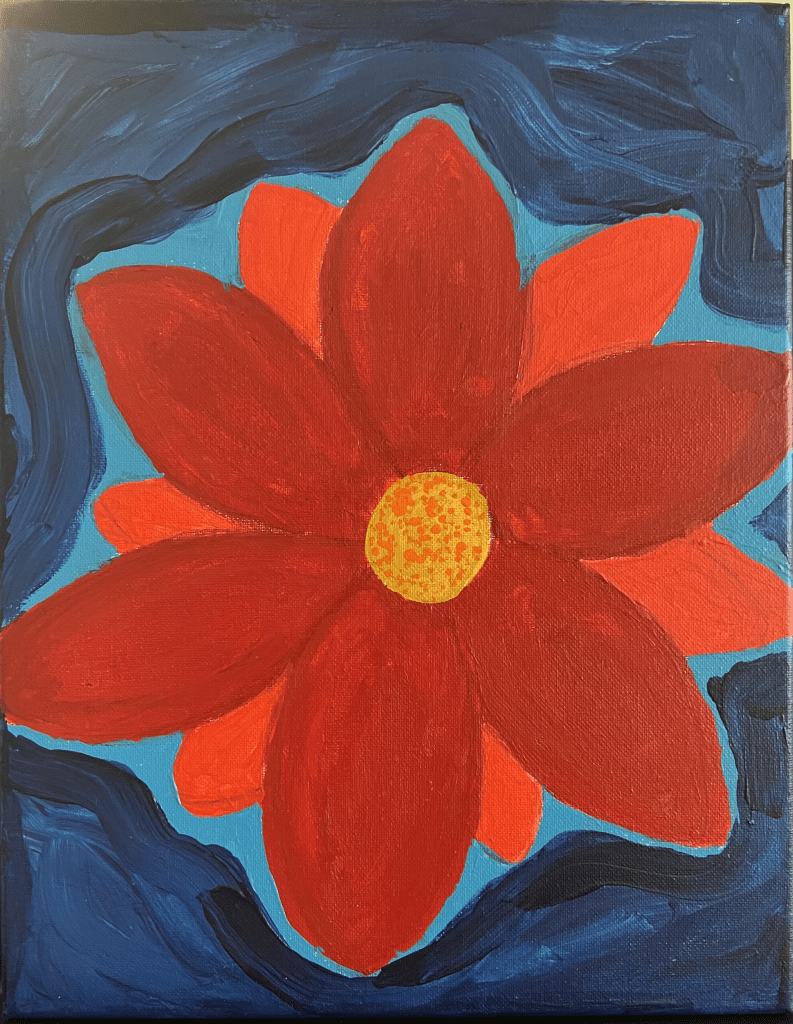
We are already halfway through spring! There are so many colorful flowers in bloom. In fact, there are so many flowers in bloom that this spring was officially announced to be a Super Bloom, the first Super Bloom since 2019. So many flowers! It is starting to feel a little bit like summer already! Before we fully get into summer though, it is predicted that we are still going to get a few more “spring showers” in the near future. All the better for the flowers! Speaking of flowers…
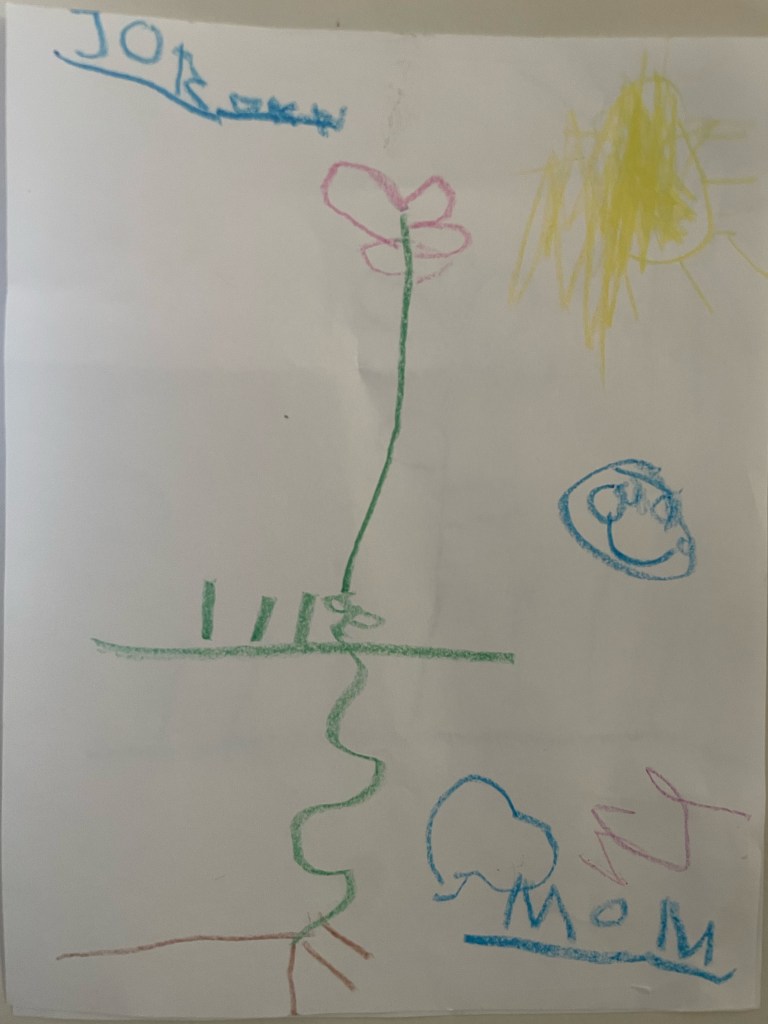
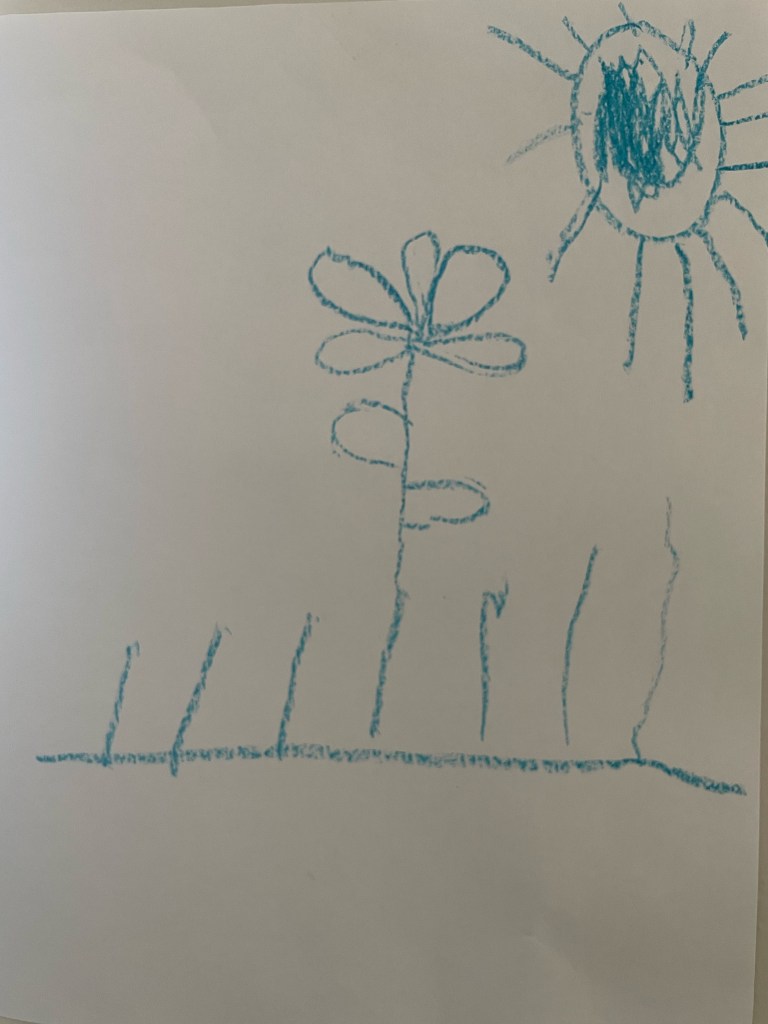
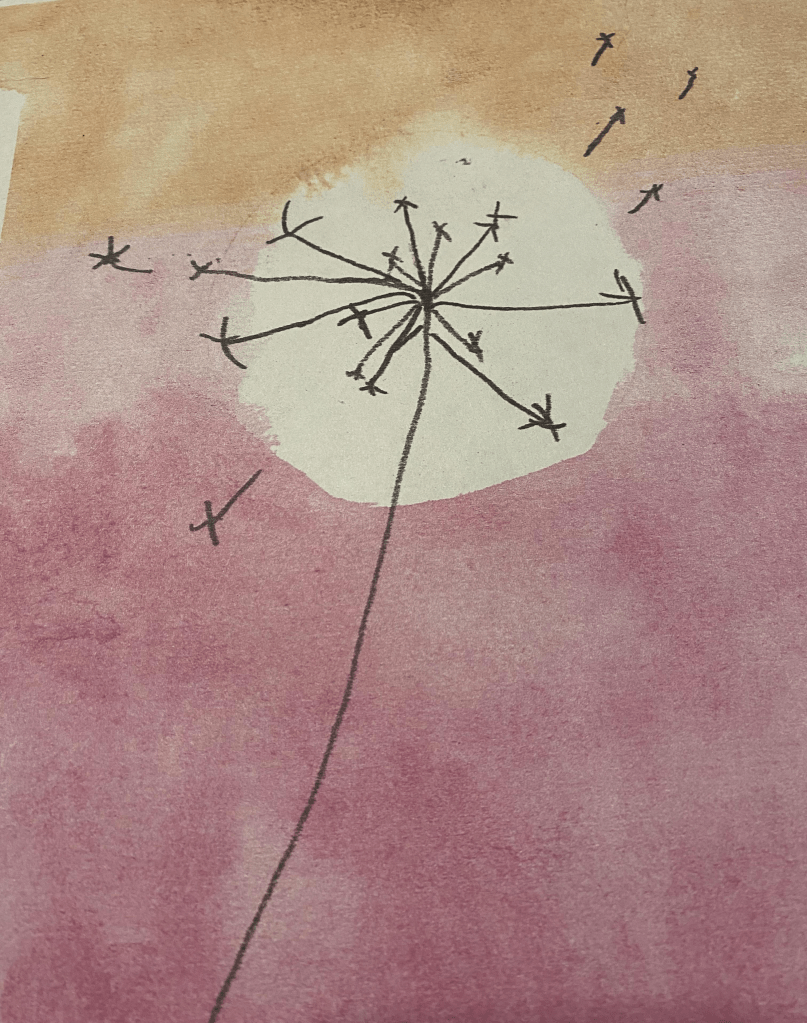
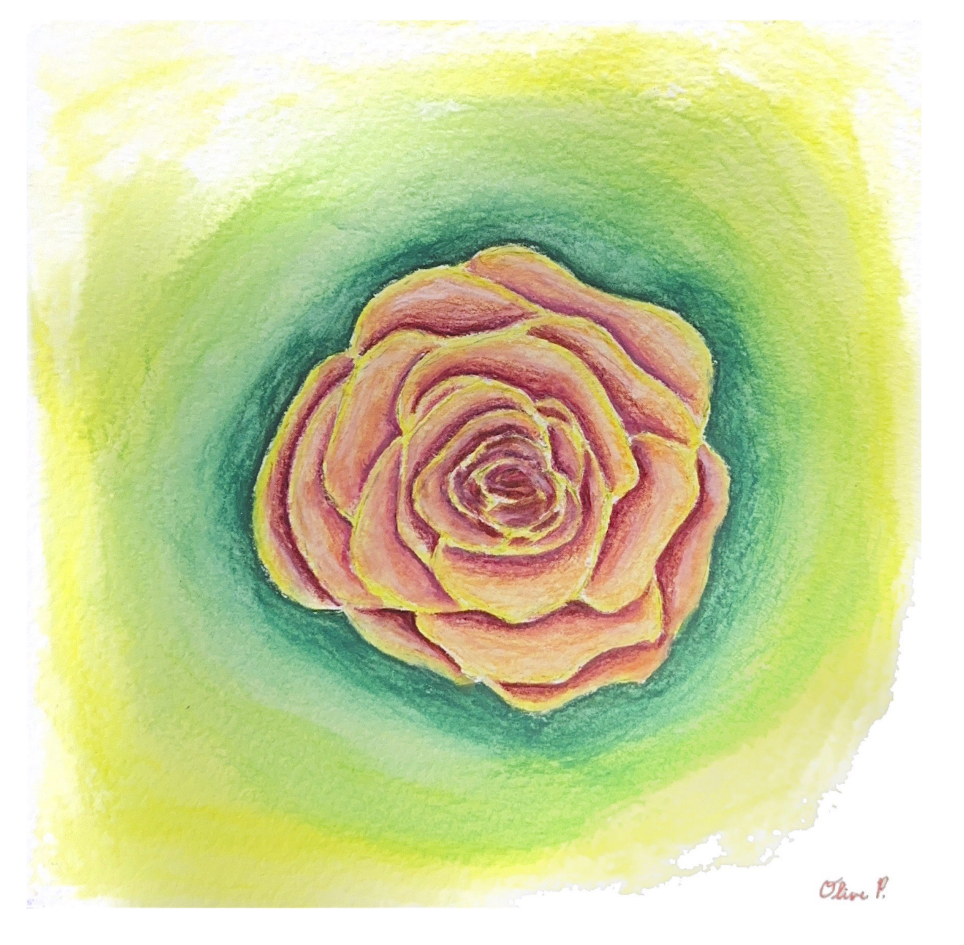
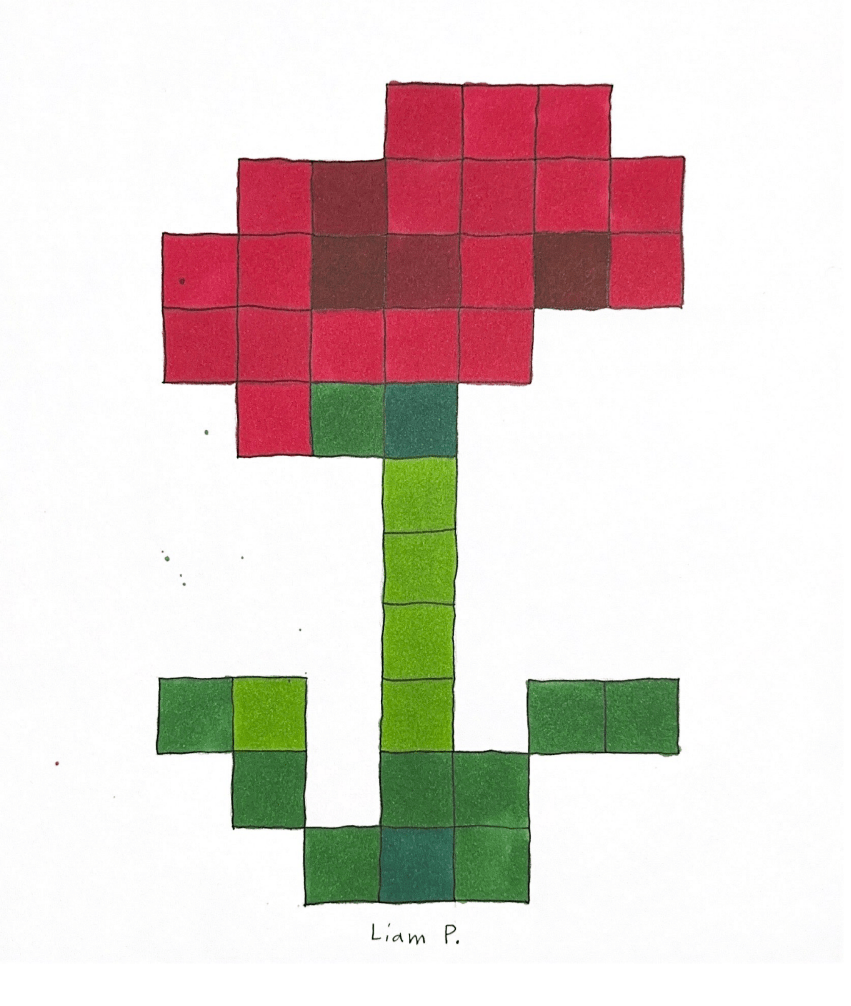
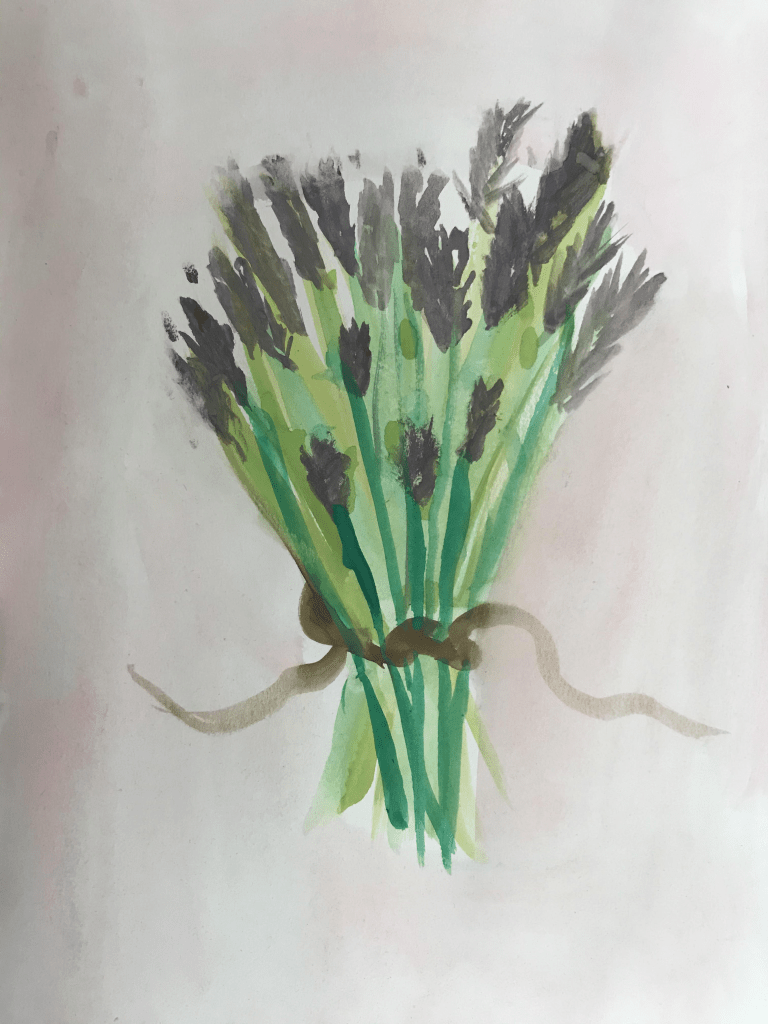
Two months ago we gave you a spring themed art challenge! The challenge was to draw, paint, sketch, etc. a flower of your choosing. We received (3) submissions! (Also a few from our staff). Here they are:
Jordan Olson, age 6
Maria K., age 10
Thank you all for sharing such wonderful artwork with us! We really appreciate you and your talent.
Here is some art made by a few people on our staff:
This is the last official publishing of the Lighthouse, although we will be covering two future events that land just out of our last publication. These events are the Teen Formal (May 6th) and the Promotion and Graduation Ceremony (May 24th). Even though we do not publish through the summer, you can still reach out to us thelighthousetve@gmail.com if you are interested in joining our team. You can also ask us questions right from the home page.
It’s finally time for Summer vacation! It’s that time of year when most families go on a fun vacation. Whether it is by car, boat, train or plane. Getting to the destination takes a while, especially when there’s nothing to do. I would know, because I have traveled many times. Once, I was sitting in my plane seat, staring out the window in boredom, until my mom gave me a sticker book. I spent a lot of time using it, and the time flew faster than the plane.
Printouts
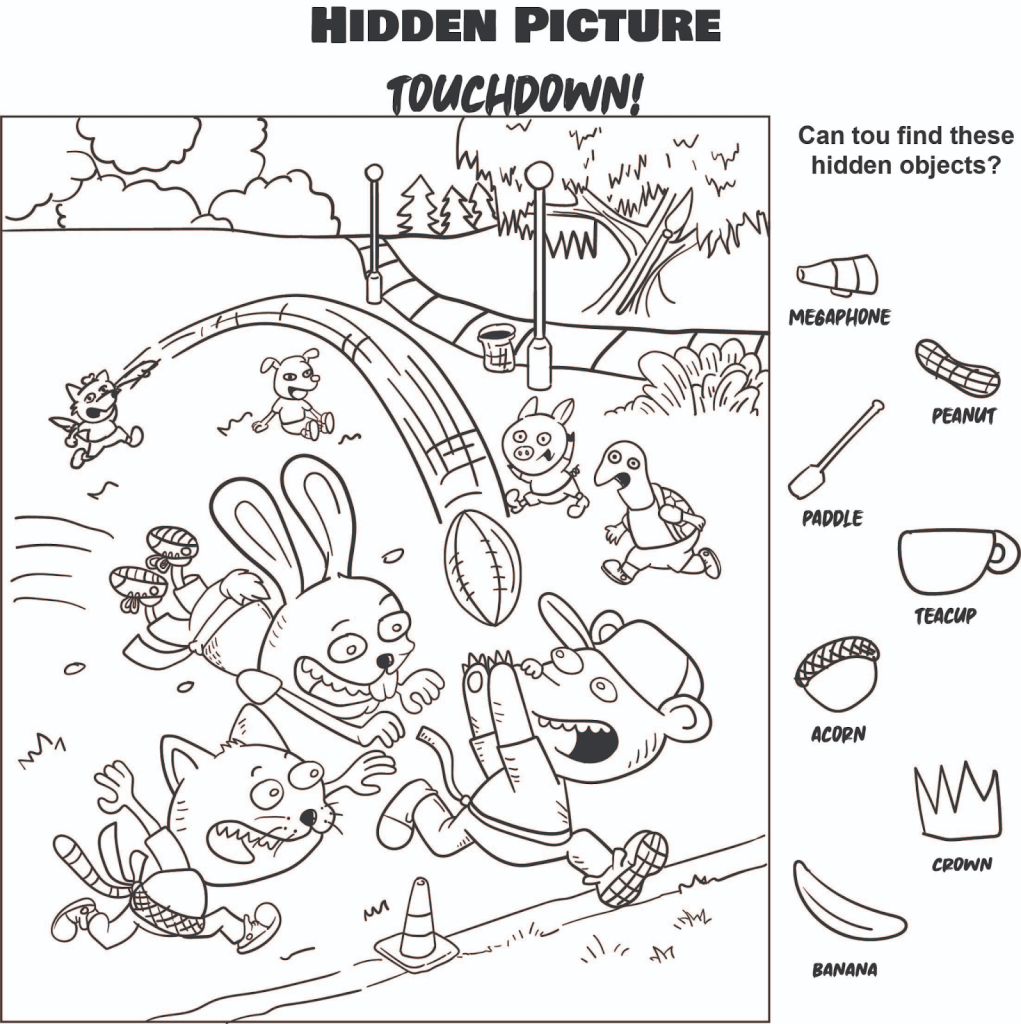
Printouts are very easy to transport, and very fun to use. From mazes to crafts, printouts include a variety of fun activities to do. Another great thing about them is that you only need to print them out instead of rushing to the store and spending lots of money on toys, or expensive things that take up lots of space, and are probably only going to be used once.
If you have a younger sibling about 2 to 6 years old, then I recommend Sago Mini printouts at
https://sagomini.com/printables/
If you have an older family member that’s about 6 and up, then I recommend Highlights printouts at:
Mad Libs
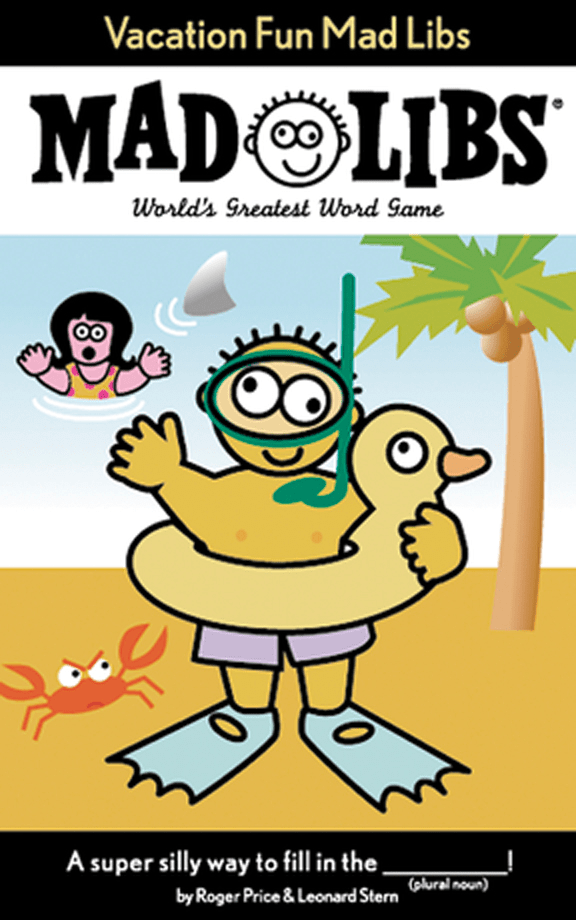
Mad Libs is a favorite for everyone. A great thing about it is that it is portable, and easy to travel with. It’s also fun for the whole family. Mad Libs is a book, and each page has a story where the players have to take turns filling in the blanks. Once all the blanks are filled in, one player reads the story aloud. Usually, the outcome is hilarious. After the trip, kids can play Mad Libs with their friends. Another excellent thing about Mad Libs is that it is the perfect way to practice grammar skills. It’s easier to remember what an adjective is when you have fun learning about it. Mad Libs is also good for hours of laughter. For example, the Little Red Riding Hood probably didn’t have a chair as a hat.
A very popular choice would be this Mad Libs:
If a larger one is preferred, then this one is best:
Movies!
An incredibly popular travel activity is to watch a nice, long movie. Many people keep “Movies to-watch” lists, and traveling is the perfect time to utilize them. Downloading some movies on an iPad, or phone through Netflix, Disney+, or other “on demand movie” apps is a good way to plan your movie-watching ahead of time.
If you need assistance on deciding which movies you would like to watch, I wrote an article in the past with 12 ideas:

Table Topics
Table Topics are cards that come in a small box. Each card has a question on it to ask your family. For example, “What was your all time favorite vacation?”. This is a great bonding experience that gets family members to share interesting facts about themselves. Most people believe that they know everything there is to know about their family, but this game can prove those people wrong. An awesome thing about Table Topics is that they come in packs for specific events. There is a Table Topics pack for dinner parties, road trips, family time, and more.
Table Topics travel:
Table Topics family conversation pack:

Sticker Books
Sticker books are great for children who need a fun activity, and they help little ones improve motor skills. Older kids can have fun with them too. Sticker books can be very cheap, and they come in travel packs. The best part about sticker books is that there are so many varieties. There are “Paint by Sticker” books, jelly sticker books, character dress up books, and more!
If there’s a toddler in your family, I recommend Reusable Jelly sticker books:
Make-a-Face sticker books are suitable for kiddos 3 to 6:
Paint By Sticker books are very popular for kids ages 6 and up.
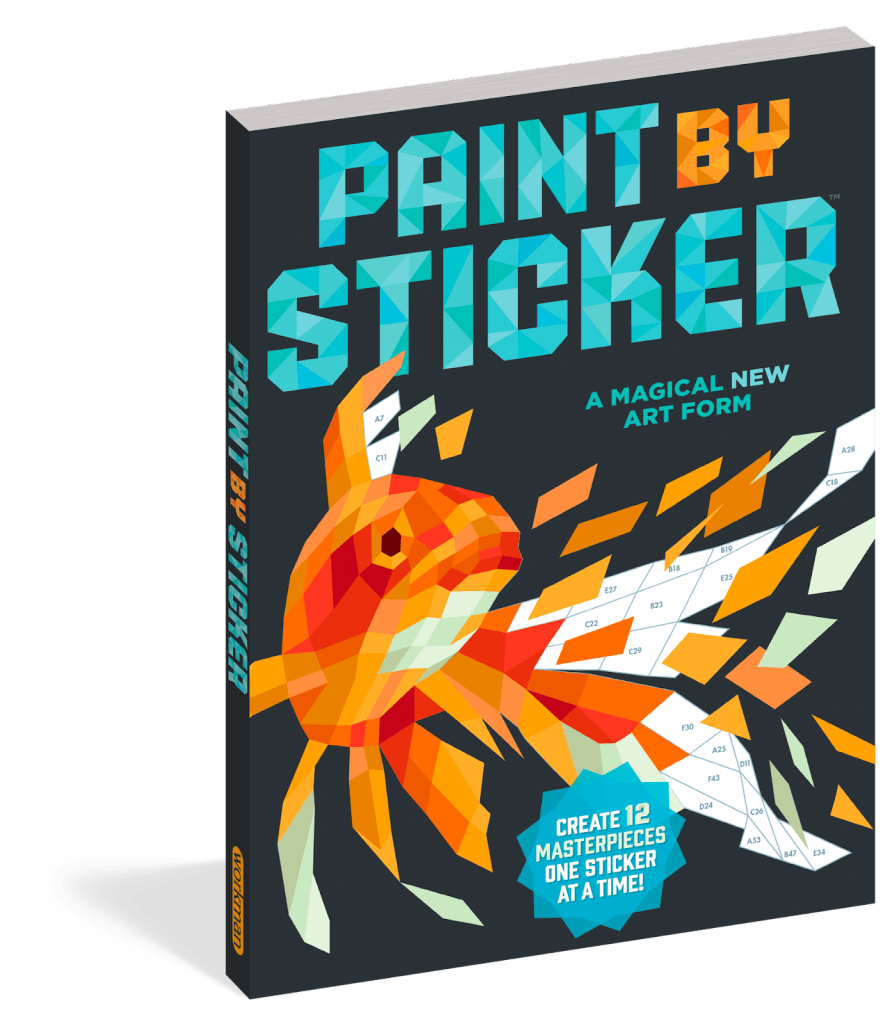
Happy Summer!
by Meru S.
The Marine Mammal Center is the world’s largest marine mammal hospital, with Operations in Monterey Bay, San Luis Obispo, and Fort Bragg, California. The Center’s Main Hospital and Headquarters are located in Sausalito, California., They also have a hospital and visitor center in Kona, Hawaii — the Ke Kai Ola (The Healing Sea) Hawaiian Monk Seal Hospital, which opened in 2014 as part of the Center’s work to save the Hawaiian monk seals.

The Center rescues marine mammals such as seals, dolphins, sea lions, sea otters, elephant seals, and more. The Center works 24 hours a day, 365 days a year, responds to more than 10,000 reports annually, and has rescued more than 24,000 animals to date!
When an Operation receives a report of an animal that may be diseased, injured, orphaned, or entangled in plastic or trash, a team of trained volunteers is dispatched as soon as possible to rescue and transport the animal to the nearest facility. After an animal is transported to the hospital, it undergoes an admission exam in which the veterinarians at the Center take blood samples, check vital signs, and look for injuries or illnesses. After being rehabilitated at the Center and once the veterinarians have ensured that the patient is thoroughly healed and has the necessary skills needed to survive on its own, the patient is released back into the wild, either close to the location where it was found, or on a quiet beach that has no public access. Sometimes patients will be released further out at sea, so they will have minimal contact with humans and not rely on them for food. Flipper tags are attached to the patients before they are released. This enables the Center to track them in the wild and recognize them if they are seen again or are in need of rescue again.
In Monterey Bay and San Luis Obispo, the operations provide space for the patients to be kept for a few days before being transported to the main hospital in Sausalito. In the Fort Bragg operation, patients are immediately transported to Sausalito.

The Center keeps a list of their current and previous patients on their website along with their species and gender. Every patient is given a name. You can sign up to get patient updates via email.
Here are the names and species of some of their current and past patients:
Taxi—Harbor Seal (male)
Posh—Harbor Seal (female)
Reuben—Northern Elephant Seal (male)
Salamander—Northern Elephant Seal (female)
Southpaw—California Sea Lion (female)
Pixy—California Sea Lion (male)
Mayhem—California Sea Lion (male)
Salta—Steller Sea Lion (female)
Makoa—Hawaiian Monk Seal (female)
Giant—Guadalupe Fur Seal (female)
Paddlewan—Southern Sea Otter (male)
The Marine Mammal Center offers a Youth Crew service-learning program for high school students aged 15-18 in the San Francisco Bay Area. The Youth Crew is a year-long opportunity where students can volunteer at the Center by helping out with tasks such as recording observations, cleaning animal pens and pools, washing equipment, weighing animals, sorting fish for feeding, and managing the animals in pens.
My family went on a homeschooling field trip to the Marine Mammal Center in Sausalito. We were taken on two guided tours led by staff members. First, we went on a tour of the hospital where the guide explained and demonstrated how the animals are rescued, fed, and cared for. The second tour was about the different jobs and careers at the Center. The guide of this tour talked about each job and showed us the areas where they are performed. We also got to see the rehabilitation pools in which the marine mammals are kept while being cared for. The animals are transported within the Center in ‘seal’ barrows. Every visitor is sure to be amused by the loud vocalizations of the seals. The guides shared that the way the seals move has a special term called ‘galumphing’.
If you ever notice a marine mammal in distress, please call the Center’s 24/7 hotline: 415-289-7325 (SEAL). For more information, please visit The Marine Mammal Center.
by Ava Salado
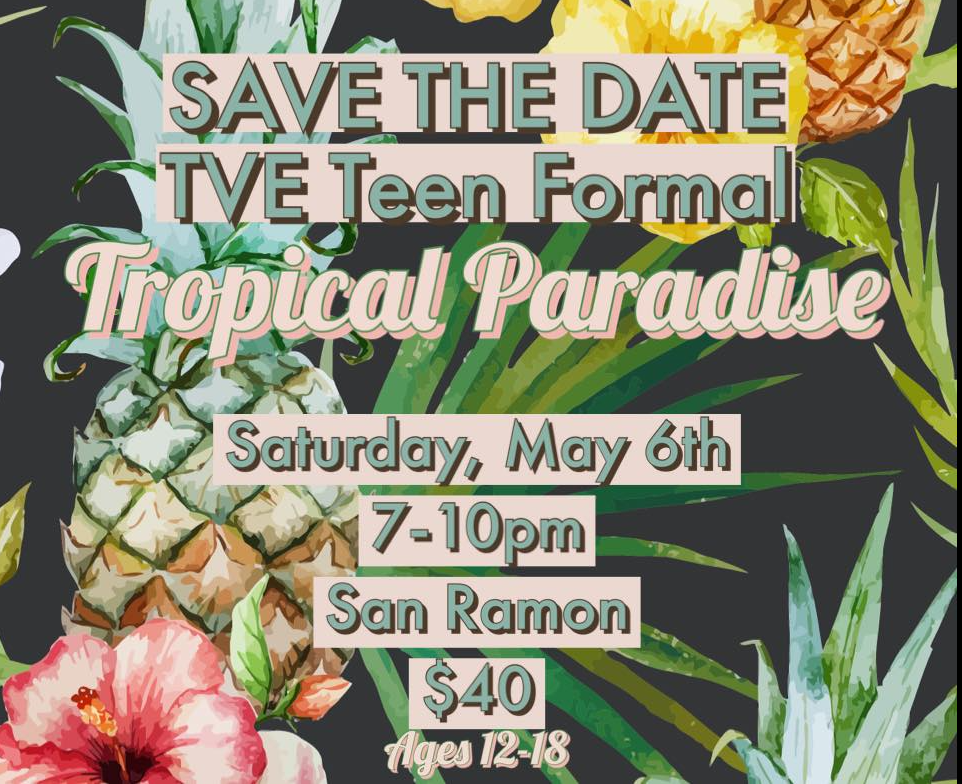
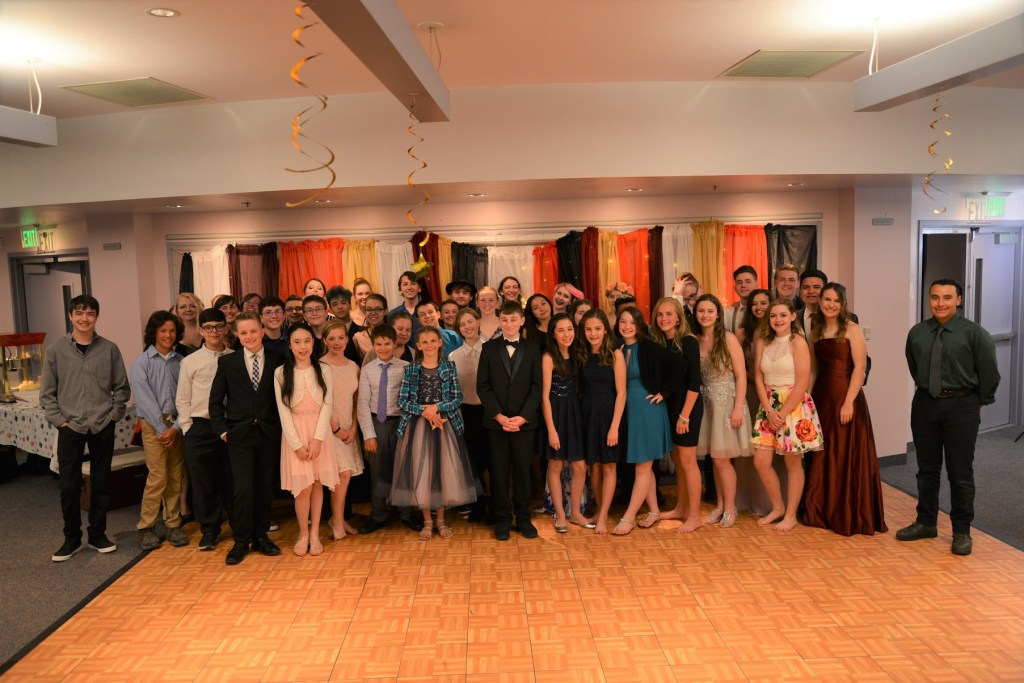
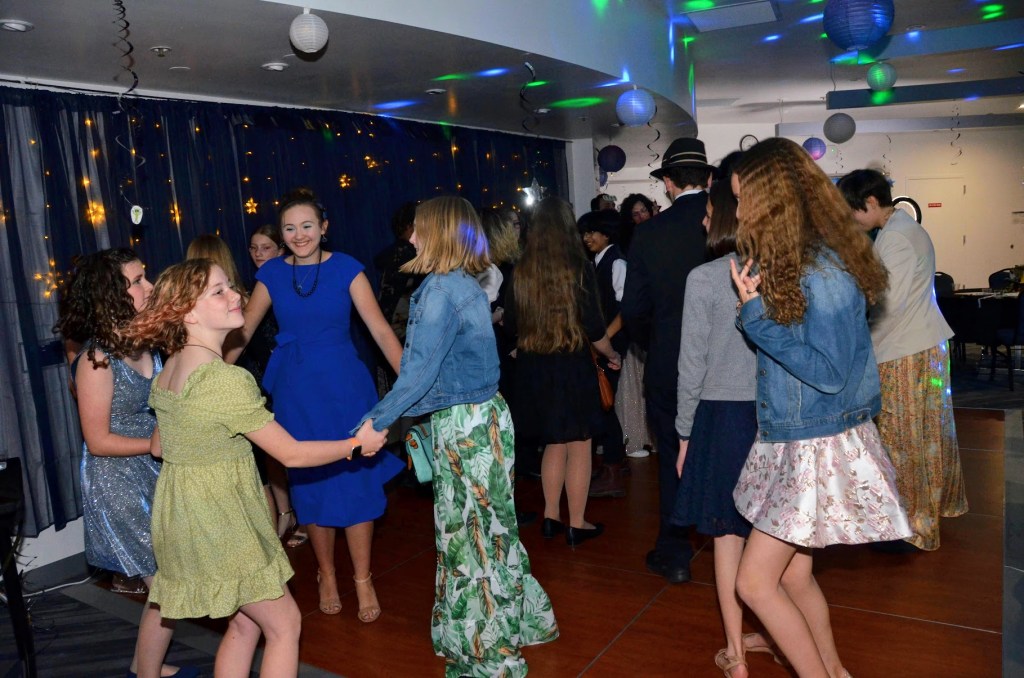
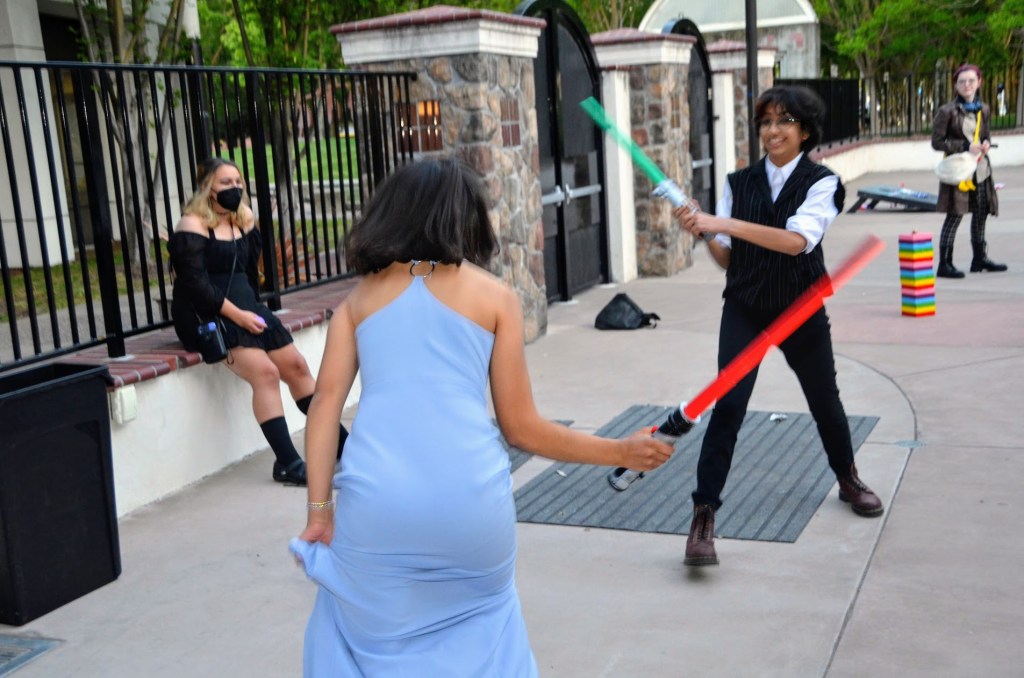
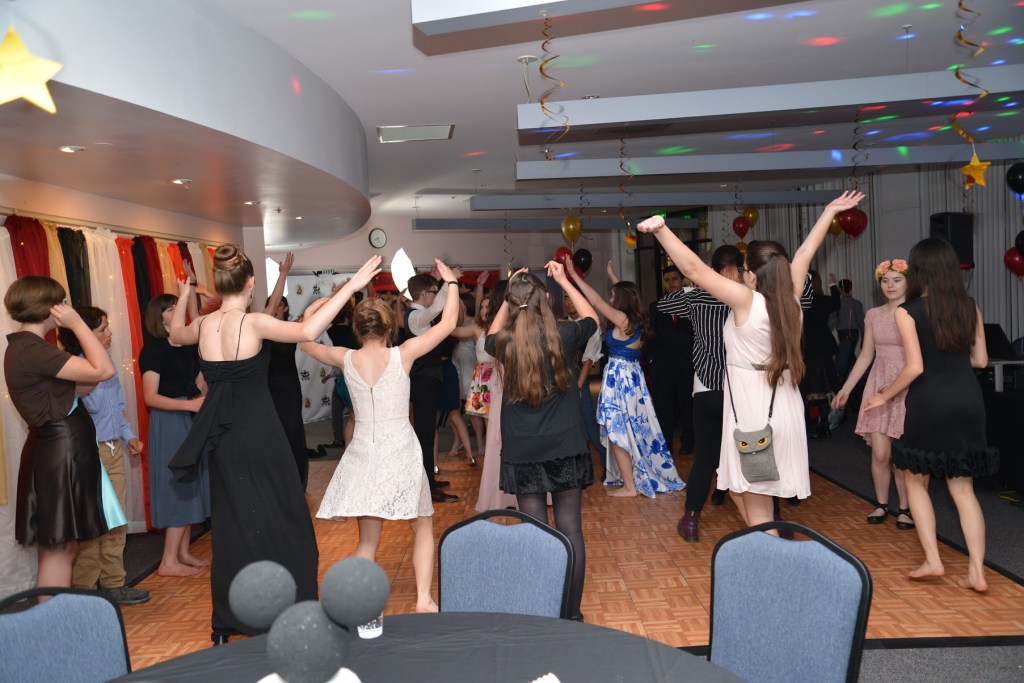
It’s that time of year again! Prom season! A very common misconception about homeschoolers is that we don’t have proms or formals, but this couldn’t be farther from the truth. Every year, TVE hosts its annual Teen Formal! If you are a homeschool student, aged 12 to 19, then you are formally, cordially, and sincerely invited to this year’s event. If desired, each student may invite a homeschooled or non-homeschooled guest. But this event is unlike your other ‘proms’, students do not need to come with a ‘special someone’. Many guests will be coming alone or with a group of friends. This is not a ‘date night,’ but instead, a celebration of friendship, the school year, and our homeschool community! (But, of course, if there is a ‘special someone’ we do not discourage shooting your shot) and welcome guests.
The Event Planning Committee is proud to announce that this year’s theme is Tropical Paradise.
We ask that you “Dress to Impress” with fancy attire or your best threads, but dressing to the theme is not required. (No bathing suits, trunks, snorkel gear, etc.) Clothing should be appropriately fitted and modest. This is your chance to ‘strut your style’. Although these are the comfiest options, no jeans, shorts, sweats, or t-shirts.
Got a favorite jam? Awesome, (we do too) you may request up to two dance songs. Please include song title and artist. This doesn’t guarantee placement on the playlist, but we will try to accommodate all requests. But don’t worry, the absolute, classic dance-tunes will always make their way onto TVEs playlist. You can submit your song(s) request on the ‘Registration Form‘ of the Formal. No explicit lyrics, please.
Here are all the details:
Date: May 6, 2023
Time: 7pm – 10pm
Location: San Ramon, CA. (full location and address can be found on the TVE facebook page.)
Age: 12-19
$40 per teen
Refunds:
100% before April 7th,
50% between April 7th and April 21st.
No refunds after April 21st.
Fun time: Assured
Smiles: Required
The guest must be registered to attend and purchase their own ticket. Go to the TVE Facebook page for the registration form and for more information. Make sure you read the form carefully with your teen(s) and any guest.
You can contact TVE Leadership with any questions here: tve.membership@gmail.com
We hope to see you in Tropical Paradise!


Subscribe to get access to the rest of this post and other subscriber-only content.
Before you read this, here is a glossary of Arabic words:

It’s time for Ramadan! This is the holiest month for Muslims because it is a time to reflect and be conscious of our actions through fasting, prayer, charity, and remembrance of Allah (Arabic for God). My family does so many things around this time of year. Fasting, or sawm, is one of the five pillars of Islam, which are mandatory actions that Muslims must follow. You can see more about fasting below. The word Ramadan means “The Holy Month” in Arabic. Muslims follow the Lunar calendar which does not align with the Gregorian calendar. Because of this, Ramadan does not start on on the same day every year, but instead slips back ten days every year. Ramadan lasts for 29 or 30 days, depending on the year, and at the end of it, we have a huge celebration called Eid-ul-Fitr (Festival of Breaking Fast)! Here are some of the things we do:
1. During the holy month of Ramadan, we fast during the day.
Basically, we have a pre-dawn meal, called suhoor, before the sun comes up. This year, we wake up around 4:30am. After our meal, we perform the first prayer of the day, the morning prayers, and then we go back to sleep. To us, sawm means no food OR water during the day, and it helps us learn self-control. When the sun goes down, around 7:30pm, we break our fast with a date, water and a meal. Afterwards, we pray the fourth prayer of the day, the sunset prayer. Fasting helps us connect with Allah and by not worrying about meals, we can reflect on those that are less fortunate than us, as well as gratefulness for what we do have.
2. We do special nightly prayers, called Taraweeh.
One of the five pillars of Islam is praying five times a day, but during Ramadan, there is a special evening prayer performed every single night, called Taraweeh which starts around 9:30pm and lasts about two hours! This is not obligatory, but we gain so much reward from Allah for performing them. They are held at the mosque (our holy place of worship), and hundreds, if not thousands, of worshippers congregate and pray together. Last year I was able to pray with my friend, and this year I was able to join my mom and sister!
3. We decorate!
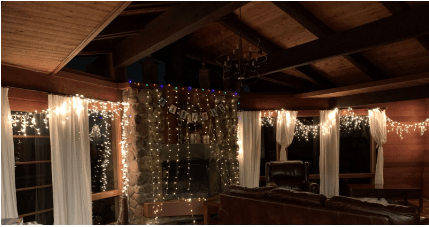
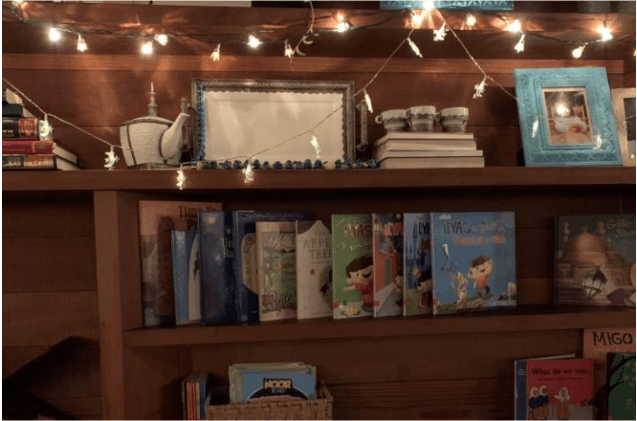
You know how they always bring out trees and lights for Christmas? Well, we do similar things for Ramadan and Eid! We set up lots of pretty lights, and put out our favorite Islamic story books. We bring out a garland that says ‘Ramadan’ and change it out to one that says ‘Eid Mubarak’ when the time comes. Adults gift children money, called Eidi. My family personally decorates not just for Eid, but for Ramadan, too!
4. Good Deeds and Charity.
In Ramadan, we gain more rewards for all of the good deeds and charity that we do. Some examples of good deeds are volunteering, picking up litter, visiting the sick, being generous, feeding others, being kind to others, even smiling at someone else is considered a good deed! Charity falls under good deeds as well. We are asked to give whatever we can to the poor and needy. For Eid, each Muslim family must give Zakat-ul-Fitr, about $15 for each member of your immediate family. Zakat-up-Fitr goes to help the poor and the needy, to give them the ability to buy necessities they need to survive.
Ramadan began during the time of our last Prophet, Muhammad. The Quran (our holy book) was revealed to him during this month. We believe that through the angel Jibreel (Gabriel), Allah commanded that Muhammad and his followers fast for the entire month of Ramadan. It was revealed in Makkah and Medina. Over 23 years, 114 surahs, or 6,348 ayat, were revealed.
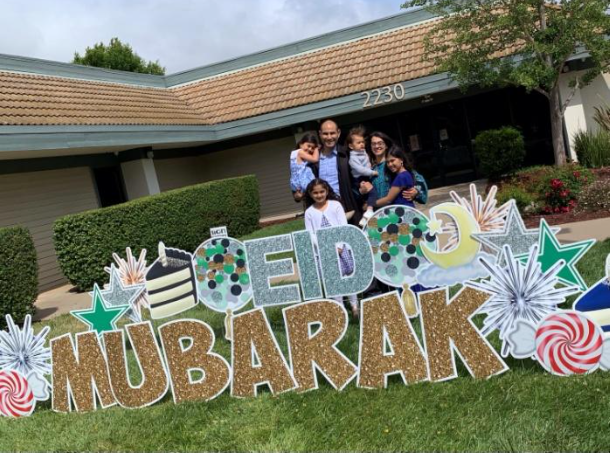
Did you know that there are actually two Eids? One is at the end of Ramadan (Eid-ul-Fitr), and the other is later in the year (Eid-ul-Adha). Eid-ul-Fitr usually takes place at a mosque, and after prayers, we play games and have fun!
Ramadan Kareem, and Eid Mubarak!!!
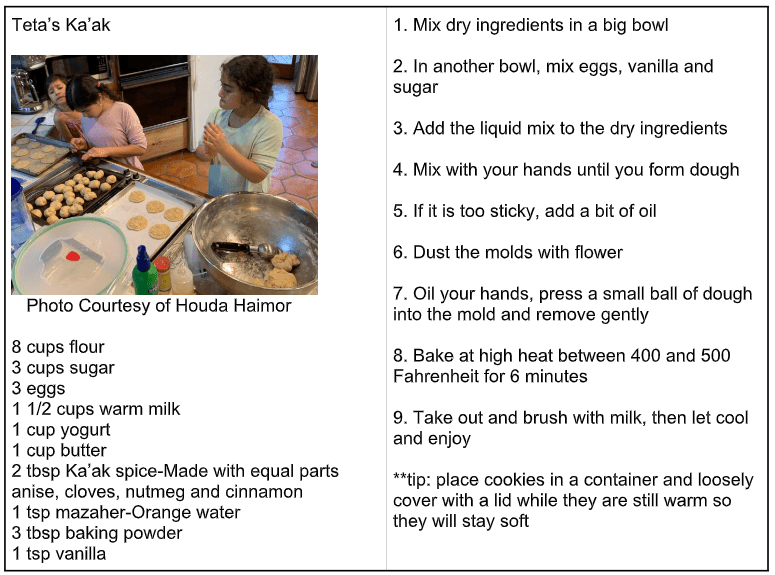
Here’s my Teta’s recipe for a special treat, Ka’ak. It’s a cookie that we make often during
Ramadan!
by Olive Pea
Have you ever wondered what your pet cat was trying to tell you? When your cat is rubbing on your legs, you probably have thought, “Does my little fur ball want food or pets?” It can be quite difficult to tell what they are trying to say, and sometimes misunderstandings can lead to a scratch or bite. For instance, if a cat rolls over and displays its belly to you, it kind of looks like it wants you to pet it. That fluffy belly is very tempting, but beware! If you try to even get close, you will probably end up putting bandages on your hand. It might be confusing to you, but to the cat, rolling over in front of you is a sign of friendship. Your cat is basically saying, “Hello! I’m sooo excited to see you!” It didn’t want you to pet its fluffy belly! Crazy, right?

Cats understand us better than we understand them. Sure, they don’t speak our language, but they are still constantly trying to tell us things. They can only communicate with a few sounds, but mostly they use body language. Imagine that! Dogs don’t speak our language either, but we understand them a lot more than we do cats. One reason for this is that dogs have lived with humans for 12,000 years, whereas cats have lived as pets with humans for only 4,000 years. Cats only joined forces with humans when people started farming, because the grain from the crops attracted rodents. Dogs became pets 8,000 years before cats, and helped humans hunt for animals. This was more helpful at the time because then, humans didn’t have crops that needed to be defended from hungry rodents. Humans mostly hunted for meat, with dogs (wolves back then) at their side ment that catching their game would be quite a bit easier. This means that dogs have had more time to practice communicating with humans. Cats became a part of human lives much later, so they are still more “wild” than dogs are.
Cats are harder to read (and train) than dogs in general. But cats are very expressive. Even though they are always using body language, it can be pretty easy to miss! When trying to read a cat, you have to pay attention to the slightest twitch of the tail, or even the direction the whiskers are pointed. To get you closer to speaking cat, here are a few signs to look for:
IDENTIFYING CAT EXPRESSIONS
EARS
When the ears are perked up, the cat is alert.
When the ears are rotated 90o or 180o, the cat is annoyed. Watch out!
When the ears are flattened back, the cat is angry and might attack!
EYES
When the pupils are wide, the cat is either frightened or zeroing in on its target. Beware, it might be looking at you!
When the pupils are narrow, the cat is experiencing bright light. Like ours, a cat’s pupils contract in the light.
When the eyelids droop, the cat is either sleepy or just resting its eyes.
TAIL
When the tail is thrashing, the cat is annoyed and/or frustrated with something. Most likely, it sees a bird or squirrel it can’t reach.
When the tail is pointing upwards, the cat is happy. An upwards pointing tail is like saying, “hello!” in cat language.
When the tail is all puffed-out and bushy, something just startled the cat. A cat puffs out its tail to make itself look bigger to its enemy.
WHISKERS
When the whiskers are pointed forward, the cat is excited. Either it’s about to get pet, or it’s about to pounce on its prey.
When the whiskers are loosely fanned out to the side, the cat is feeling friendly and stress free.
When the whiskers are pointed backwards and pressed against the cat’s cheek, the cat is angry and about to attack. You better back up!
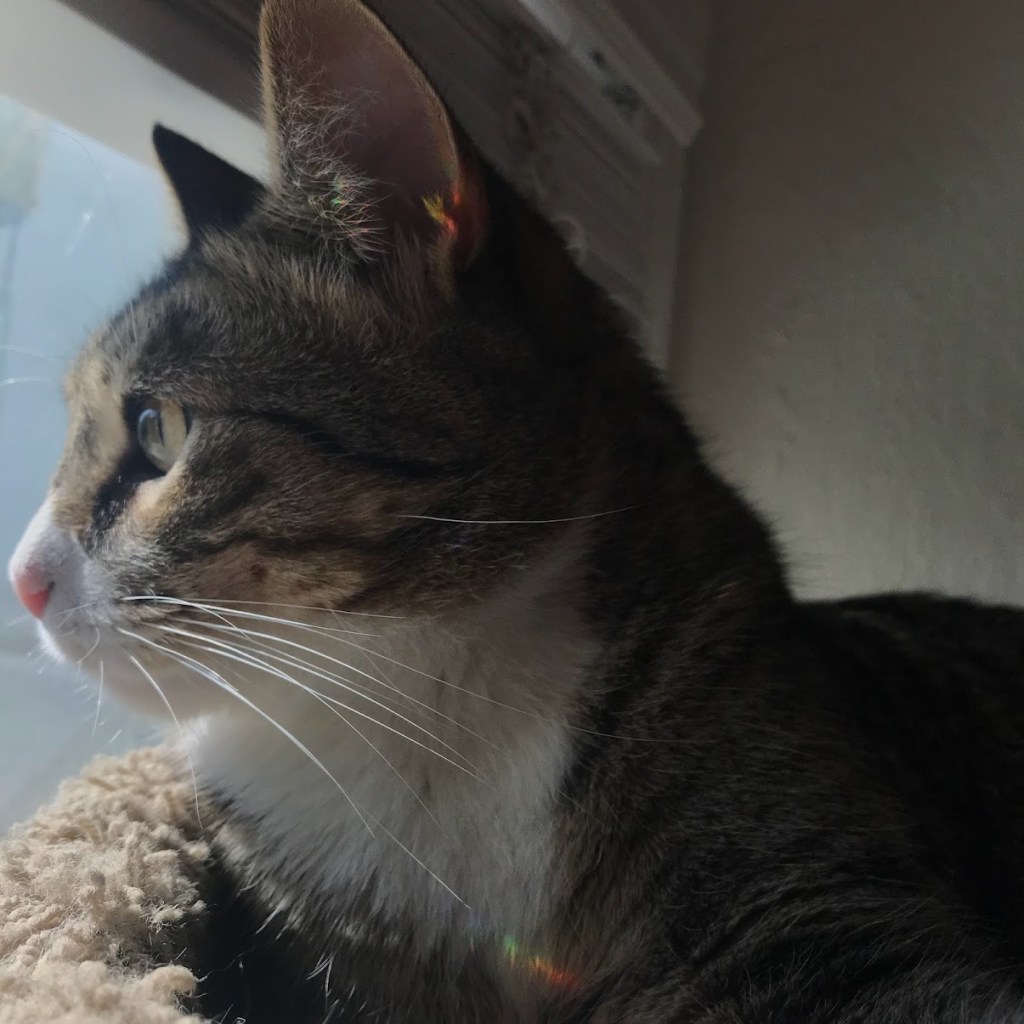
Even though cats mostly use body language to communicate, they also use a few sounds! Cats almost exclusively use their voices for their mothers and us humans, but they can become quite vocal if fighting with another cat. Sometimes they even talk to themselves when they are agitated! Here are some common cat sounds to listen for:
IDENTIFYING CAT SOUNDS
A hiss lasts about one second. Snakes make this sound too, except a cat’s hiss is much harsher. A cat hisses to try and scare off predators. If a cat hisses at you, back up. The cat might feel scared and cornered.
A chatter sounds like a string of high pitched “eh”s, along with clicking sounds. When a cat chatters, it is frustrated. Most likely it sees a bird outside it can’t reach. Even though you might want to sooth your frustrated cat by petting it, don’t even try. It might take its frustration out on you!
A meow literally sounds like “meow”. If your cat meows at you, it most likely is asking for something. Most likely the request is for food or to be let through some door, but sometimes the cat is just saying hello.
A purr sounds like one long, deep, voicelessly rolled “R”. When a cat purrs, it typically means the cat is deeply content. But sometimes a cat purrs to soothe itself when it is anxious.
A caterwaul sounds like “ahh-roo-ugh”. This sound either comes from two dueling cats that are about to attack, or a female cat in heat calling out for a potential mate.
A trill lasts about half a second, and basically sounds like a meow and purr combined. When a cat trills, it is feeling very happy and friendly. If a cat trills at you, it is happy to see you!
A growl varies in length, and sounds like a very low and almost inaudible “grrrrrrrrrrrrrrrrr”. When a cat growls it is very angry, and is warning that it will attack if its opponent gets any closer. If a cat is growling at you, back up and walk away.

Now that you are all up to date on cat language, it’s time for you to speak cat! Here are some ways to communicate with cats:
4 EASY WAYS TO COMMUNICATE WITH A CAT
When a cat blinks slowly at you, it is basically the cat version of kissing you on the cheek. Often they will do a slow blink and then look away from you. This might seem rude, but this is a sign of trust. If they look away, it means that they trust you won’t do anything to scare or hurt them. Next time you see a cat or are hanging around your own cat, try blinking slowly at them. Make sure that they are looking at you, then once you make eye contact try blinking slowly at them. If they blink back, then they basically said “I love you too!”
Before you pet a cat, especially an unfamiliar one, you should always crouch down first. If you are standing up, you might seem big and scary. Just imagine if a human the size of an oak tree reached down to touch you. Wouldn’t you jump out of the way? You probably would run screaming! Then imagine if that human was crouched down. They would seem a lot less intimidating because now it is closer to your size. If you crouch down, the cat will see that you are closer in size and might even walk over to you. Another reason why you shouldn’t be standing when you pet a cat is because in a cat’s mind, a hand reaching down from above is very similar to the talon of an eagle or hawk that is hoping to have cat for lunch.
Cats rub noses with each other to say hello. However, they don’t rub their noses with any cat, dog, or human. Cats only rub their nose with animals and humans that they consider family. A nose rub doesn’t just mean hello, it also spreads the cat’s scent onto the animal or human that they rub on. This makes the cat recognize you easier, just as if it gave you a label that reads “family” in it. Next time you see your pet cat or the well known cat that visits your porch, try crouching down and gently touching the back of your finger on the cat’s nose. If it works and the cat rubs its nose back, then congratulations! You just gave the cat a proper hello in cat language!
Start by gently scratching between the ears, then behind the ears. After that, rub one hand all the way down the back to the tail. Then, gently scratch under the chin. The cat will love this, and likely start to purr. The reason cats love being petted in these spots is because these spots have a special gland that releases a scent that only cats can smell. Cats use this to mark territory. When you pet a cat in one of these spots, it releases their scent and soothes them. Cats also have scent glands in between their toes and on their cheeks, but they don’t enjoy being pet there as much. It would tickle their toes and disturb their super sensitive whiskers.
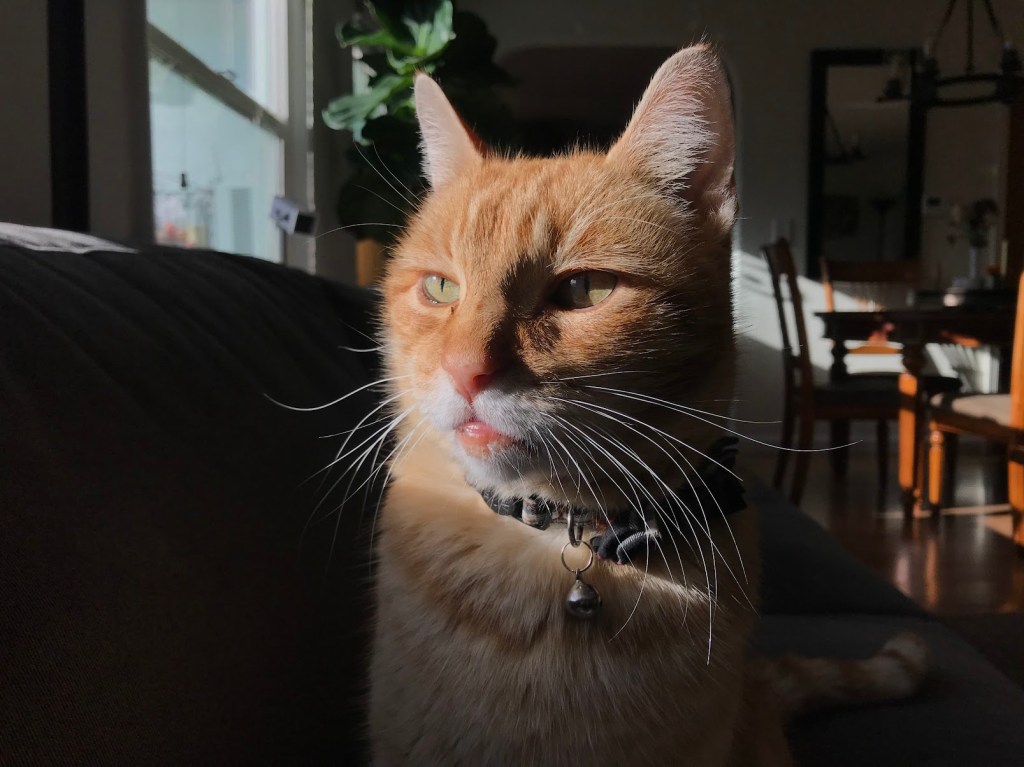
Now that you know these simple cat communications, try looking for them in the next cat you meet. It will be much easier to understand cats, and you might even be able to prevent a scratch or two! Cats are truly amazing creatures, and they are masters of communication. If you have a pet cat, let it know that the Lighthouse says hi!
 The Lighthouse