Sports

The Beautiful Game

by Cy Bernardi

Two hundred fifty million people play soccer every year. This is 50,000,000 more than the population of Western Europe. To put that in perspective, imagine every single person living in that region getting out and playing soccer all at once! For thousands of years, some form of the sport has been played in almost every culture across the globe. In the ancient Americas, a combination of soccer and basketball was played to please the gods, who we can assume were very entertained by this new human creation. Although these games are not exactly the same as modern soccer, very similar forms of the sport were played in ancient Greece, China, Australia, and Japan. Shockingly, soccer didn’t evolve in Western Europe until the twelfth century. Even more surprising, rules weren’t created for the sport until the mid-1800s. It is truly amazing that so many different versions of the same basic idea could coalesce into the beautiful game we know today. 

The first recorded organized ball game was played in Ancient Mesoamerica around 3,000 years ago. During this period, many of the most powerful rulers in Central and South America were devoutly religious and worshiped their gods without question, despite their violent and warlike depictions. Many high priests in these ancient empires devised various sacrificial ceremonies to please the more bloodthirsty deities. One of these rituals was a ball game called Tchatali. This sport was played on a pitch similar to a basketball court with hoops at each end. The goal was to kick the ball, which was made of rubber, through the opposing team’s hoop without using your hands, which were not allowed to touch the ball. It was a brutal game. In some cases, if the match were of particular significance, the losing team’s captain would be sacrificed to the gods. In second or third century Ancient China, a form of soccer was played on a square stone court with a spherical ball. 

In other cultures, ball games have been recorded in Aboriginal Australia, Ancient Greece, and Ancient Japan for thousands of years. Although all of these games are different from soccer, with them, the sport could evolve into the form that we know today.

Unsurprisingly, soccer in Europe was first played in England in the 12th century. At this time, it was barely recognizable as a sport. Medieval soccer was played in fields and meadows and was so violent that many participants, who were mainly peasants, died while playing. In large spaces such as towns, huge groups of people, sometimes numbering in the hundreds, would attempt to carry the ball from one side of the “field” to the other, similar to rugby or American football. There were no rules. Oftentimes, the game would get so rowdy that severe damage would be caused to the towns and villages that were being used as the pitch. Because of the dangerously high injury rate among young men, the king banned soccer from being played because so many men were hurt playing that there were not enough uninjured soldiers fit for military service. Because of this law, soccer faded from the public eye for several centuries.

In the eyes of many, modern soccer was officially created in the mid-1800s when the first campaign to create a proper set of rules was launched. Although there were many ball games in different parts of the world, the English were the first to try and create an organized sport with a defined set of rules. The first order of business was to divide the old version of soccer into rugby and what was to become the game we know and love today. The division made the game safer. However, even after this was done, there were still two very different styles of play. The English charged the opposing team and tried to score using rushing tactics. Meanwhile, the Scottish, eager to take this chance to devise their own style of play, one completely different from the English, created a shocking new strategy. The Scotts passed the ball from player to player up the field until they were close enough to the goal to shoot and, hopefully, score. This was a radical tactic at the time. The Scottish way of playing soccer gradually emerged as dominant, rendering the English rugby strategy obsolete. In the wake of the rapidly growing popularity of this new sport, the first club, London, was formed in 1863, paving the way for the rise of the most played sports in history. 

“The rules of soccer are very simple, basically it is this; If it moves, kick it. If it doesn’t move, kick it until it does.” As Phil Woosnam points out here, soccer is not a complex sport. There is something in human nature that yearns to kick objects like rocks, sticks, or whatever else lands at one’s feet. This is the simple base that soccer is built on. From Australia to Europe to Far Asia and the Americas, some form of soccer has been played at nearly every point in time. It is only natural that this passion has evolved into the most played game in history. Surprisingly, rules for the sport have only been created relatively recently compared to the amount of time ball games similar to soccer have been played. Several decades ago, Pele, one of the most famous players of all time, popularized the term “the beautiful game” to describe soccer. This phrase is still used today because, even in all its forms, soccer truly is a beautiful game.


Home, Science

A Day in the Life of a Platypus

by Lydia I. Martinov

Hello, there! My name is Percy Platypus. I can not wait to tell you what a day in my life looks like. I just woke up in my burrow, which is located on the shore near a beautiful river in Australia. It looks like it’s almost evening, so it’s time for breakfast! I am a carnivore, and I eat delicious crayfish, shrimp, worms, insects, fish, and pretty much anything I find tasty in the river. I am going to hop on into the water with my 20 inch long body (20 inches is almost 2 feet). 

Photo courtesy of Animals San Diego Zoo

Hey! Look over there! I think I see some larvae, or maybe worms. I have to scrape them up with my bill (my beak- shaped mouth), with bits of gravel, and put it all in my cheek pouches. I can use the gravel to help me mash, or “chew” the food, since I do not have teeth. Us, platypuses, grow to weigh about 3 pounds. That’s lighter than an average house cat!

Photo courtesy of National Geographic Kids

Uh oh. I see a crocodile by the rocks. He’s coming this way! I need to swim away as fast as I can. But, look! He is catching up. What can I do? Well, us male platypuses have sharp stingers on the heels of our webbed feet to stay safe from foes. They have venom inside, which is toxic. Hi – Yah! I did it! I stabbed the crocodile, and now I am safe. Time to go back home. 

Photo courtesy of National Geographic

My tummy is rumbling. Wait a minute… I don’t have a stomach! Oh, well. Either way, it’s time for lunch! I’ll be right back.

Munch, chomp, munch. Yum! Those shrimp were very filling. Now, what exactly do I do all day? I spend most of my time alone, and use this time mostly for eating and sleeping. I already ate, and I already slept, so it is time to do something else. Would you like to hear some fun facts about us platypuses? Well, here they are! First, the plural of platypus can be either platypuses, or platypodes. The English language has some interesting twists. 

I am a mammal, despite the fact that female platypuses lay eggs. My mother had 2 eggs, so I have a sister. I haven’t seen her for a while, because platypuses don’t have family reunions. Mom fed us by sweating out milk, and my sister and I would suck it out of mom’s fur. I know that it doesn’t sound very appetizing, but that’s mother nature for you.

Photo courtesy of National Geographic

I am 10 years old, and will probably live up to about 12. My neighbor, Sandy, was found by some humans when she injured her left foot. Because she now lives in captivity, she will probably live up to 20 years old. I, personally, prefer living alone out here with a beautiful river that I can have all to myself. It is dinner time now, so I better go find some tasty worms. I’ll see you later!

Gulp! All done. It is early morning now, so I should probably get to bed. Thank you for visiting me, and you’re welcome to come see me whenever you want. YAWN! Good night. Um, I mean good morning. Well… bye!

News, Science, Student Life

 Let’s have a Conversation about Conservation!

by Meru S.

My local 4-H club recently invited a guest speaker from the East Bay Municipal Utility District (EBMUD) to talk about water conservation. He spoke about the most common ways water is wasted in everyday life, and how we can use less water to conserve it. Even with the rain that we have been having during the past two to three months, we still need to continue to use water with awareness of the drought.

Here are some ways in which we can conserve water:

  •  Fix water leaks. Leaks can waste up to two hundred gallons of water a day.
  • Take shorter showers. A ten-minute shower uses about twenty-five gallons.
  • Use the dishwasher instead of washing dishes by hand. Most dishwashers use only about six gallons per load. 
  • Irrigate lawns efficiently or install a drip irrigation system. Many sprinklers spray water not only on the lawn but also on the sidewalks or driveways, which wastes a lot. Drip irrigation sends water directly to the roots and does not waste or overwater.
  • Plant drought-tolerant plants that require less water.
  • Make sure to turn off hoses and faucets when not in use.

We removed our lawn and replaced it with Kurapia, a water-wise alternative to grass. We have also planted California natives, which, once established, do not need as much water. Collecting rinsing or cooking water is something we have been doing for the past few months. We keep a watering can in the kitchen and pour the extra water from foods (such as pasta or soaked grains) into it. Then we later use it to water our plants.

Art and photo courtesy – Meru S.

March 22nd is World Water Day. Each year, World Water Day has a different theme. This year, the theme is about accelerating change to solve the water and sanitation crisis. The general goal of this celebration is to ensure that people worldwide have access to clean and safe water. The first World Water Day was held in 1993 and was created by the United Nations. East Bay Regional Park District (EBRPD) is celebrating World Water Day with a Day by the Water at Lake Del Valle in Livermore. With games and activities, you can learn more about water conservation and the different ways in which water is beneficial to us and wildlife. 

News, Student Life

Valentine’s Day, Parkday, All in One!

by Olive Pea

Wow! It’s already February! We are officially a whole month into the new year. I’m still trying to break the old habit of writing 2022 whenever I write down the date. Since a whole new year has started, this means that the cycle of TVE’s holiday events is starting over! Actually, the first holiday event of 2023 is coming up in the very near future. TVE’s Valentines Exchange will be held at two different Park Days. The first one takes place at Larkey Park Day, Thursday, February 9th. The second one takes place at Boone Acres Park Day, Friday, February 10th.

 WHAT TO EXPECT

TVE’s annual Valentines exchange gives the kids of our homeschool community the opportunity to exchange Valentines with their Park Day friends! Once the exchange starts, everybody who brought Valentines should have them ready. While the kids are getting their Valentines ready, everybody should begin preparing the tables and set up Valentine boxes (or bags) for each participant. Once everything is set up, then kids who brought cards can start to drop them into other people’s boxes. Once everyone has put their Valentines in their friend’s Valentine boxes, the kids can start looking through the Valentines that they received.

THINGS TO BRING

 In order to participate, you must bring these necessities:

  1. A box (or bag) with your name written in large letters on the front. This will be used for others to easily find where to put their Valentine to you.

Note:

 Bags for you to decorate will be provided at the Boone Acres Park Day along with markers and stickers.  

  1. Kid friendly Valentine cards, either pre made or handmade to give to your Park Day friends. Goodies can be included, but they are optional. Food is not allowed, to make sure those with food allergies are also included.

In past events, there were many Valentines received, and many smiling faces. Last year at Boone Acres Park Day the amount of children was underestimated and there was said to be double the amount on Exchange participants! At the Larkey Park Day, there were bouncy balls that everyone had a lot of fun playing with.

We hope to see you at this wonderful event, and hope you get lots of Valentines!

For more information, visit the TVE Park Day pages on Facebook to find out who will be at your Park Day! 

Science, Student Life

5 Coolest Jellyfish

by Guest Author Mila M. (age 5)

I love sea animals.  In fact, jellyfish are my favorite. I hope my article gets you to like them too. I find jellyfish to be very beautiful, because of their many bright colors, glowing in the dark, and cool shapes. They have been around for almost 600 million years, so they are extra interesting.  Here are some facts about my favorite kinds of these fun creatures.                         

1. Moon Jellyfish (my most favorite of them all)

These jellyfish have bodies shaped like a saucer, with very short tentacles attached. They use these tentacles to catch plankton for dinner. The moon jellyfish can be found in most parts of the ocean, but not in very cold waters. They grow up to 12 inches (30 centimeters).  A fun fact: they are the most popular (widespread) jellyfish.

Photo courtesy of Georgia Aquarium                                                              

2. Deep-sea Jellyfish       

Deep-sea jellyfish have some tentacles that are held straight up. This creature belongs to a group called coronate jellyfish. They are shaped like a bell wearing a ballet tutu. This jellyfish can squirt out a big cloud of ink and grows up to 35 centimeters. 

Photo courtesy of Alamy Images       

3. Mauve Stinger

This jellyfish is gorgeous because of the beautiful bioluminescent light it emits, but it is also a mean stinger.  (Bioluminescence is when a deep-sea animal glows).  They have eight stinging tentacles and their sting is very painful, but not dangerous. This jellyfish grows up to 5 inches (13 centimeters) long. The Mauve Stinger lives near the surface, so be careful around it!

Courtesy of New York Post

4. Immortal Jellyfish (super cool and unusual, my sister’s favorite jellyfish)

This is the only creature on earth that can actually live forever! These jellyfish are able to reverse their life cycle. They live in oceans all around the world. The Immortal jellyfish eats plankton, and is tiny at about 4.5 millimeters or 0.18 inches long. Its predators are swordfish, penguins, sharks, tuna, sea turtles, sea anemones, and larger jellyfish. If an Immortal Jellyfish is frightened it turns back into a baby and restarts its life cycle.  How unbelievable is that!?

Photo courtesy of The American Museum of Natural History

5. Lion’s Mane Jellyfish

The Lion’s Mane Jellyfish is the biggest jellyfish in the world. Its bell body can reach a diameter of almost 8 feet, and with tentacles, it can grow up to 100 feet long. That’s huge! It eats fish, larvae, eggs, and tiny crustaceans (crabs, lobsters, barnacles). This jellyfish only has one predator. Can you guess which one? A sea turtle! Don’t stand near this jellyfish, though, because the tentacles can sting you. The Lion’s Mane jellyfish lives in cold waters.

Photo courtesy of Monterey Bay Aquarium

I hope you liked my article and are more interested in these creatures now. Next time you’re swimming at the beach in the ocean, watch out for some of these guys!

Sources: 

“Ocean. The Definitive Visual Guide”, Fabien Cousteau, Rob Dunn, Isobel Comley

American Museum of Natural History

Monterey Bay Aquarium

Science, Student Life

Mt. Diablo Audubon Society 2022 Christmas Bird Count Results

by Meru S.

Mt. Diablo Audubon Society (MDAS) announced the results of the 2022 Central and East Contra Costa County Christmas Bird Count on their Facebook page on January 16th, 2023. A total of 160 bird species were seen in Central County, one less than 2020’s record of 161. In East County, a total of 148 species were seen.

Every year MDAS participates in the National Audubon Christmas Bird Count. According to  MDAS, this event has been occurring annually since 1900 and is the longest-running community science project in the world!  Two Counts are conducted each year in Contra Costa County, one in Central County, and one in East County. MDAS sponsors both of these events.

The story behind the Christmas Bird Count (CBC) – In 1900, Frank M. Chapman, an Audubon Society member, started the first CBC as an alternative to the old traditional Christmas ‘Side Hunt’  in which hunters competed against each other to kill as many birds and mammals as possible. The data collected on the Bird Counts (which take place all across the U.S. between December 14th and January 5th) is used to monitor the population of the birds throughout North America.

My family and I participated in the Count led by East Bay Regional Parks for Central County at the Thurgood Marshall Regional Park on December 17th, 2022. The morning was crisp, cold, and clear when the walk began at 7:30 a.m. A naturalist from East Bay Regional Parks led and guided the group of around fifteen participants. We used birding scopes and binoculars to identify the different species, and kept track of the numbers. We were also given a checklist of species seen in Counts of previous years. We walked along the trails for about seven miles round-trip observing bird sightings. The event lasted for five hours.

Some of the birds we saw were:

Acorn Woodpecker

American Kestrel

Black Phoebe

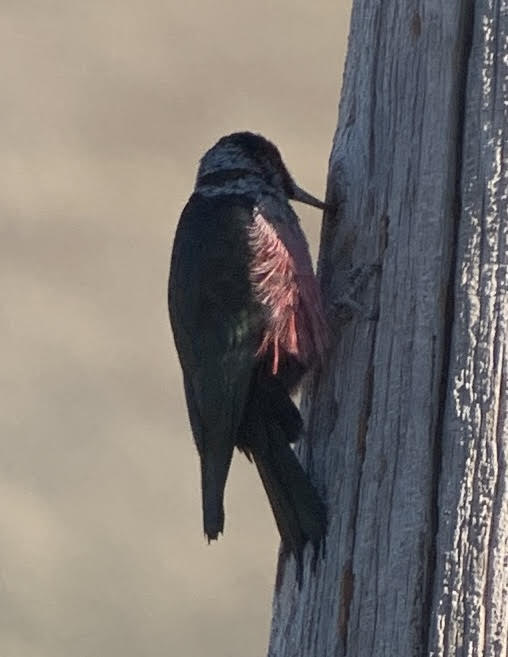
Lewis’s Woodpecker

Loggerhead Shrike

Mountain Bluebird

Mourning Dove

Northern Flicker

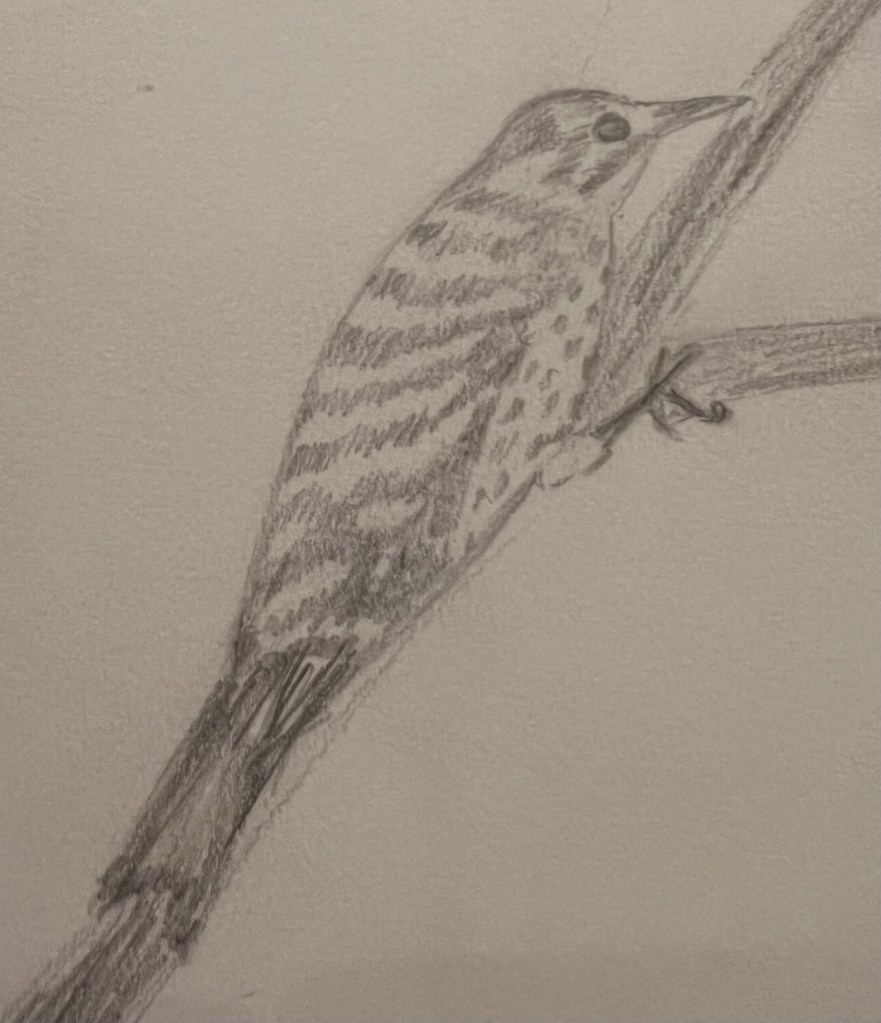
Nuttall’s Woodpecker

Pipit

Red-tailed Hawk

Red-winged Blackbird

Say’s Phoebe

Photo courtesy Sashi S.

A photograph of a Lewis’s Woodpecker that we took through a birding scope.

Sketch and photo by Meru S.

A sketch of a Nuttall’s Woodpecker from my nature journal.

The 2023 Central County Christmas Bird Count is tentatively scheduled for December 16th. The Count for East County is tentatively scheduled for December 20th. For further information on these and other events, please visit: Mt. Diablo Audubon Society.

Arts and Culture, Student Life

Book Review of The Martian

by Guest Author Lucas D.

The story follows Mark Watney, a member of NASA’s team sent to explore Mars. After a martian sandstorm leaves him stranded and injured, he is cut off from human communication and left to face the overwhelming challenges of surviving Mars. So ultimately, this book chronicles the story of Mark versus Mars. The main character’s bone-dry humor as he records his mission logs is both clever and entertaining. Another big strength of the book is the author’s attention to scientific detail and accuracy, while still managing to make the reader laugh. The author authenticated as much as possible the science behind the story. This was shown especially with application of physics on atmospheric pressure and the mathematics and chemistry behind the protagonist’s attempted solutions to problems that arise. I recommend this book for ten year old kids through adult, but the language is very explicit, so there is “Classroom Edition” for youth. This book is definitely worth your time if you are a sci-fi fan. There is a movie based off the book that I also recommend, but be sure to read the book first!

News, Student Life

How to Become a Guest Author

by Ava Salado

Do you want to publish one of your papers, essays, or creative writing but don’t have time to join The Lighthouse, no problem at all! Just become a guest writer! Email us at: thelighthousetve@gmail.com with your completed work, and we can publish it on our website. As you might have noticed, we have two (yes two!) guest authors this month. And we invite you to become one too!

Arts and Culture, News, Student Life

Poetry for You and Me

by Olive Pea

First off, Happy New Year everyone! Our Staff hopes all of you had a wonderful holiday season. Now that a new year has started we should all look back to see how far we have come and give ourselves a high-five for all we have accomplished! Don’t just look back, look to the future! The new year hosts many great and exciting opportunities for all of us. This article contains three poems that were submitted for our poetry challenge, so read on!

About the poetry challenge

Last month, our Staff posted a non-competitive poetry challenge. Submissions were to be sent to us by the 20th of December, and we got three fantastic poems! The submitted poems were to be posted in this very article, and never fear, we will not disappoint you!

Here are the three poems that were submitted by three kids from the TVE community! It’s not just poems that were submitted, actually, some art was submitted as well!

Christmastime

By Livi Skikos – 14 years old

Ornaments on every tree, some homemade of clay

People shovel snowy paths while candles light the way

Christmas cheer floods the homes of every girl and boy

Writing letters to the one who’ll bring them a new toy

Families gather ‘round to place a star on the tree

Children sled through the snow, feeling bright and free

Candy canes and silver bells remind you of the day

When Christmastime will come again, with Santa on his sleigh

HOPE

by Aleena Haimor

Hope is the bright flame

Like sunshine in the shadows

That I long to touch

Made by Max Yang

Sunfish

by Max Yang – 8 years old 

Sunfish, sunfish,

you remind me of a wish.

You are like the sun drifting away.

You remind me of the sun on most sunny days.

Oh oh, sunfish,

In my dreams,

you keep me company.

In the Monterey Bay Aquarium,

you wait for me.

Congratulations to all three of you! Give yourself a nice pat on the back for your hard work. These three poems are a joy to read!

These poems were read by our Staff, and were given these titles in the following categories:

Christmastime – Best Rhymes and Most Joyful

Hope – Best Topic

Sunfish – Brightest and Most Creative

We hope that all those who read these poems enjoyed them as much as we did. And a big virtual high-five to the participants. Once again, Happy New Year!

News, Student Life

The Terrific Train of Lights

by Lydia Martinov

Winter time? Check! Cars? Check! Hot Cocoa? Check! Thousands of lights? Check!  With holiday decorations inside and out, the Train of Lights is ready to choo-choo down the tracks. The antique coaches are quite a sight, especially in the open cars which feature wonderful views of the train. This one and a half hour ride is a truly fun activity, surrounded by a mesmerizing holiday atmosphere. The journey offers a “rare opportunity to experience a train ride through Niles Canyon at night,” as described on the Niles Canyon Railway website. It goes round trip through the Niles Canyon. With Santa Claus hitching a ride too, children of all ages can enjoy his company and the beautiful sights. The Train of Lights comes every year to take people on a Christmas-approved journey during November and December evenings.

The tickets to the train sell out very quickly, so it is recommended to purchase them months in advance. They go on sale on the Niles Canyon Railway website on October 1st, and sell out within the first couple of hours on the same day. First class tickets are sold at a higher price, and sell out even faster. These tickets come with extra perks, such as unlimited free hot chocolate, cookies, other snacks, and access to the exclusive first class cars. After the tickets are purchased, people arrive at the Niles Canyon Railway at the appointed time. The crew on the Train of Lights is made up of very knowledgeable and kind volunteers. Once everybody gets on and takes their seats, the conductor starts the train. You can walk through all the cars, which include the gift shop, a snack car (with snacks for purchase), a couple of open-air cars and uniquely decorated coach cars. Maybe, while you walk through the cars, you’ll find Santa Claus! You can take a picture with him, or ask him a question. 

I took a ride on the Train of Lights to take pictures for you to see. As one of my fellow passengers said, “The beauty of the train doesn’t show as well through photos, as it would in person.”  Here are some of them:

The train turning past a train crossing through the dome car window:

Photo by Lydia Martinov

Inside of one of the cars:

Photo by Lydia Martinov

Some fun Christmas decor

Photo by Lydia Martinov

Enjoying the view in an open car:

Photo by Lydia Martinov

Beautifully decorated open car:

Photo by Lydia Martinov

Some of the cars get pretty busy:

Photo by Lydia Martinov

The outside of the train:

Photo by Lydia Martinov

According to Jaqcuez Verdier, a first-class Dome car volunteer, “There are over a million Christmas lights on the train.” The reason it is called the Train of Lights is because each car is decorated by many lights, which in turn, are powered by 2 generators. 

When Santa came to the car we were in, my sister asked what he would like for Christmas. He said “I would like for all of the boys and girls to get what they wanted for Christmas this year.”

Santa!!!:

Photo by Lydia Martinov

The Train of Lights is a truly magical thing. Maybe you can take a ride someday, and see Santa in person. Don’t forget to have a cup of hot cocoa, and ask the volunteers about the train. They are very knowledgeable. Have a wonderful 2023!

More information at:

Train of Lights