Arts and Culture

The Hidden Meanings of Howl’s Moving Castle

by Lydia I. Martinov

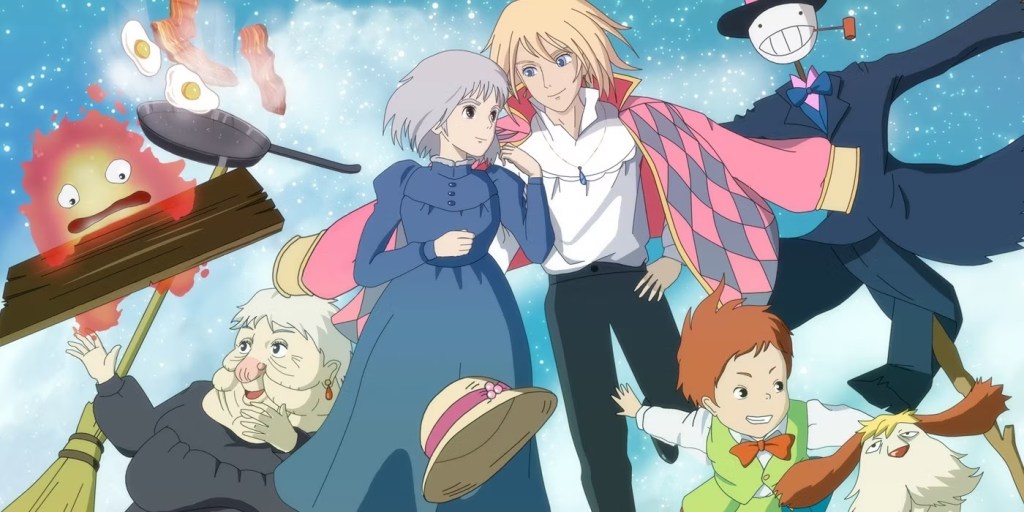
Howl’s Moving Castle is a book by Diana Wynn Jones, which was turned into an animated movie by Studio Ghibli. It has many philosophical sub-themes, and hidden meanings. It is not your average kids movie. When you first watch this masterpiece, you will probably find it unusual, strange, or even insane. Nobody knows exactly what the author of the book, Diana Wynn Jones, or the director of the movie, Hayao Miyazaki, were going for with these hidden meanings, but many have come up with some very interesting theories. 

The Castle:

A popular theory about the castle is that it symbolizes Howl’s unwillingness to settle down. It’s a bit strange, but the castle and Howl are kind of the same. It is powerful, but it appears to be disorganized and on the verge of falling apart, a lot like how Howl is crushed by the weight of his burdens, and can collapse at any moment. The state of the castle changes near the end of the movie, and stabilizes, mirroring Howl’s change.

The Curse:

In the beginning, Sophie is a young girl working all day, not having fun like other girls her age, and overall acting like an old lady. Because she is the eldest of three, she feels the need to work all day, and every day in her father’s hat shop, and one day take over. She has no life outside of the shop. When she was put under the spell, she didn’t fight it. She just accepted it. I believe that the curse reflected the age of her soul. The more she fell in love, and felt young, the younger she became. In other words, the curse is a metaphor to how Sophie feels on the inside. Whenever she would feel confident and passionate, you could see a glimpse of her youth. That’s why her age kept changing throughout the movie. In the beginning, she enjoyed a quieter, slower life. It was only after she became an old woman that she realized that life is too precious to waste.

Sophie’s Hair:

Why did Sophie’s hair remain grey? A common theory is that the curse never truly went away. Maybe a hint of the magic from the curse made it the color of “starlight”.  On the other hand, it could represent her life experience. Maybe the wisdom that she gained on her journey caused the grey in her hair to remain. Her entire personality did not change. Just her experiences.

Time Travel:

Sophie went back in time and saw young Howl and Calcifer. She said “Find me in the future”. Howl, as a child, remembered and began a journey to find her. He recalled her as the most beautiful girl in the world. In order to find her, he began searching, and decided that he had to look “beautiful” himself in order to seduce beautiful girls so he could eventually find Sophie. This is why he was so sad during his hair crisis. He thought he was not attractive enough for his questionable methods. Furthermore, he seduced the Witch of the Waste because he thought she was beautiful, but left her when he found out she used spells to keep herself looking pretty. 

Howl’s Curse:

Howl’s curse was the contract he made when he traded his heart to Calcifer so he could gain power. Without a heart, he slowly becomes emotionless and inhumane. Sophie was the only one who could break the curse, which is what happened after he fell in love with her. Since Calcifer is technically Howl’s heart, when Sophie came into the castle it was as if Howl was letting her into his heart. Also, many rumors stated that Howl “ate” women’s hearts. In reality, he didn’t “eat” them. He broke them.

If you haven’t already read the book (or seen the movie), it is highly recommended that you do. Prepare yourself for the adventure of a lifetime as you travel with Sophie Hatter to a moving castle with a handsome wizard, and a “scary”, powerful fire demon.

Courtesy of Screen Rant
Stories

Four Little Hunters ~A short story

by Olive Pea

It was August in a small English town, and the melancholy gray sky over the trees had ceased its weeping for just a moment. Four children pleaded to be let outside and their mothers finally shooed them through the doors to play for a while, but not without the usual warnings, “be safe, don’t ruin your clothes, and do not go near the woods”. Within minutes, the four young boys convened at the northern edge of town, gaping up at the wall of trees that seemed to erupt from the ground like knives.

The foolish four knew of the beast in the woods. The teachers and parents warned, the townsfolk whispered, and recently the paper brought news of three missing young men found dead in the woods. But never mind all that. Today these four children were, according to Adam, to become heroes, monster hunters, the stuff of legends. Adam, of course, was the leader, as always. He had gathered the other three around him, forming a sort of square.

“I shall defend you all, as your leader, with my mighty sword!” Adam declared, hoisting his fantastic sword, an old stick, to the gray sky, tossing back his hazel-brown hair with a flourish. Bertie looked up at him in awe, just as he always did. Bertie was Adam’s best friend, 10 years old like Adam but stalkier with fair hair. They were both best friends since before they could remember and spent every day after school at each other’s houses. 

The other two boys were younger. Connor and Sean Wallace were 9 and 5 respectively. The brothers had flaming red hair and sparkling blue eyes. They had moved to the town in January from Ireland after their father died. They were mostly quiet, but when they did speak their voices rang with the melodious tones of their homeland.

“I don’t reckon you’re plannin’ on goin’ in there,” Connor said, his bright blue eyes nervously flitting across the forest line. “That’s where the beast is.”

Adam shot him an irritated glance. “That is the plan, we are monster hunters after all. We’re going to find that beast and kill it!”

“But–but they told us not to. It’s dangerous! We could get hurt—”

“Shut up. We’re monster hunters, don’t listen to the old people, they’re looney!!”

“I will go in,” Bertie said loyally.

“Alright then, in we go!” Adam declared.

So, in they went. Three excitedly skipping through the first trees, while one cautiously crept. With Adam leading, sword raised, they stormed through the forest like titans. Past a boulder. Around a pond. Over a fallen tree. Dusk had begun to seize the sky when they finally found the perfect cave. The walls dripped with moisture, leafless vines covered the entrance, and a decrepit tree stood on either side, bent and shriveled with death. Little Sean danced around in a circle and giggled, while Bertie looked at the cave with glee. Connor kept glancing over his shoulder; Adam had a stealed look painted on his face. He held up his mighty sword. Then the sky began to weep again, and they pulled their hoods over their heads.

“What is that?” Connor pointed at a muddy mark on the ground. It looked like a footprint. There were more, leading into the cave. 

Adam investigated and announced, “Monster tracks. We’re going in my crew, heave ho!”

Conner did not like this, looked at Adam with a furrowed brow, and said with concern, “if we really have found monster tracks, then I say we should tell the grownups. It’s too dangerous. We could die Adam, we could die!”

Adam laughed. He laughed some more. Then Bertie joined in. Even Sean, aloof, began to giggle. When Adam had finally gained control over his outbursts, he shouted, “we are going in! We are monster hunters, and I shall kill the monster with my sword and rid these lands of this beast!!”

Conner didn’t look so sure of that and said warily, “I’m staying out here.”

“That’s right, you’ll be our guard’” Adam proclaimed. He then turned toward the cave and under his breath muttered, “looney.”

Bertie copied Adam and whispered stupidly, “looney.”

So in they went, except Connor who was stationed just outside the mouth of the cave. All flashlights clicked on at the same time, as was Adam’s orders.

Dark and brooding stood the thing. Its ghastly sunken face loomed 5 feet above their heads, suspended from an unnaturally tall and twisted body like a rotting tree. The thing opened its mouth, revealing a cavern of rows and rows of sharp teeth, and it inhaled with a raspy gurgling sound, sucking out the light of their flashlights. The shadow neared them, and footsteps thundered off of the cave walls. Then the noise abruptly stopped, the tall shadow right before them. Adam screamed and jumped forward, swinging his sword wildly in all directions. Then a piercing shriek came from Bertie, beside him. The monster growled and its footsteps boomed out of the cave. Sean started to cry as moans of agony came from Bertie’s hunched shadow. Adam rushed towards him and dragged him out of the cave, ordering Sean to follow.

Now he could see Bertie’s face; a slash ran across his left eye from his forehead to his left cheek. Adam looked at his mighty sword. Its tip was red with blood, and Adam smiled giddily.

“Look Bertie, I wounded the beast! I sliced at him like a true monster hunter, and scared him away. Now he shall have a great scar to remember me by. Hah!”

Bertie moaned, clutching his ruined eye with both hands.

Connor then rushed from his hiding spot in the bushes towards the three, a look of horror on his pale face.

“It’s comin’ back!! It’s comin’ back, run!!!”  

They heard the crashing footsteps quickly nearing them once again. Adam grabbed Bertie’s arm and pulled him while Connor swooped up his little brother into his arms.

Then they became like all things hunted, running breathlessly and numbly; deer leaping over logs, hares bounding amongst the ferns, mice scurrying through the grass. But the thing was fast. 

Tears in their eyes, hearts pounding vigorously, legs aching, the boys ran, Adam still pulling Bertie along and Conner carrying Sean. Their clothes tore as the branches and bushes snatched at them like gnarled hands and fingers; the rocks tripped them, making them stumble into muddy puddles that filled their boots; even the wind seemed to be fighting against them as it pelted raindrops in their faces at a slant; nevertheless, they sprinted as fast as they could. Over the fallen tree. Around the pond. Past the boulder. The footsteps subsided, but their fear had not and so they mindlessly continued to flee in panic.

The rain fell like arrows shot from heaven, the inky stain of death from the fallen sun had bled through all remaining daylight, making it difficult to see, but still they stumbled on.

The four finally reached the town. Though lamps were lit the streets were bare. They struggled toward the first house, and pounded on its vivid red door. Exhausted, panting, Adam released Bertie and Connor set Sean on the sheltered porch. The door opened and an elderly man, back bent with age, looked down upon the ragged boys. “You hunted it, didn’t you? Come in you fools! You should have heeded the warnings. You could have lost more than an eye!”

The End

Science

Learn About Your Body – The Skeletal System!

by Aleena Haimor

Wow! We’re already three systems in! Next up on our list of the body’s systems to learn about is the skeletal system. The skeleton is made up of bones, which act as the body’s support system. 

Here are some of the most important bones in your body:

  1. Skull – Protects the brain and sensory organs (eyes, ears, etc.), making it vital for protecting the central nervous system.
  2. Spine (Vertebral Column) – Protects the spinal cord, allows flexibility, and supports the body’s weight. It is crucial for movement and posture.
  3. Femur – The thigh bone is the longest and strongest bone, supporting much of the body’s weight during movement, walking, and running.
  4. Pelvis – Supports the upper body’s weight while standing, walking, and running, and protects vital organs such as the bladder and reproductive organs.
  5. Rib Cage – Protects the heart and lungs, two of the most vital organs for survival.
Source: teachpe.com

The skeletal system is super cool! Some facts about it are: as a child, you have around 270 bones, but as you get older, some of them fuse together to get 206 bones. Another fact is that there are different types of bones, including Long bones, Short bones, Flat bones, Irregular bones and Sesamoid bones.

In the end, each body system makes its own contributions to the body, and the skeletal system is no different!

News

Air and Naval Power in WWII – What Were Its Effects and Was It Worth It?

by Emery Pugh

The 1900s were a period of military technological revolution. The airplane changed the scope of warfare and was constantly improved upon since its invention. Radar and sonar were introduced during WWII. Battleships gained more and more firepower and had cannons that could launch projectiles farther and farther. Aircraft carriers were emerging as an extremely important asset in naval tactics. So how did the airplane and the warship impact World War II?

Air forces and navies were used as auxiliaries to enhance ground operations. If you had naval or air parity with another country, it meant that neither country was able to destroy enough air or naval assets of the enemy to gain an advantage. Superiority meant that you could attack enemy ground troops with little worry of opposition, and supremacy meant total control – you could do whatever you intended in that realm with almost no resistance because you had destroyed all or nearly all of the enemy’s assets (planes or ships) in that realm and their industrial capability to produce more. Air power was used to target the enemy’s industrial capacity by using strategic bombers, such as the Boeing B-29 Superfortress (see image below). Tactical and attack bombers could provide valuable support to land operations, and fighters patrolled the skies to attempt to shoot down enemy bombers and other fighters. Naval power could be used to bombard coastal military bases and industrial factories. Each type of ship was generally specialized for one or two purposes. The main types of ships are: aircraft carriers, which were used as mobile airbases, battleships to counter surface threats with their immense firepower, battlecruisers as a lighter and more mobile version of a battleship, destroyers for scouting and neutralizing enemy submarines, cruisers mainly for anti-air with some surface combat elements, submarines for stealth and surprise, and support ships for resupplying oil, food, and other resources.

Image of a B-29 Superfortress strategic bomber

How did each military of the six major powers in World War II – the United States, Great Britain, the Soviet Union, Germany, Italy, and Japan – use air and naval power? The Germans had huge initial successes against its neighbors with its army-focused military, though they did have an air force and a navy. The German Luftwaffe, the name for the German air force, was highly lethal at the beginning of the war. The German Kriegsmarine (the German navy) consisted primarily of U-Boats, also called submarines. Despite how effective the Germans were against its neighbors like France, though, they couldn’t seem to dominate Great Britain or any of the other Allied powers the same way. That’s because the German military could only fight efficiently against enemies a short distance away. The German air force did not have very many long-ranged bombers like the United States or Great Britain. In fact, they did not build a single four-engine bomber throughout the entire war. Once they realized the importance of aircraft carriers and how far behind they were in the production of aircraft carriers, the Germans started mass-producing hundreds of submarines to compensate for the lack of aircraft carriers. Not the right move.

Image of a German U-Boat

Militarily, Italy usually took a back seat to Germany. For the Italians, the main battlefront was in North Africa against the British and later the Americans as well. Italy’s navy and air force didn’t play a major role, but the navy was mainly used to protect supply routes and maintain superiority in the Mediterranean. Both Italy’s navy and air force were outmatched by the British and Americans in technology and coordination. Italian officers were often overly cautious because of Italy’s limited resources available to produce military assets.

Japan’s naval strategy was aimed at one goal: to defeat the American Pacific Fleet as fast as possible. Japan knew that they would lose in a war of attrition against the United States, since the U.S. had far more industrial capacity. To begin with, Japan actually had a more powerful navy and air force, in terms of numbers. The Japanese not only had industrial shortcomings, but also the lack of the ability to train enough pilots. Japan used island bases as “unsinkable” yet immobile aircraft carriers. These islands created a ring of defense for the Home Islands. Yet they had a major problem: they could not supply their military with enough fuel and across such great distances between the Pacific islands and their sources of oil. However, American submarines intervened in Japanese shipping routes to disrupt their stratagem. Japan’s air strategy was built on surprise and quick yet sharp strikes, like at Pearl Harbor. Later in the war, Japan shifted to a more defensive stance and opted for kamikazes (suicide by crashing into enemy ships with planes). They hoped that enough people would be willing to sacrifice themselves for the survival of Japan and the kamikazes would be successful so as to sink a sufficient number of American ships to have a chance at winning the war.

The Soviet Union did not have a major air force or navy. About 80% of their military personnel were in the army. Russia did not have motivation to have a sizable navy or air force, since the only goal of their military was to stop Germany from taking Moscow. They were more likely to invest their resources into making an artillery unit or a tank than a strategic bomber or a battleship, for example.

Great Britain had the largest and most powerful navy going into World War II. The Royal Air Force (RAF) was also arguably superior to all other air forces. Britain’s approach to fighting the war was defensive for the first couple years. Its air force engaged the German Luftwaffe in the famous Battle of Britain, successfully preventing the Germans from launching an invasion of the British Isles. The RAF launched strategic bombing campaigns against the Axis Powers in Europe (primarily Germany) and provided intelligence on German troop movements. Elements of the RAF were stationed across the world (mostly in Europe), such as Norway and Greece, to help defend those countries from Germany and Italy. Their navy was critical in protecting transport ships from their colonies, such as Canada, Australia, and India. Near the end of the war, combined British and American naval forces gained naval supremacy (complete control over the seas) in relation to the European Axis powers, which allowed them to execute Operation Overlord, also known as the amphibious landing at Normandy or D-Day.

Last but certainly not least, we come to the United States of America. The United States entered World War II with a comparatively small constable force to the major European powers, since they had no reason to have a large military – it’s not like the U.S. was planning to invade Canada or Mexico, and we didn’t want to get involved in WWII, although we sympathized with the Allies. At the outset of the war, the United States had around 1.4 million active-duty troops. After WWII, that number increased to over 12 million, which was the largest mobilization ever performed in the history of warfare. America’s air force had only around fifteen hundred planes when they entered World War II in 1941. Four years later, they had a staggering 80,000 planes. Similarly, the American Navy also experienced rapid expansion in the extreme: in 1941, the United States had approximately 790 ships and 8 aircraft carriers. At the end of WWII, they had a mind-blowing 6,800 ships and over 100 aircraft carriers, an unimaginable industrial feat. The naval tonnage (how much the navy weighs) of the United States exceeded that of Great Britain, France, the Soviet Union, Germany, Italy, and Japan combined after 1945. Yet a highly productive economy was not the only reason why the United States was able to become such a great military power. While Japan’s admirals had vaunted reputations due to the empire Japan had established in the Pacific, they did not adapt to the new style of naval warfare that was taking hold. Admiral Yamamoto’s tactics were based on outdated and conventional teachings. He wished to engage the Americans in classic style with battleships. On the contrary, most American admirals, such as Chester A. Nimitz and later Arleigh Burke, recognized the importance of aircraft carriers and preferred more mobile ships such as destroyers over the clunky and slow battleship. In both the European and Pacific theaters, the United States supported ground operations (in the Pacific, U.S. Marines to take islands) and had strategic bombing campaigns to destroy the Axis Powers’ ability to produce enough naval and air assets to fight back.

Image of an Essex Class aircraft carrier

So, going back to one of our original questions, was air and naval power worth it? For the United States alone, approximately 90,000 airmen and 62,000 naval crewmen died. Hundreds of thousands of airmen and naval crewmen died from all countries engaged in World War II. More than 20,000 ships and submarines were sunk, and over 100,000 aircraft were destroyed. Accounting for modern day inflation, the budget for WWII was over $4.1 trillion for all countries combined. Air and naval power accounted for a significant portion of that amount. Despite all that, in my opinion, air and naval power was worth it. Because without it, the Allies would likely not have won World War II. Many lives were lost, but at the same time, many lives were saved. If air and naval power were not as preeminent as they were, ground forces would have to fight many more fierce battles, resulting in far more casualties than what actually happened.

You might be thinking: if air and naval power reduced casualties, why does World War II have the most casualties of any war, including World War I? That’s a good question. To explain the immense amount of death and injuries, you can turn to Germany and Japan. The German and Japanese armies were not just conventional armies; they were slaughtering machines, instructed to kill anyone in sight whether in a military uniform or not. Approximately nineteen million Russian civilians were killed by the Germans (excluding the 8 million military deaths), and around 15-20 million Chinese civilians were killed by the Japanese (this estimate varies: some say around 7 million, others as high as 50 million). Russia and China weren’t the only places of mass killing, though. Japan committed war crimes all around the Pacific, killing millions from whatever territory they happened to conquer. Germany had thousands of infamous concentration camps, where millions of people were sentenced to death (primarily Jews). As you can see, a major part of deaths in World War II were not caused by battles. Air and naval power, in the end, saved lives.

I’ll wrap it up with one of the most debated subjects in World War II: the droppings of the atomic bombs on Hiroshima and Nagasaki. Some think of it as an inhumane war crime. Others call it a show of power to scare the Soviet Union. Still others think it was used as a method to quickly end the war. Yet another viewpoint argues that it was a way of getting back at the Japanese for Pearl Harbor and the other atrocities the Japanese committed. There are countless different perspectives on this topic, but I don’t agree with any of those listed above. Japan had refused to surrender for months and stated that they would fight until the end. The United States had three options: execute a ground invasion of Japan, continue to fire-bomb the Home Islands, or drop nuclear weapons. A ground invasion of Japan could potentially cost tens of millions of lives (especially due to the suicidal nature of Japanese soldiers and civilians), and fire-bombing Japan would similarly cost millions of lives. The atomic bombs killed at most half a million people (accounting for deaths caused by aftereffects), which stands in sharp contrast when compared with the other two options. Nobody supports the use of nuclear weapons, and half a million lives is still a lot, but there was no other better option at the time. The U.S. dropped the second bomb only because Japan still refused to surrender. Based on this reasoning, I think the real motive of the United States dropping the atomic bombs on Hiroshima and Nagasaki was simply to save lives.

Arts and Culture, Student Life

As We Walk Through the Woods – A Poem

As we walk through the woods,
we try with all our might
to make memory of this beautiful night.
For we stand under the stars of the sky.
We talk til day has come,
and sun has risen.
As we walk through the woods,
I can’t help but grieve.
For it is a time of sorrow,
a time of loss,
a time of death,
a time to mourn with what’s left.
But the war is over,
the war is won.
We have battled the last battle
and we have won!
Peace has fallen, ground is regained.
Plants regrown,
buildings rebuilt,
as we walk through the woods

By guest author Jonathan David

Home

Hudson Ebach – Staff Writer

Hudson, 15, has been with TVE for about three years. Being in a Military family, Hudson has spent most of his time moving around the US, only sticking around the eastern part until 2021. So Hudson seems like this alien from Michigan, but anyway, Hudson enjoys spending his time either listening to Will Wood, playing video games such as BeamNG.drive, Stardew Valley and Halo: Reach, editing videos/skits, making skits such as Skater Dave, Go Karting, drawing, and hanging out with his friends and family.

Our Staff

Camden S. – Technology Editor

Camden S. is 15 years old and enjoys spending his free time coding, creating board games and making stuff with his 3D printer. Also, he loves animals, especially dogs. He enjoys reading and his favorite subjects to learn about are history and science. A passion of his has always been computers and he loves learning about how they work, and his future job will probably have something to do with computer science. He is always excited to learn more about the world around him. An interest of his since a young age has been paleontology and he has always loved Jurassic Park! Another thing he enjoys is being in nature and exploring new places. He is excited to explore Europe and Hawaii the most. He also enjoys fencing and would like to participate in tournaments in the near future. He likes playing games like chess, risk and monopoly with his family and friends.

Science

What is a Good Game Engine for Beginners?

by Camden S.

What is a game engine? A game engine is a software that is essentially a framework that can be used to create video games. It can help you create a video game by providing tools that make the process easier. There are many game engines, and a lot of them have a very high learning curve. Here are some recommendations of game engines for beginners:

Scratch is a free 2D game engine designed by MIT, and was created as a nonprofit game engine. It is a very basic game engine, but can be a great introduction to video game development. Scratch uses a block system to code and is better at creating smaller games. Because it is nonprofit, they do not let you sell anything made on Scratch.

GameMaker is primarily a 2D game engine, but can be used for some 3D games. It has a free version, but if you plan to sell your game you will have to purchase the game engine. GameMaker has their own coding language, but they also have an intuitive visual scripting system which does not require coding knowledge. This game engine has a decent sized community, an asset store, and free tutorials for you to use. You can publish your games almost anywhere,  including consoles, and there are no royalty fees. With the free version you can still upload your game to GX.games.

Construct 3 is very similar to GameMaker, and is considered a great alternative. Like GameMaker, it is primarily a 2D game engine, but has limited 3D as well. It includes a free trial, but to sell your games you will have to pay for a subscription. Construct 3 uses JavaScript, but it has a very good and intuitive visual scripting system. Construct 3 has a smaller community compared to GameMaker, but it has a great asset store, and the free tutorials are well made. You can publish your games almost anywhere (except consoles), and they do not have royalty fees. Also, you can publish games made on Construct 3 to their arcade for free.

Which one is best? It really comes down to personal preference. You may like one game engine better than another. Since Scratch is so simplistic, if you are planning to make a polished game, it is probably better to find a more advanced game engine. You might even find that as you get better at making games, game engines like GameMaker and Construct 3 do not have the features you might need. There are many other great game engines that have more features and have better 3D capability. Some more advanced game engines are Unity, Unreal and Godot. Keep in mind that some game engines like Unreal are known to have a high learning curve.

Different game engines are better suited for different types of games. Try experimenting with multiple game engines to see which one works best for your project. There is no wrong choice. It just depends on which one you like best.

Science

Learn About Your Body – The Digestive System!

by Aleena Haimor

Our next body system is the digestive system! When you eat food, your body has to turn it into nutrients to keep you going. The nutrients are energy for your body. This is all done by your amazing digestive system!

Here are the steps to digesting food:

  1. Ingestion: Food enters the mouth. You chew the food, mix it with saliva, and swallow it.
  1. Propulsion: The food moves down the esophagus.
  1. Stomach: In the stomach, the chewed food is mixed with stomach acid which breaks the food down further. This is called chyme
  1. Small Intestine: Chyme moves into the small intestine, where nutrients are absorbed from the food.
  1. Absorption: Nutrients are absorbed through the small intestine’s walls via villi and microvilli into the bloodstream. 
  1. Large Intestine: The leftover undigested food and waste products move into the large intestine, where leftover liquids are absorbed, and the remaining material becomes feces.
The Digestive System.
Source: k8schoollessons.com

The circulatory system contains many interesting secrets and facts! Did you know that in its entirety, the adult digestive system stretched out would be about 30 feet long? Also, did you know that it takes about 24 to 72 hours to digest food? 

Overall, the digestive system is a very interesting part of the body. It is important to help us take in nutrients. Wow!

Stories

The Midgard Serpent – Percy Jackson Fanfiction ~ Ch. 10

by Emery Pugh

SPOILER ALERT: The following content may reveal parts of the plot of the Percy Jackson book series. There may also be spoilers about the Heroes of Olympus book series, which is a five-book sequel to the Percy Jackson series. The Trials of Apollo series, the sequel to Heroes of Olympus, will be mentioned. It is highly recommended that you read at least the Percy Jackson series AND the first book of the Heroes of Olympus series. If you don’t mind the spoilers, then read on. Don’t say I didn’t warn you.

Chapter 10

Godric

         It could not have been me! There must have been another son of Zeus in the room! Right? This must be the one time I get lucky.

         Unfortunately, no. Everyone in the room was staring at me.

         “You have a few days to prepare before the Roman campers arrive,” Chiron said. “The quest will be announced to the rest of the camp tomorrow. Meeting adjourned.”

         Everyone else filed out of the room. I stood there in silence, staring at the surface of the Ping-Pong table.

Chiron wheeled over to me. We were alone.

He put a hand on my shoulder. “I’ve seen many heroes go through the same challenges as you, but fate chose you – for a reason.”

“What reason?” I asked, still staring at the Ping-Pong table.

“Because you can do it.” Chiron smiled and started to wheel himself out the door. “Oh,and one more thing, Godric.”

I looked at him. “Yeah?”

“Trust the one who seems most unlikely.”

“Okay,” I said slowly. “But… who is the one who seems most unlikely?”

“It’s what they always ask,” sighed Chiron. “That’s for you to figure out. Now go get some sleep. You’ll need it.”

I didn’t sleep. I didn’t even go to my cabin. For the next few hours, I stood there, staring at the Ping-Pong table. Once that got boring, I roamed around camp, hardly knowing (or caring, for that matter) where I was going.

The sun finally rose from the east. I stopped walking and snapped to attention. I found myself at the edge of the camp woods.

A howl came from the trees. It was surprisingly close by. I reached for my sword, but it wasn’t there. I cursed and remembered that I had left it in my cabin before the camp counselor meeting. So naturally, I ran.

I caught a glimpse of a wolf flashing between the trees. I was pretty sure it was one of the same pack of wolves in the Labyrinth during capture the flag.

The conch horn sounded. It was time for breakfast.

Before going to the dining pavilion, I rushed to my cabin and grabbed my sword and set off on a run. I almost knocked over Sanderson on the way out.

“Ow!” Sanderson gasped. “My ribs!”

“Sorry,” I said sheepishly.

“Where were you last night?” demanded Sanderson. “I came to your cabin to tell you something.”

I thought for a moment. “Honestly, I didn’t even know where I was going for most of the night. So… what were you trying to tell me?”

“I wanted to tell you that I’m in on the quest.”

That comment made my day. He actually volunteered to sign his death warrant by going on this quest with me.

“Thanks, man. Now we can both die together.”

Sanderson grinned. “Yup. C’mon, let’s go to breakfast.”

I sat down to breakfast with absolutely no appetite. Time seemed to whizz by like a flash. I had just sat down and stared at my food for a little bit when Chiron pounded his hoof on the marble floor.

“Announcements!” he called, as the diving pavilion quieted down. “A quest has been made. The Romans have discovered what has been causing these monster attacks. A team of seven will be organized, of both Romans and Greeks, led by Godric. He is yet to choose his quest partners.”

Murmuring rippled across the room. I could tell I was receiving many glances and stares.

Chiron opened his mouth to say something, but froze and slowly sat down. The muttering came to an abrupt halt. I looked around wildly, thinking that I suddenly went deaf. Then I realized what actually happened. They were all staring at the new camper, Hector, who was sitting at the Hermes table, as is custom for unclaimed demigods.

Shadows were swirling around Hector. A dark skull flashed for a moment over his head. Some of the other campers screamed.

Hector looked confused. “What? Why are you all staring at me like that?”

Chiron stood up. “Welcome to Camp Half-Blood, Hector, son of Hades.”

I abruptly stood up and pointed at Hector. There was a reason why Hades chose to claim his son at this moment. It was a sign.

“You’re going with me on this quest,” I said.