Science, Student Life

The Psychology of Stress

by Lucas David

Understanding stress is very important for a number of reasons, especially for teens, who experience comparatively high amounts of stress in their daily lives. For one, stress has a direct impact on your mental wellbeing, as it can cause you to feel overwhelmed or anxious, as well as causing difficulty concentrating, memory problems, and sleep changes. For another, it can affect your physical health by damaging your heart’s functionality, causing digestive issues, weakening your immune system, making it more difficult to sleep, and much more. It is also important to understand stress because it helps allow you to identify stressors in your life, recognize your bodies reactions to them, and develop methods to cope with them and manage your stress levels before they begin to affect your physical and mental health. Recognizing stress early on can help prevent you from developing health issues, and make them significantly easier to manage if they arise. This can lead to improved mental wellbeing, enhanced decision making, healthier relationships, greater productivity, and an increase in happiness overall.
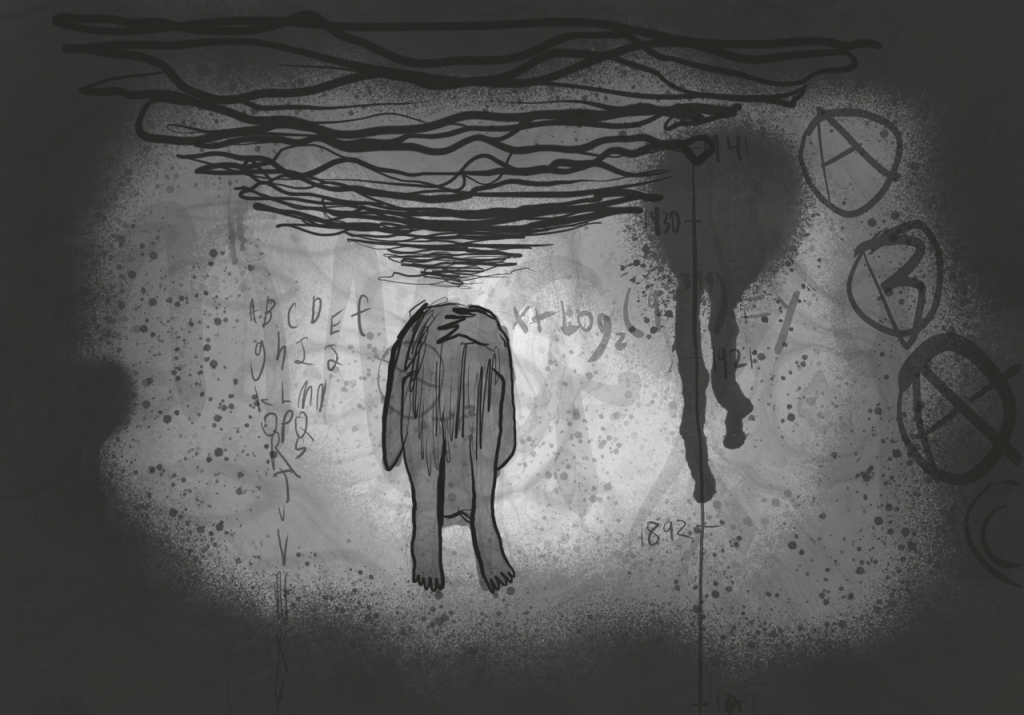
Image made by Lucas David

So far we’ve talked a lot about what stress does, but what is stress, anyways? Stress is a natural response to threats or challenges that involves both the mind and the body. It can help prepare you for the future, but too much of it can negatively affect your health. Stress is caused by significant events such as moving to a new home, beginning a new job, going through trauma or an onslaught of homework or illness. Very often, it is helped along by a perceived lack of control, a feeling of social isolation, negative thoughts or beliefs or poor coping mechanisms.

However, not all stress is bad for you. Good stress, or eustress, is a short term challenge that can motivate you to succeed and help you develop as a person by building resilience, developing life skills, helping to focus your energy, improving your performance and enhancing your sense of accomplishment. Bad stress, also called distress, is long term and can damage your health by creating anxiety, confusion, worsening your concentration and lessening your performance. To help monitor your stress to make sure that the majority of it starts with an eu, we need to talk about stressors. Simply put, stressors are stimuli that trigger a stress response in an organism. By monitoring which stressors cause distress, and which cause eustress, we can develop coping mechanisms to help alter our stimuli to suit our needs.

Coping mechanisms are behaviors or strategies individuals use to manage the negative effects of spending time in stressful situations. Some common examples of coping mechanisms include exercise, relaxation techniques such as deep breaths or meditation, social support, positive thinking, journaling, and focusing on what you can control. Most types of coping mechanisms can be sorted into one of two categories: Problem based coping, which involves trying to sort out the real-life source of the stressor, and emotion based coping, which involves focusing on dealing with the emotions that spring from the situation. Perceived control can also have a huge impact on a person’s ability to cope with stress because when a person believes they have agency, or the ability to affect a situation, their ability to cope with stress from that situation increases significantly.

Managing our stress is one way that we, as humans, attempt to chase happiness. What is happiness? Happiness is a feeling of joy, contentedness, satisfaction or well being. It is a complex, multi-faceted emotion that is influenced by many factors, including social and cultural norms, and is highly subjective, meaning that what makes one person happy may not make another person happy. Flow, and whether or not a person regularly enters what could be considered flow, can also have an influence on a person’s happiness because it is a state of mind in which a person is fully immersed in an activity, and highly focused and enjoyable.

For teens, Psychology Today offers some tips to keep stress levels low. For one, it states that having smooth communication with parents can make a large difference. That means being open and honest with your parents about your life and emotions. It’s also important to set realistic expectations for yourself, knowing that not only is it ok to fail at things, but it in fact provides opportunity for growth. Personally, I suggest setting and enforcing your personal boundaries with yourself and others, to help keep you from being pushed too far from your comfort zone.s

In conclusion, we covered a range of topics relating to stress and mental wellbeing, including stress itself, good stress versus bad stress, flow and the pursuit of happiness. We also learned that managing stress and understanding your stressors can be vital to helping to keep from becoming overwhelmed, as well as how our use of various coping mechanisms can have a significant impact on our daily lives. Many of us, as teens, are often heavily exposed to all kinds of stressors, from social situations to academics to family issues, and we must be self-aware to stay happy and healthy.

Arts and Culture, Science

Concorde: A Pinnacle of Air Travel

By Hudson Ebach

The Concorde was a supersonic jet airliner, manufactured by Aérospatiale, British Aircraft Corporation, Sud Aviation, and British Aerospace. It was made in 1976 and was retired in 2003.

About The Concorde.

The Concorde went speeds up to Mach 2 (over 1500 MPH), making it the fastest airliner to have ever been built. It was so fast that if you left London in the afternoon and flew to New York, the passengers would see the sun rising again! It flew faster than the earth’s rotation!

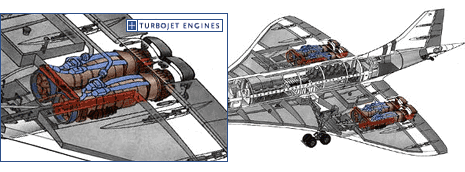
The engines, Rolls-Royce/Snecma Olympus 593 (Thanks google!) were turbojet engines. These engines (turbojet type) would eject a high energy gas stream from the engines exhaust nozzle. They were placed on the back of the Concorde’s wings.

Image from Heritage Concorde

The Concorde’s wings were different from the ones you would see today. Most airliner wings don’t connect through the whole fuselage, however “…the Concorde’s wings were triangular. And there was no space between the fuselage and the wing of the Concorde as there was in a standard passenger airliner. The Concorde’s wing was called a ‘delta-wing’ design and did the following: Reduces drag by being thin and swept back (55 degrees with the fuselage) [and] provides sufficient lift for takeoff and landing at subsonic speeds.” (courtesy of HowStuffWorks). So, just like any other plane, while unique, the Delta Wings were an important part of the Concorde.

Image courtesy of PBS

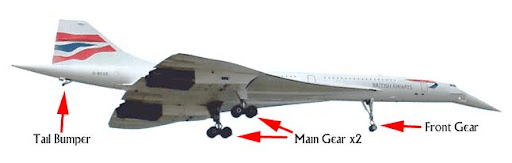
Another thing that made the Concorde unique was its landing gear. The landing gear was standard, similar to other airliners which only have three landing gear parts that come down. However, on the Concorde, there were four separate parts, two on the side, one on the front,  and one on the tail. The reason for the “Bumper” landing gear was because the Concorde landed at an 11-degree angle, caused by the Delta Wings.

Image from Concorde SST

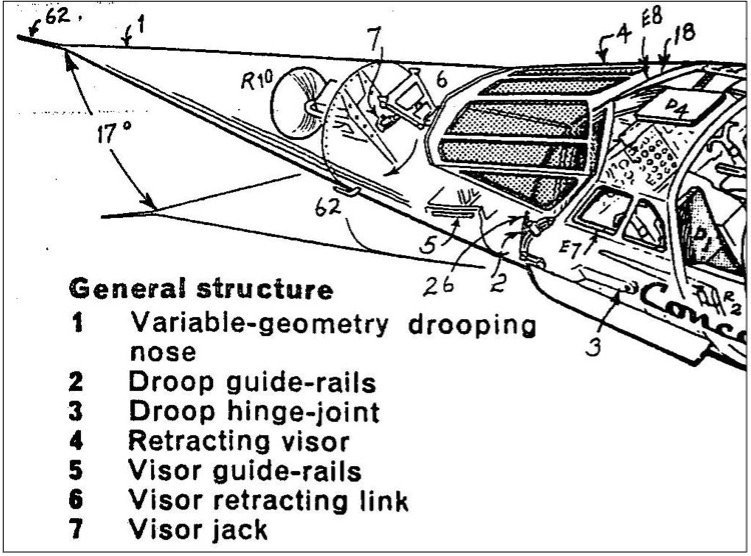
With the Concorde landing at an 11-degree angle, the pilots couldn’t see the runway while taking off and landing. To fix this issue, the nose of the Concorde would move down at a 5-degree angle during takeoff and a 12.5-degree angle while landing. This movable nose (Called the Droop Snoot) was one of the most well-known things about the Concorde. The Droop Snoot is one of the things that make Concorde one of the most well-known airliners today.

Image from hooperquinn.com/concorde

The Downfall of the Concorde.

Remember how I said, “the Concorde went to speeds up to Mach 2.”? Well, a plane that goes Mach 2 is expensive. Not that expensive, only about ONE BILLION DOLLARS. A standard A320 Is only about $10,000,000. But not this beast, you could probably fill a whole Olympic swimming pool full of Peanut Butter with One Billion Dollars. Maybe 2 pools. But the big whammy was a thing that would guarantee it shutting down.

The End of the Concorde (and Hôtelissimo Les Relais Bleus)

It’s July 25, 2000 and Air France flight 4590 is about to taxi onto Runway 26 from Paris Charles de Gaulle airport. Just before that, a Continental jet had just taken off or landed, and during that process it lost a titanium alloy strip, leaving it on the tarmac. Flight 4590 lined up on the runway with 2645.55 pounds of taxi fuel left, which was supposed to be burned off before takeoff. At this point, there were lots of red flags but ATC gave Flight 4590 the clearance for takeoff and started taking off. Everything was going fine, until one of the Concorde’s tires ran over the titanium alloy strip. The tire then exploded, shooting a piece of rubber into a fuel tank. Unfortunately at this point the leftover taxi fuel exploded in a fiery mess. The landing gear got stuck and being past the takeoff bail mark, the pilots had to take off with a fireball on the rear of the plane.

Image from Google images, believed to have been licensed to the Associated Press

So, at this point the flight is in bad shape and unfortunately it is going to get worse. Flight 4590 then tried to get to a high enough altitude to land the plane. They only got so high and then started descending, right into Hôtelissimo Les Relais Bleus. 103 people died in the plane. Four died in the hotel. This was a major cause of the downfall of the Concorde.

The Concorde had its last flight on November 26, 2003.

Should they bring back the Concorde?

In my opinion as an Avgeek, yes. But as a person who thinks “normally”, no.

The Concorde cost way too much and was a ticking time bomb. Any plane that needs a nose that moves to see the runway seems like a bad idea.

With that said, the Concorde was just a glimpse of what aviation is. Just to show what humans can do. In closing, I, Hudson, want to state, bring it back! We can make it safer and better! 

Science

Learn About Your Body – The Skeletal System!

by Aleena Haimor

Wow! We’re already three systems in! Next up on our list of the body’s systems to learn about is the skeletal system. The skeleton is made up of bones, which act as the body’s support system. 

Here are some of the most important bones in your body:

  1. Skull – Protects the brain and sensory organs (eyes, ears, etc.), making it vital for protecting the central nervous system.
  2. Spine (Vertebral Column) – Protects the spinal cord, allows flexibility, and supports the body’s weight. It is crucial for movement and posture.
  3. Femur – The thigh bone is the longest and strongest bone, supporting much of the body’s weight during movement, walking, and running.
  4. Pelvis – Supports the upper body’s weight while standing, walking, and running, and protects vital organs such as the bladder and reproductive organs.
  5. Rib Cage – Protects the heart and lungs, two of the most vital organs for survival.
Source: teachpe.com

The skeletal system is super cool! Some facts about it are: as a child, you have around 270 bones, but as you get older, some of them fuse together to get 206 bones. Another fact is that there are different types of bones, including Long bones, Short bones, Flat bones, Irregular bones and Sesamoid bones.

In the end, each body system makes its own contributions to the body, and the skeletal system is no different!

Science

What is a Good Game Engine for Beginners?

by Camden S.

What is a game engine? A game engine is a software that is essentially a framework that can be used to create video games. It can help you create a video game by providing tools that make the process easier. There are many game engines, and a lot of them have a very high learning curve. Here are some recommendations of game engines for beginners:

Scratch is a free 2D game engine designed by MIT, and was created as a nonprofit game engine. It is a very basic game engine, but can be a great introduction to video game development. Scratch uses a block system to code and is better at creating smaller games. Because it is nonprofit, they do not let you sell anything made on Scratch.

GameMaker is primarily a 2D game engine, but can be used for some 3D games. It has a free version, but if you plan to sell your game you will have to purchase the game engine. GameMaker has their own coding language, but they also have an intuitive visual scripting system which does not require coding knowledge. This game engine has a decent sized community, an asset store, and free tutorials for you to use. You can publish your games almost anywhere,  including consoles, and there are no royalty fees. With the free version you can still upload your game to GX.games.

Construct 3 is very similar to GameMaker, and is considered a great alternative. Like GameMaker, it is primarily a 2D game engine, but has limited 3D as well. It includes a free trial, but to sell your games you will have to pay for a subscription. Construct 3 uses JavaScript, but it has a very good and intuitive visual scripting system. Construct 3 has a smaller community compared to GameMaker, but it has a great asset store, and the free tutorials are well made. You can publish your games almost anywhere (except consoles), and they do not have royalty fees. Also, you can publish games made on Construct 3 to their arcade for free.

Which one is best? It really comes down to personal preference. You may like one game engine better than another. Since Scratch is so simplistic, if you are planning to make a polished game, it is probably better to find a more advanced game engine. You might even find that as you get better at making games, game engines like GameMaker and Construct 3 do not have the features you might need. There are many other great game engines that have more features and have better 3D capability. Some more advanced game engines are Unity, Unreal and Godot. Keep in mind that some game engines like Unreal are known to have a high learning curve.

Different game engines are better suited for different types of games. Try experimenting with multiple game engines to see which one works best for your project. There is no wrong choice. It just depends on which one you like best.

Science

Learn About Your Body – The Digestive System!

by Aleena Haimor

Our next body system is the digestive system! When you eat food, your body has to turn it into nutrients to keep you going. The nutrients are energy for your body. This is all done by your amazing digestive system!

Here are the steps to digesting food:

  1. Ingestion: Food enters the mouth. You chew the food, mix it with saliva, and swallow it.
  1. Propulsion: The food moves down the esophagus.
  1. Stomach: In the stomach, the chewed food is mixed with stomach acid which breaks the food down further. This is called chyme
  1. Small Intestine: Chyme moves into the small intestine, where nutrients are absorbed from the food.
  1. Absorption: Nutrients are absorbed through the small intestine’s walls via villi and microvilli into the bloodstream. 
  1. Large Intestine: The leftover undigested food and waste products move into the large intestine, where leftover liquids are absorbed, and the remaining material becomes feces.
The Digestive System.
Source: k8schoollessons.com

The circulatory system contains many interesting secrets and facts! Did you know that in its entirety, the adult digestive system stretched out would be about 30 feet long? Also, did you know that it takes about 24 to 72 hours to digest food? 

Overall, the digestive system is a very interesting part of the body. It is important to help us take in nutrients. Wow!

Science

Learn About Your Body – The Circulatory System

by Aleena Haimor

Have you ever wondered how your body works? How your heart beats? How your brain controls your body? Well, you’re in luck! I’m starting a new series on how the body works! Every publishing, I’ll dive into a different body system. Let’s begin!

First up is the circulatory system! It is one of the most well-known body systems. The circulatory system’s job is to transport blood and oxygen throughout the human body. It also helps get rid of waste, including carbon dioxide and other unneeded substances.

The circulatory system functions using blood vessels such as arteries, veins, and capillaries. There are seven steps:

  1. The right ventricle is one of the heart’s four chambers. Located on the lower right of the circulatory system, it sends to the lungs blood that is low or out of oxygen. Blood travels through the pulmonary trunk (which is the main pulmonary artery).
  2. The blood cells pick up oxygen from your lungs.
  3. Pulmonary veins carry the oxygen-rich blood from the lungs to the upper left chamber of the heart, also known as the left atrium.
  4. The left atrium sends the blood into the left ventricle, which is just below it. From there, it gets pumped to the rest of the body.
  5. The blood collects and drops off nutrients, waste, and hormones throughout the body. 
  6. Veins carry oxygen-less blood to the heart once again, and it gets pumped to the lungs. 
  7. The body gets rid of the leftover carbon dioxide waste when you exhale.

Wow! That’s a lot of information!

News, Science

Monarch Butterfly Life Cycles!

by guest author Ayah Haimor

Butterflies are amazing creatures. They do so much for the earth. Today I will be telling you about Monarch butterflies. Let’s get started! 

First I will tell you about one type, or species, of butterfly. There are many different kinds of  butterflies, but today I’ll tell you about the monarch butterfly. Monarch butterflies are so cool. They have cool designs and patterns on their wings.

Today, I will tell you about their life cycle. There are 4  steps. First, a monarch butterfly lays an egg on a milkweed leaf. Second, the monarch butterfly’s egg hatches into a caterpillar, which then eats the milkweed leaves of the plant that it’s on. Third, after it gets big enough, it comes out .  And it’s a beautiful butterfly! 

But wait, the wings on the butterfly are still wet! The moisture comes from the butterfly dries its wings in the sun. When the wings are done drying the butterfly flies away and goes to collect nectar from flowers. If you go close to a butterfly it will fly away. Fun fact you can get a monarch butterfly to come to your backyard if you plant a lot of flowers. Monarch  butterflies can’t fly that high like, for example a monarch butterfly  could not fly to space because  the monarch butterfly’s wings would freeze and it wouldn’t be able to fly because it’s freezing  up there.

I hope you enjoyed learning about butterflies! Bye!

News, Science

The Resent Total Solar Eclipse

by Lucas David

Last week, I flew to Texas to see the total solar eclipse, only to find the sky obstructed by heavy clouds that blanketed most of Texas. The forecast showed the possibility of blue sky in a couple different directions, hours away from us, but we couldn’t know for sure which of them (if any) would have a clear view of the eclipse. So that morning, my family and I picked one at random, and got very lucky. Only two or three clouds thick enough to obscure the sun actually passed over it during the eclipse, and none of them during totality. As the moon covered more and more of the sun, the sky darkened as though there was a sunset on all horizons, and the dazed and confused crickets began to chirp. 

Once the sun was completely obscured, we could take off our protective glasses and see the eclipse without any layers of separation. The sun was blotted from the sky, the dark cavity in its place haloed by the sun’s corona. The corona itself looked about two and a half times the diameter of the sun (864,575 miles) in length, which means that that halo was really about 2,161,439 miles of plasma flying from a ball of gas 333,000 times the size of the earth and into an endless void. 

Having tasted a total eclipse once, I’ve concluded that I’ll have no choice but to go to Egypt in seven years to witness the next one, hopefully with a recording device capable of giving a detailed view of the eclipse this time. 

Arts and Culture, Science

Lise Meitner and her Scientific Discoveries

by Olive Pea

“Life need not be easy, provided only that it is not empty” stated Lise Meitner. Despite being at a disadvantage in many ways, Lise Meitner earned the impressive title “Mother of the Atomic Bomb”. She was a determined physicist who made many discoveries such as the radioactive element protactinium, and nuclear fission. She has paved the way for women in all science research fields.

Lise Meitner has a captivating life story. She was born the year 1878 to a well-off family in Vienna, Austria. Lise got a tutor for school in physics, and at the age of 27 in the year 1906 she earned a PHD in physics at the University of Vienna. Lise was the second woman to do so. In 1907 she moved to Germany to work with chemist Otto Hahn. Her laboratory was at the University of Berlin, and since she was a woman she received no pay for her work. Not to mention her workspace was a damp, converted carpenter’s shop! Since she could not get a paying job, she lived off of a small allowance from her parents.Together, Lise and Otto Hahn discovered many Beta emitters. In 1914, she helped wounded soldiers of WWI by taking their X-Rays. In the same year, Otto Hahn started working on developing chemical weaponry for Germany. 

When Lise concluded helping with the wounded soldiers and Otto finished working on Germany’s chemical weapons, they both went back to studying physics. They discovered the highly radioactive element, protactinium (element 91), while studying the mineral pitchblende in the years 1917-1918.

In the summer of 1938, Lise had to flee Nazi Germany because she was Jewish. Otto tried to get her a passport, but it was rejected. She packed only two suitcases, and had to leave her life’s work behind. Dirk Coster, a friend of Lise, assisted with her escape to Sweden. Lise could now only secretly communicate with Otto Hahn via letter, which slowed everything down in their research. During Christmas in 1938, Lise and her nephew, Otto Robert Frisch, discovered nuclear fission. Nephew Frisch later wrote, “We took a walk up and down in the snow, I on skis, and she on foot, and gradually, the idea took shape.” In 1942, Lise was invited to work on the Manhattan Project, and rejected. She said, “I will have nothing to do with a bomb!”. 

In 1939, Otto Hahn took all credit for the discovery of nuclear fission, even though he and his collaborator, chemist Fritz Strassmann, only provided the evidence for it. He stated, “In all our work, we absolutely never touched on Physics. Instead, we only did chemical separations, over and over again.” In 1944, he won the Nobel Prize and at the time, most of the credit for Lise’s discovery. He probably did this due to political danger in Germany, with Lise being a Jewish exile, and his illegal communication with her. This put a lot of strain in their friendship, but they still remained friends somehow. She did not speak against him publicly, but she would express her view to him in letters. Lise once wrote to Otto, “You all worked for Nazi Germany, and you did not even try passive resistance. And millions of innocent people were murdered, and there was no protest. You first betrayed your friends, then your men, and your children, in that you let them give their lives in a criminal war, and you betrayed Germany itself. Perhaps you will remember that while I was still in Germany, I often said to you, as long as only we have sleepless nights, and not you, things will not get better in Germany. But you had no sleepless nights. You did not want to see. It was too uncomfortable.” Lise settled in England and remained there till the end of her days.

Lise Meitner’s hard work, determination, and discoveries have greatly impacted science today. Her fascinating, even empowering against-the-odds story has inspired and paved the way for many scientists, especially women, to this day. In fact, element 109, first discovered in Germany the year 1982, was named Meitnerium in her honor.

News, Science

Solar Eclipse Facts!

by Layal Hilal

Have you ever seen a solar eclipse? Solar eclipses are amazing phenomena and are once-in-a-lifetime experiences…or twice-in-a-lifetime! In fact, during a time period of about four minutes, a solar eclipse will occur on April 8th, 2024. And in order to properly prepare for this eclipse, I will be sharing some facts about solar eclipses and warnings in general, and some specifically about the solar eclipse happening in April. 

  • There are two types of eclipses; lunar, which occur when the earth is positioned between the sun and moon and it gives the moon a reddish tint. Lunar eclipses are also known as “blood moons” and, honestly, the name definitely makes sense. The other type of eclipses are solar, which occur when the moon comes close to the earth and it completely or partially locks the sun from view for a few moments. 
Photo courtesy of Space.com
  • Solar and lunar eclipses follow a “path of totality”, and the only way to see a total eclipse is if you are along the path of totality. This year, the path of totality in America is in Texas, Mexico, and several states in the far eastern side of the U.S. The eclipse will still be viewable from states such as California, Oregon, Colorado, and Nevada, but it will only be viewable as a partial eclipse.
Total Solar Eclipse: Photo courtesy of NASA Science
Partial Solar Eclipse: Photo courtesy of WSTM

  • Although eclipses are beautiful and amazing, they are, like most things are, dangerous. Never look at a solar or lunar eclipse without special eclipse glasses unless the eclipse has entered the totality phase. If you do look at an eclipse that is not in totality with a naked eye, you may injure your eyes really badly. Make sure to be very careful!
  • In general, eclipses are pretty rare. But for a total solar eclipse to happen for a full four minutes? It is going to be amazing and you do not want to miss it. If you can’t visit a place that is in the path of totality, make sure you still get a good view of the eclipse from wherever you will be, and don’t forget to get solar eclipse glasses. Remember to only look at an eclipse with your naked eye if it has reached totality.
  • I’m pretty sure that by now, you’re wondering “What is a solar eclipse exactly and why is it so special?” Well, solar eclipses only occur when the moon’s orbit carries it close to the earth, so close that the moon actually seems to block the sun from view and it casts a shadow on a certain part of the earth.
  • Usually, the shadow—from the eclipse—falls onto an ocean, and, naturally, it is extremely difficult to get out onto the ocean to see an eclipse. So when an eclipse does fall onto land, it is very special. 

I hope you can see the eclipse, wherever you are, and I really hope you don’t look at the eclipse before it’s in totality! Remember, the solar eclipse is viewable all over the U.S., but only in totality from a few places. It occurs April 8th, and don’t forget to get some eclipse glasses. Have fun!