Arts and Culture, Home, News, Student Life

Ramadan and Eid-Ul-Fitr

by Aleena Haimor

Before you read this, here is a glossary of Arabic words:

It’s time for Ramadan! This is the holiest month for Muslims because it is a time to reflect and be conscious of our actions through fasting, prayer, charity, and remembrance of Allah (Arabic for God). My family does so many things around this time of year. Fasting, or sawm, is one of the five pillars of Islam, which are mandatory actions that Muslims must follow. You can see more about fasting below. The word Ramadan means “The Holy Month” in Arabic. Muslims follow the Lunar calendar which does not align with the Gregorian calendar. Because of this, Ramadan does not start on on the same day every year, but instead slips back ten days every year. Ramadan lasts for 29 or 30 days, depending on the year, and at the end of it, we have a huge celebration called Eid-ul-Fitr (Festival of Breaking Fast)! Here are some of the things we do:

1. During the holy month of Ramadan, we fast during the day.

Basically, we have a pre-dawn meal, called suhoor, before the sun comes up. This year, we wake up around 4:30am. After our meal, we perform the first prayer of the day, the morning prayers, and then we go back to sleep. To us, sawm means no food OR water during the day, and it helps us learn self-control. When the sun goes down, around 7:30pm, we break our fast with a date, water and a meal. Afterwards, we pray the fourth prayer of the day, the sunset prayer. Fasting helps us connect with Allah and by not worrying about meals, we can reflect on those that are less fortunate than us, as well as gratefulness for what we do have.

2. We do special nightly prayers, called Taraweeh.

One of the five pillars of Islam is praying five times a day, but during Ramadan, there is a special evening prayer performed every single night, called Taraweeh which starts around 9:30pm and lasts about two hours! This is not obligatory, but we gain so much reward from Allah for performing them. They are held at the mosque (our holy place of worship), and hundreds, if not thousands, of worshippers congregate and pray together. Last year I was able to pray with my friend, and this year I was able to join my mom and sister!

3. We decorate!

Photo Courtesy of Aleena Haimor

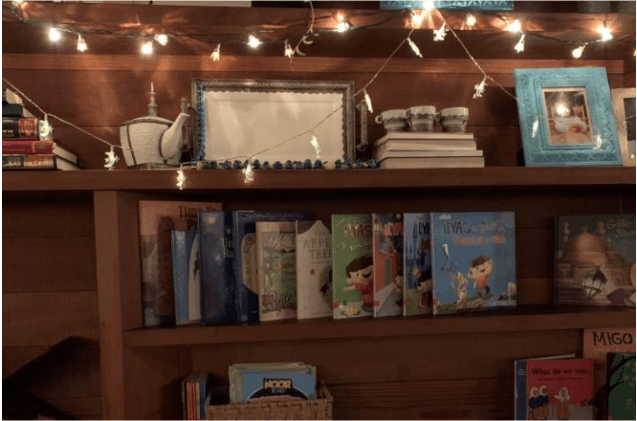
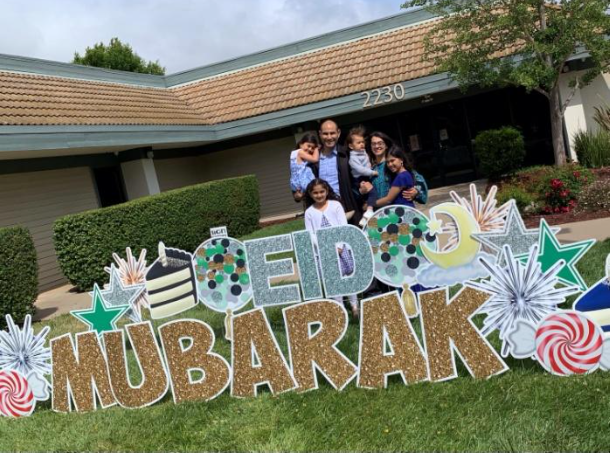
You know how they always bring out trees and lights for Christmas? Well, we do similar things for Ramadan and Eid! We set up lots of pretty lights, and put out our favorite Islamic story books. We bring out a garland that says ‘Ramadan’ and change it out to one that says ‘Eid Mubarak’ when the time comes. Adults gift children money, called Eidi. My family personally decorates not just for Eid, but for Ramadan, too!

4. Good Deeds and Charity.

Photo Courtesy of Aleena Haimor

In Ramadan, we gain more rewards for all of the good deeds and charity that we do. Some examples of good deeds are volunteering, picking up litter, visiting the sick, being generous, feeding others, being kind to others, even smiling at someone else is considered a good deed! Charity falls under good deeds as well. We are asked to give whatever we can to the poor and needy. For Eid, each Muslim family must give Zakat-ul-Fitr, about $15 for each member of your immediate family. Zakat-up-Fitr goes to help the poor and the needy, to give them the ability to buy necessities they need to survive.

Ramadan began during the time of our last Prophet, Muhammad. The Quran (our holy book) was revealed to him during this month. We believe that through the angel Jibreel (Gabriel), Allah commanded that Muhammad and his followers fast for the entire month of Ramadan. It was revealed in Makkah and Medina. Over 23 years, 114 surahs, or 6,348 ayat, were revealed.             

Photo Courtesy of Said Haimor, my
Jidu

Did you know that there are actually two Eids? One is at the end of Ramadan (Eid-ul-Fitr), and the other is later in the year (Eid-ul-Adha). Eid-ul-Fitr usually takes place at a mosque, and after prayers, we play games and have fun! 

Ramadan Kareem, and Eid Mubarak!!!

Here’s my Teta’s recipe for a special treat, Ka’ak. It’s a cookie that we make often during
Ramadan!

Arts and Culture, News, Student Life

Springtime Art Challenge!

by Olive Pea

Spring is right around the corner! The days are getting longer, and the sun is shining brighter. The birds are singing, the bees are buzzing, and everything is becoming more vibrant and alive! One of the most exciting parts of spring is watching the flowers bloom. They come in such a variety of thrilling colors and shapes, that you could never find two that look alike! Flowers bring joy and interest to a landscape or garden that has been asleep for the winter. Sometimes it looks as though a giant has spilled its paint all over the green foliage. For this colorful time of year, the Lighthouse has put together a drawing challenge for you! You can probably guess what the theme is by now…  flowers!

ABOUT THE CHALLENGE

The flowers that you will be drawing can be drawn with any medium of your choosing! Pencils, paint, oils or charcoal, just to name a few. You can draw any type of flower you want! Some common spring flowers include Tulips, Daffodils, Daisies, and Roses. You can even draw a flower that you came up with yourself! You can get as creative as you like. This is a non-competitive challenge, and all art submissions will be included in the next publishing in the Arts and Culture section. 

HOW TO SUBMIT YOUR ART

All art should be submitted by May 1st, and you will see your artwork when articles are published on May 5th. We accept kids of all ages, and ask that you please give us your age and first name. You may include your last name, or last initial. We value your privacy! You can submit your art to us by taking a picture and emailing it to us at thelighthousetve@gmail.com.

We hope to see your artwork! Remember, you can get as creative as you like.

News, Science, Student Life

 Let’s have a Conversation about Conservation!

by Meru S.

My local 4-H club recently invited a guest speaker from the East Bay Municipal Utility District (EBMUD) to talk about water conservation. He spoke about the most common ways water is wasted in everyday life, and how we can use less water to conserve it. Even with the rain that we have been having during the past two to three months, we still need to continue to use water with awareness of the drought.

Here are some ways in which we can conserve water:

  •  Fix water leaks. Leaks can waste up to two hundred gallons of water a day.
  • Take shorter showers. A ten-minute shower uses about twenty-five gallons.
  • Use the dishwasher instead of washing dishes by hand. Most dishwashers use only about six gallons per load. 
  • Irrigate lawns efficiently or install a drip irrigation system. Many sprinklers spray water not only on the lawn but also on the sidewalks or driveways, which wastes a lot. Drip irrigation sends water directly to the roots and does not waste or overwater.
  • Plant drought-tolerant plants that require less water.
  • Make sure to turn off hoses and faucets when not in use.

We removed our lawn and replaced it with Kurapia, a water-wise alternative to grass. We have also planted California natives, which, once established, do not need as much water. Collecting rinsing or cooking water is something we have been doing for the past few months. We keep a watering can in the kitchen and pour the extra water from foods (such as pasta or soaked grains) into it. Then we later use it to water our plants.

Art and photo courtesy – Meru S.

March 22nd is World Water Day. Each year, World Water Day has a different theme. This year, the theme is about accelerating change to solve the water and sanitation crisis. The general goal of this celebration is to ensure that people worldwide have access to clean and safe water. The first World Water Day was held in 1993 and was created by the United Nations. East Bay Regional Park District (EBRPD) is celebrating World Water Day with a Day by the Water at Lake Del Valle in Livermore. With games and activities, you can learn more about water conservation and the different ways in which water is beneficial to us and wildlife. 

News, Student Life

Valentine’s Day, Parkday, All in One!

by Olive Pea

Wow! It’s already February! We are officially a whole month into the new year. I’m still trying to break the old habit of writing 2022 whenever I write down the date. Since a whole new year has started, this means that the cycle of TVE’s holiday events is starting over! Actually, the first holiday event of 2023 is coming up in the very near future. TVE’s Valentines Exchange will be held at two different Park Days. The first one takes place at Larkey Park Day, Thursday, February 9th. The second one takes place at Boone Acres Park Day, Friday, February 10th.

 WHAT TO EXPECT

TVE’s annual Valentines exchange gives the kids of our homeschool community the opportunity to exchange Valentines with their Park Day friends! Once the exchange starts, everybody who brought Valentines should have them ready. While the kids are getting their Valentines ready, everybody should begin preparing the tables and set up Valentine boxes (or bags) for each participant. Once everything is set up, then kids who brought cards can start to drop them into other people’s boxes. Once everyone has put their Valentines in their friend’s Valentine boxes, the kids can start looking through the Valentines that they received.

THINGS TO BRING

 In order to participate, you must bring these necessities:

  1. A box (or bag) with your name written in large letters on the front. This will be used for others to easily find where to put their Valentine to you.

Note:

 Bags for you to decorate will be provided at the Boone Acres Park Day along with markers and stickers.  

  1. Kid friendly Valentine cards, either pre made or handmade to give to your Park Day friends. Goodies can be included, but they are optional. Food is not allowed, to make sure those with food allergies are also included.

In past events, there were many Valentines received, and many smiling faces. Last year at Boone Acres Park Day the amount of children was underestimated and there was said to be double the amount on Exchange participants! At the Larkey Park Day, there were bouncy balls that everyone had a lot of fun playing with.

We hope to see you at this wonderful event, and hope you get lots of Valentines!

For more information, visit the TVE Park Day pages on Facebook to find out who will be at your Park Day! 

Science, Student Life

5 Coolest Jellyfish

by Guest Author Mila M. (age 5)

I love sea animals.  In fact, jellyfish are my favorite. I hope my article gets you to like them too. I find jellyfish to be very beautiful, because of their many bright colors, glowing in the dark, and cool shapes. They have been around for almost 600 million years, so they are extra interesting.  Here are some facts about my favorite kinds of these fun creatures.                         

1. Moon Jellyfish (my most favorite of them all)

These jellyfish have bodies shaped like a saucer, with very short tentacles attached. They use these tentacles to catch plankton for dinner. The moon jellyfish can be found in most parts of the ocean, but not in very cold waters. They grow up to 12 inches (30 centimeters).  A fun fact: they are the most popular (widespread) jellyfish.

Photo courtesy of Georgia Aquarium                                                              

2. Deep-sea Jellyfish       

Deep-sea jellyfish have some tentacles that are held straight up. This creature belongs to a group called coronate jellyfish. They are shaped like a bell wearing a ballet tutu. This jellyfish can squirt out a big cloud of ink and grows up to 35 centimeters. 

Photo courtesy of Alamy Images       

3. Mauve Stinger

This jellyfish is gorgeous because of the beautiful bioluminescent light it emits, but it is also a mean stinger.  (Bioluminescence is when a deep-sea animal glows).  They have eight stinging tentacles and their sting is very painful, but not dangerous. This jellyfish grows up to 5 inches (13 centimeters) long. The Mauve Stinger lives near the surface, so be careful around it!

Courtesy of New York Post

4. Immortal Jellyfish (super cool and unusual, my sister’s favorite jellyfish)

This is the only creature on earth that can actually live forever! These jellyfish are able to reverse their life cycle. They live in oceans all around the world. The Immortal jellyfish eats plankton, and is tiny at about 4.5 millimeters or 0.18 inches long. Its predators are swordfish, penguins, sharks, tuna, sea turtles, sea anemones, and larger jellyfish. If an Immortal Jellyfish is frightened it turns back into a baby and restarts its life cycle.  How unbelievable is that!?

Photo courtesy of The American Museum of Natural History

5. Lion’s Mane Jellyfish

The Lion’s Mane Jellyfish is the biggest jellyfish in the world. Its bell body can reach a diameter of almost 8 feet, and with tentacles, it can grow up to 100 feet long. That’s huge! It eats fish, larvae, eggs, and tiny crustaceans (crabs, lobsters, barnacles). This jellyfish only has one predator. Can you guess which one? A sea turtle! Don’t stand near this jellyfish, though, because the tentacles can sting you. The Lion’s Mane jellyfish lives in cold waters.

Photo courtesy of Monterey Bay Aquarium

I hope you liked my article and are more interested in these creatures now. Next time you’re swimming at the beach in the ocean, watch out for some of these guys!

Sources: 

“Ocean. The Definitive Visual Guide”, Fabien Cousteau, Rob Dunn, Isobel Comley

American Museum of Natural History

Monterey Bay Aquarium

Science, Student Life

Mt. Diablo Audubon Society 2022 Christmas Bird Count Results

by Meru S.

Mt. Diablo Audubon Society (MDAS) announced the results of the 2022 Central and East Contra Costa County Christmas Bird Count on their Facebook page on January 16th, 2023. A total of 160 bird species were seen in Central County, one less than 2020’s record of 161. In East County, a total of 148 species were seen.

Every year MDAS participates in the National Audubon Christmas Bird Count. According to  MDAS, this event has been occurring annually since 1900 and is the longest-running community science project in the world!  Two Counts are conducted each year in Contra Costa County, one in Central County, and one in East County. MDAS sponsors both of these events.

The story behind the Christmas Bird Count (CBC) – In 1900, Frank M. Chapman, an Audubon Society member, started the first CBC as an alternative to the old traditional Christmas ‘Side Hunt’  in which hunters competed against each other to kill as many birds and mammals as possible. The data collected on the Bird Counts (which take place all across the U.S. between December 14th and January 5th) is used to monitor the population of the birds throughout North America.

My family and I participated in the Count led by East Bay Regional Parks for Central County at the Thurgood Marshall Regional Park on December 17th, 2022. The morning was crisp, cold, and clear when the walk began at 7:30 a.m. A naturalist from East Bay Regional Parks led and guided the group of around fifteen participants. We used birding scopes and binoculars to identify the different species, and kept track of the numbers. We were also given a checklist of species seen in Counts of previous years. We walked along the trails for about seven miles round-trip observing bird sightings. The event lasted for five hours.

Some of the birds we saw were:

Acorn Woodpecker

American Kestrel

Black Phoebe

Lewis’s Woodpecker

Loggerhead Shrike

Mountain Bluebird

Mourning Dove

Northern Flicker

Nuttall’s Woodpecker

Pipit

Red-tailed Hawk

Red-winged Blackbird

Say’s Phoebe

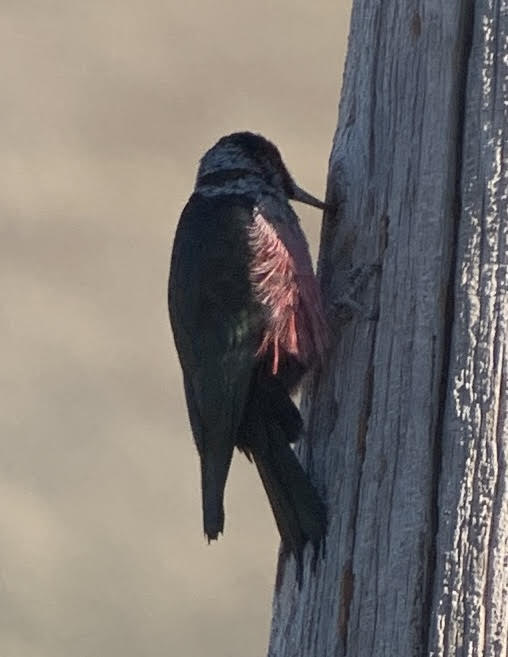
Photo courtesy Sashi S.

A photograph of a Lewis’s Woodpecker that we took through a birding scope.

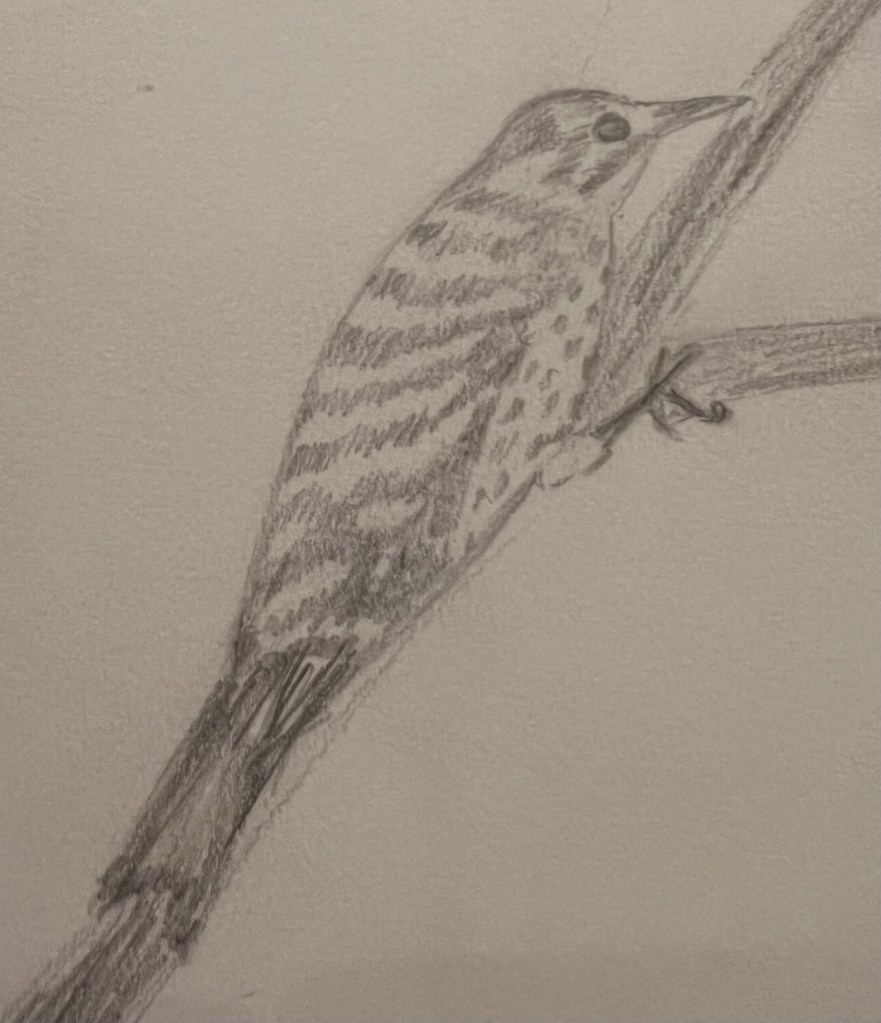
Sketch and photo by Meru S.

A sketch of a Nuttall’s Woodpecker from my nature journal.

The 2023 Central County Christmas Bird Count is tentatively scheduled for December 16th. The Count for East County is tentatively scheduled for December 20th. For further information on these and other events, please visit: Mt. Diablo Audubon Society.

Arts and Culture, Student Life

Book Review of The Martian

by Guest Author Lucas D.

The story follows Mark Watney, a member of NASA’s team sent to explore Mars. After a martian sandstorm leaves him stranded and injured, he is cut off from human communication and left to face the overwhelming challenges of surviving Mars. So ultimately, this book chronicles the story of Mark versus Mars. The main character’s bone-dry humor as he records his mission logs is both clever and entertaining. Another big strength of the book is the author’s attention to scientific detail and accuracy, while still managing to make the reader laugh. The author authenticated as much as possible the science behind the story. This was shown especially with application of physics on atmospheric pressure and the mathematics and chemistry behind the protagonist’s attempted solutions to problems that arise. I recommend this book for ten year old kids through adult, but the language is very explicit, so there is “Classroom Edition” for youth. This book is definitely worth your time if you are a sci-fi fan. There is a movie based off the book that I also recommend, but be sure to read the book first!

News, Student Life

How to Become a Guest Author

by Ava Salado

Do you want to publish one of your papers, essays, or creative writing but don’t have time to join The Lighthouse, no problem at all! Just become a guest writer! Email us at: thelighthousetve@gmail.com with your completed work, and we can publish it on our website. As you might have noticed, we have two (yes two!) guest authors this month. And we invite you to become one too!

Arts and Culture, News, Student Life

Poetry for You and Me

by Olive Pea

First off, Happy New Year everyone! Our Staff hopes all of you had a wonderful holiday season. Now that a new year has started we should all look back to see how far we have come and give ourselves a high-five for all we have accomplished! Don’t just look back, look to the future! The new year hosts many great and exciting opportunities for all of us. This article contains three poems that were submitted for our poetry challenge, so read on!

About the poetry challenge

Last month, our Staff posted a non-competitive poetry challenge. Submissions were to be sent to us by the 20th of December, and we got three fantastic poems! The submitted poems were to be posted in this very article, and never fear, we will not disappoint you!

Here are the three poems that were submitted by three kids from the TVE community! It’s not just poems that were submitted, actually, some art was submitted as well!

Christmastime

By Livi Skikos – 14 years old

Ornaments on every tree, some homemade of clay

People shovel snowy paths while candles light the way

Christmas cheer floods the homes of every girl and boy

Writing letters to the one who’ll bring them a new toy

Families gather ‘round to place a star on the tree

Children sled through the snow, feeling bright and free

Candy canes and silver bells remind you of the day

When Christmastime will come again, with Santa on his sleigh

HOPE

by Aleena Haimor

Hope is the bright flame

Like sunshine in the shadows

That I long to touch

Made by Max Yang

Sunfish

by Max Yang – 8 years old 

Sunfish, sunfish,

you remind me of a wish.

You are like the sun drifting away.

You remind me of the sun on most sunny days.

Oh oh, sunfish,

In my dreams,

you keep me company.

In the Monterey Bay Aquarium,

you wait for me.

Congratulations to all three of you! Give yourself a nice pat on the back for your hard work. These three poems are a joy to read!

These poems were read by our Staff, and were given these titles in the following categories:

Christmastime – Best Rhymes and Most Joyful

Hope – Best Topic

Sunfish – Brightest and Most Creative

We hope that all those who read these poems enjoyed them as much as we did. And a big virtual high-five to the participants. Once again, Happy New Year!

News, Student Life

The Terrific Train of Lights

by Lydia Martinov

Winter time? Check! Cars? Check! Hot Cocoa? Check! Thousands of lights? Check!  With holiday decorations inside and out, the Train of Lights is ready to choo-choo down the tracks. The antique coaches are quite a sight, especially in the open cars which feature wonderful views of the train. This one and a half hour ride is a truly fun activity, surrounded by a mesmerizing holiday atmosphere. The journey offers a “rare opportunity to experience a train ride through Niles Canyon at night,” as described on the Niles Canyon Railway website. It goes round trip through the Niles Canyon. With Santa Claus hitching a ride too, children of all ages can enjoy his company and the beautiful sights. The Train of Lights comes every year to take people on a Christmas-approved journey during November and December evenings.

The tickets to the train sell out very quickly, so it is recommended to purchase them months in advance. They go on sale on the Niles Canyon Railway website on October 1st, and sell out within the first couple of hours on the same day. First class tickets are sold at a higher price, and sell out even faster. These tickets come with extra perks, such as unlimited free hot chocolate, cookies, other snacks, and access to the exclusive first class cars. After the tickets are purchased, people arrive at the Niles Canyon Railway at the appointed time. The crew on the Train of Lights is made up of very knowledgeable and kind volunteers. Once everybody gets on and takes their seats, the conductor starts the train. You can walk through all the cars, which include the gift shop, a snack car (with snacks for purchase), a couple of open-air cars and uniquely decorated coach cars. Maybe, while you walk through the cars, you’ll find Santa Claus! You can take a picture with him, or ask him a question. 

I took a ride on the Train of Lights to take pictures for you to see. As one of my fellow passengers said, “The beauty of the train doesn’t show as well through photos, as it would in person.”  Here are some of them:

The train turning past a train crossing through the dome car window:

Photo by Lydia Martinov

Inside of one of the cars:

Photo by Lydia Martinov

Some fun Christmas decor

Photo by Lydia Martinov

Enjoying the view in an open car:

Photo by Lydia Martinov

Beautifully decorated open car:

Photo by Lydia Martinov

Some of the cars get pretty busy:

Photo by Lydia Martinov

The outside of the train:

Photo by Lydia Martinov

According to Jaqcuez Verdier, a first-class Dome car volunteer, “There are over a million Christmas lights on the train.” The reason it is called the Train of Lights is because each car is decorated by many lights, which in turn, are powered by 2 generators. 

When Santa came to the car we were in, my sister asked what he would like for Christmas. He said “I would like for all of the boys and girls to get what they wanted for Christmas this year.”

Santa!!!:

Photo by Lydia Martinov

The Train of Lights is a truly magical thing. Maybe you can take a ride someday, and see Santa in person. Don’t forget to have a cup of hot cocoa, and ask the volunteers about the train. They are very knowledgeable. Have a wonderful 2023!

More information at:

Train of Lights