Arts and Culture, Comic Strip, Home

Animation Tips – Part 1.

by Lucas David

Animation is like lying to your eyes. Every second, your brain processes a certain number of images and strings them together into a perceived movement. When you make an animation, you create a series of flat images resembling a 3 dimensional object and flash them in front of someone so fast that your brain performs its motion recognition process on the flat images. This creates a powerful illusion that can be entertaining, educational, and expressive. 

To make a drawing really feel like a living being, you not only have to create a visually unique and consistent character, but animate it to move like a breathing, seeing, hearing, feeling creature that reacts to its environment even when the viewer might not be paying attention. Unless they are standing unusually still in the scene, they should almost never stop moving completely. Even if the character is standing still, you still want to redraw it each frame, or have enough drawings on a loop to produce a similar effect. Here’s an example of an idle character that still reacts to its environment and does not rest on one drawing:

I find it likely that you, like me, are much more interested in animating an active character than an idle one, which we will explore in more depth next month. Creating a character in the process of performing something more exciting than standing, such as walking, (unheard of, I know), is easy to overcomplicate if you put unnecessary difficulty on yourself. It may appear robotic at first if you aren’t careful. One of the easiest errors for me is to start thinking about the character as a three dimensional object that holds its dimensions when rotated. 

This is a mistake because all that matters is what the viewer sees, and they see one angle. Even in 3D animated films, the characters would not look as natural if you turned the camera to view them from a different side. Our eyes see things differently in reality than when we see things on a screen, so the change is necessary and should come naturally as you animate more. This also means there is no need for you to correct it in your animations. In fact, “correcting” your imperfect character drawings will equate to shooting yourself in the foot over time, something I do rather frequently out of perfectionism.

Another tidbit to keep in mind is that no animal moves with perfect smoothness. This means that characters start movements slowly, speed up in the middle and end slowly again. If a movement is constant the whole way through, it causes your animation to look mechanical, and your characters to appear less alive to the viewer. If a piece of animation is feeling difficult to get started or you are having trouble deciding how to represent it, acting it out in front of a camera a few times and watching the recording can help remind your brain what the movement is supposed to look like, and make it easier to get going again.

Animation takes a lot of time and energy, and it’s not difficult to burn yourself out, especially when working on an ongoing project. One way that I avoid burnout is, on a particular day, if I notice I do not feel like animating, I try to assess whether I actually don’t want to animate or if I just need to work on a different part of my project. If I just don’t feel like animating, or feel like working on a short side project for a while, I let myself pursue the whim. You don’t have to force yourself to work on your project every single day, and in doing so you run the risk of turning it into a chore that you feel obligated to complete and find no joy in, which in my personal opinion is worse than quitting.

The last thing I will talk about today is how to manage your time effectively so that you can create more art in the time you have available. The biggest thing to keep in mind, especially in the context of ongoing animations, is that you don’t need it to be perfect, just good enough. Your art is usually better than you think, and NEWS FLASH you are not required to pump out pixar-level animations during your time as a student, or during any time for that matter. If you want to make the most beautiful animations ever, that’s awesome, and you should focus on getting used to spending tens of hours on a few seconds of art. If you’re more interested in the storytelling and narrative aspects, however, it’s helpful to be open to compromising a movement’s quality slightly because the show must go on.

Arts and Culture

How an Opera Comes Together – Part 1.

by Aleena Haimor

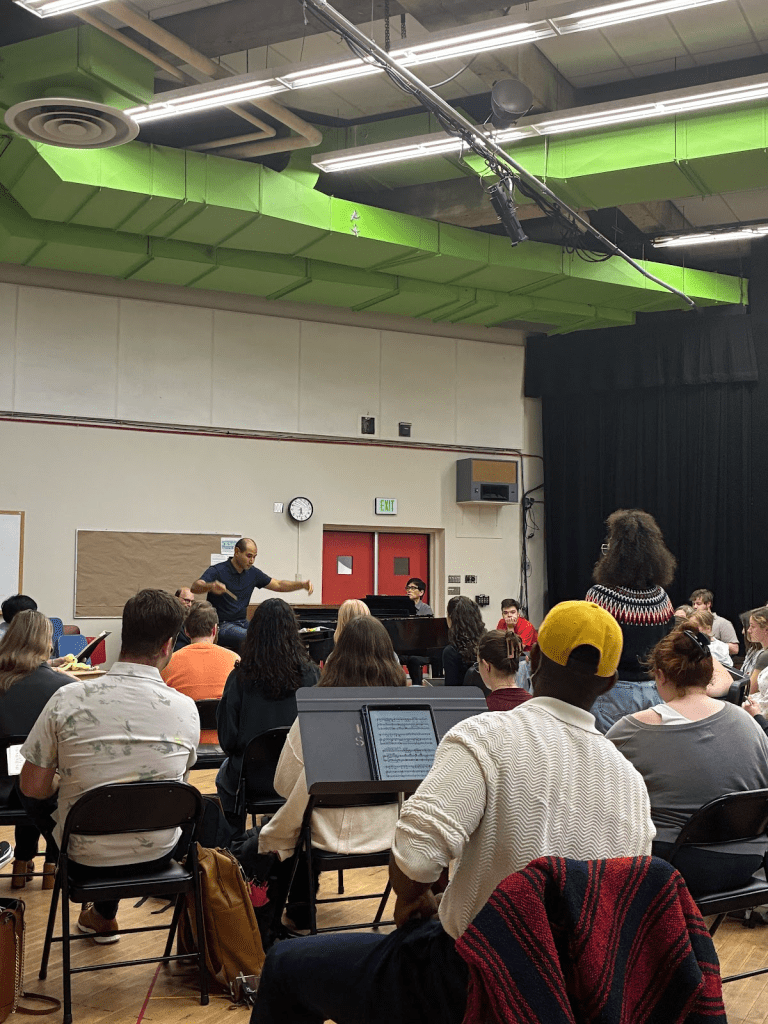
Recently, my father was invited to Indiana University (IU) Jacobs School of Music at Bloomington, Indiana, to conduct a production of Maurice Ravel’s opera, L’Enfant et les Sortilèges (The Child and the Spells). My dad went to IU from 2008-2009, where he completed his master’s degree in conducting. Now, he works as the Music Director of the Marin Symphony in Marin, California.

It has been an eye-opening experience for me, personally, to watch these rehearsals and see how an opera comes together, and I thought it would be amazing to share all about it!

So, without further ado, this is how an opera is made!


What is an opera?

An opera is a musical drama, where actors in costumes tell a story fully or mostly through singing, with sets and props. Opera means ‘work’ in Italian. Singers do not use microphones, and all of the music and singing is live.


About L’Enfant et les Sortilèges

A one-act, fifty-minute French opera composed by Maurice Ravel. A naughty little boy causes mayhem and treats his toys and everything around him carelessly. Suddenly, all of the objects in his room come to life. He approaches the fire, who ‘burns the naughty and warms the polite’. He is taunted by cats, cups and armchairs. Over the course of the opera, he learns that his actions have an effect on others. The child becomes kind, treating the animals and objects well when they eventually try to attack him. All the animals and objects praise his new wisdom.


The Early Stages: 

Every opera needs a cast. This opera, performed by a university-age cast (ranging from 18 to 27 years of age), has about eighteen characters aside from the chorus. I had the great privilege to speak to many people who are part of the two casts performing the same opera on different days. 

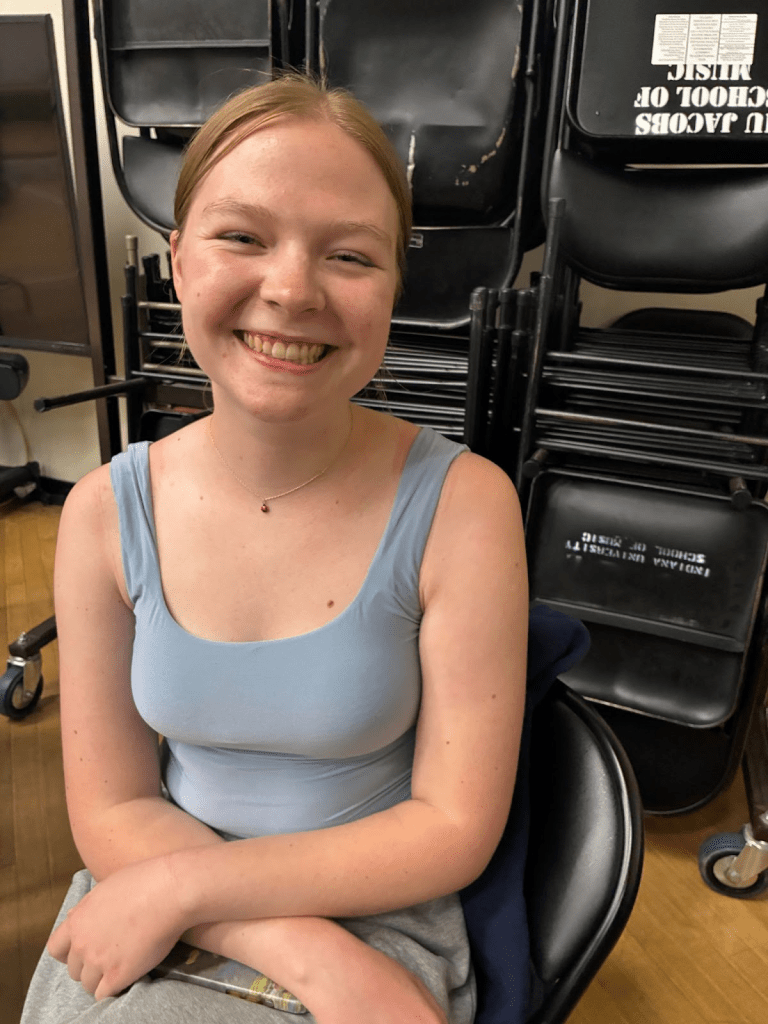
The play will be performed on October 17th and 18th, and the two cast lists came out way back in May. The actors and actresses rehearsed for hours on ends, almost every day, practicing on their own for weeks before starting rehearsals together. They also managed to keep their grades up from the many other university classes they were taking. I was able to interview some of the cast, and here is a short conversation I had with Sarai Burgos, who plays the protagonist in one of the two casts. Even though the character is a boy, many child male roles are played by girls, because of how high pitched a child’s voice is.


Aleena Haimor: How old are you, and what year of university?

Sarai Burgos: I’m 23, and in my second year master’s.

AH: What was your reaction to getting cast as L’Enfant (The Child)?

SB: It was amongst a bunch of other crazy things. My voice teacher emailed me a bit before the cast list came out. I was really grateful and happy.

AH: Tell us a bit about L’Enfant and how you’re bringing him to life?

SB: My character is around 7 or 8, maybe a little older, maybe a little younger. He’s pretty complex. There are a lot of ways my imagination can bring him to life. To me, he really wants to be seen and understood by others, but it comes across as being naughty or mean. Deep down, he’s really sweet and cares about others.

AH: Any acting tips for young actors and actresses?

SB: Learn to put yourself to the side and fully embrace communicating to the audience.  

Thank you so much, Sarai!

Sarai Burgos

Learning French Lyrics:

L’Enfant et les Sortilèges is completely sung-through in French, and the actors and actresses had to start learning French lyrics for the opera. They worked with a French dictation coach, Elsa Quéron, to make sure they pronounced the beautiful words correctly. 

Rehearsal, Late September

One of the actresses, Leah Nykaza, was luckily already familiar with the French language. She is playing L’Enfant in the second cast. She did an interview with me about how it was easier, yet still difficult, to pronounce words right.


Aleena Haimor: How old are you, and what year of university?

Leah Nykaza: I’m 21, and it’s my senior year of college.

AH: What character do you play, and what was your reaction to getting cast?

LN: I’m playing L’Enfant, and when I found out, I was excited and surprised. It’s my very first time being in a university production and an opera.

AH: Was it hard learning French for the opera?

LN: Luckily, I just finished taking two whole semesters of French last year. The two hardest things are the sounds we don’t have in English, and the difference between singing in French and speaking in French.

Thank you for speaking with me, Leah!

Leah Nykaza

This is part one of a multi-part article! Part two is out next month. Thank you for reading The Lighthouse!

Thank you to these incredible people for enabling me to write this article!

Actors/Actresses: Sarai Burgos, Leah Nykaza, Chloe Hopson, Kathleen Simunek, Natalie Vong, Pelagia Pamel, Maggie Stall, Kathrine Barbour, Jisoo Choi, Morgan Feeney-Davies, Brynn Jacobs, Nate Paul, Jeremiah Angel, Evan Gunter, Cody Horne, Andreas Psillos, Molly Singer, Cathrine Tamayo, Ana Ambartsumian, Ambriehl Ivy, Nina Royston, Kirsten Tierney, Yixin Yang, and Langelihle Mngxati.

Chorus: Julianna Banfe, Emma DiSanto, Savanna Holley, Laura Looper, Ruby Miller, Sabrina Schubert, Lauren Smedberg, Brittany Weinstock, Issana Yaguda, Simo Brea, Tynan Butler, Robbie Erickson, Lane Harden, Gannon Hays, Xiang Li, Preston Rogers, Stephen Stavnicky, and Tyler Whitney.

Production: Fawzi Haimor, Omer Ben Seadia, Walter Huff, Lydia Spellman, Russell Long, Gina Cerimele-Mechley, Olivia Essebaggers, Virgil Fok, Katrina Keat, Rachel Rock, Jennifer Hong, Miles Swaminathan, Shuichi Umeyama, Chuck Prestinari, Janice Kim, and Elsa Quéron.

Sources: 

https://www.eno.org/discover-opera/articles/the-beginners-guide-to-opera/

https://www.glyndebourne.com/opera-archive/explore-our-operas/explore-lenfant-et-les-sortileges/lenfant-et-les-sortileges-synopsis/

https://operaballet.indiana.edu/events/lenfant-et-les-sortileges.html

Arts and Culture, Stories

America’s Shining Girls – Part 2.

by Harper Smith

(Find part one here!)

Mollie’s death was a tragedy, but unfortunately, it did not gain media coverage. For all they knew, it was one girl, who suffered tragically and died horrifically, but with no one to blame. Her story could very well have gone unknown–if it was not for the girls at the factories. In fact, one in particular, Irene Rudolph, may have been the one to truly start it all. In 1922, she began regularly seeing a dentist for much of the same problems that Mollie suffered from. Although the dentists she saw had never crossed paths with the man who operated on Maggia before her death, Irene had been friends with her, and after the similar stories from a few other women who’d also worked at the dial factory, she began to be suspicious. Doctors began to suspect the chemicals from the plant may have had something to do with it, but they could find no proof, the radium companies made too much profit to even consider looking into the issue. Radium is perfectly safe, they would say, and that was that. Meanwhile, former and current employee deaths began to pile up. 

But the girls and their families wouldn’t stand for that. They tried to sue the company, and two professional medical investigators were even hired to inspect the facility. But their reports came back unhelpful–the employees’ blood was “practically normal,” from all they could tell, and Radium Dial remained fully in business. In fact, when another former employee, Hazel Kuser, began to experience a rapid decline in her health, the firm refused to pay any of her crushing medical bills, and her family was soon nearly broke. A brave group of the suffering women–Grace Fryer, Katherine Schuab, Edna Hussman, and Quinta and Albina MacDonald–did eventually press a lawsuit against the firm, but it was a very slow-moving process, and although the presence of radiation was being discovered in the corpses of the fallen girls, the company conducted many schemes to keep them from winning. Despite their efforts, the case fell short.

It seemed hopeless, and it nearly was. But in 1937, seven years after the deaths of the original women who fought for the case, five new women took a stand for their rights. They were very ill–the radium had been working its way into their body for a long time now, and it had been taking its toll. Several of them could not even travel to court, including Catherine Wolfe Donohue, who was so sick by the time of the proceedings that doctors were not sure she’d live to see the hearing. But their ailing health only made them more determined. Their bodies’ luminous glow, which had once signified wonder and prosperity, now spelled their doom: radium poisoning has no cure. But they could not let other women continue to suffer as they did. And so they fought. They found a lawyer, Leonard Grossman, who took the case for free, as they were very poor. Radium Dial was by now very sick of these meddling women indeed–but as the papers began to report on the case, calling them “The Living Dead” and taking their side, the company began to sweat. 

The girls testified on February 10, 1938. They were pushing for money, a settlement from the company to help pay the medical bills they would not have had to face if it was not for radium, but it was more than that. They wanted the truth. They wanted the company to admit what they’d done, to them and to so many others: that they’d lead an entire generation of women to their untimely deaths just for profit. 

It was Catherine who would be their savior. She was so weak that she needed the support of at least two other people to stand, and her voice was quiet and faltering as she told her story. But tell it she did, laying out the years spent working as a dial painter and the illness that followed, the company’s firm insistence that there was nothing wrong with her or the other women. There’s nothing wrong with you–these were the words spoken by the company president when Charlotte Purcell came to him missing her entire left arm. When the firm stole Peg Looney’s body and removed her radiation-drenched bones so that her death could not be tied to them. When the dial painters begged, year after year, for some closure in what was happening to them. Some explanation for why their teeth were rotting, their limbs were shrinking, their bodies were becoming riddled with cancerous growths. We are blameless, Radium Dial would say, and send their fake doctors out with the “proof.” 

Catherine talked for hours at her hearing, but she could not go forever. Halfway through, doctors–real doctors–were brought in to share the reports they had taken of her illness. It was to help prove the existence of radium poisoning, but when they shared the horrible truth–radium is permanent. Radium is terminal.–she collapsed to the ground with a scream so anguished it could be heard from the corridors outside. Catherine had so much to live for: she had her husband, her three children, she had her fellow dial painters, who had become her closest friends. She had been holding out for a cure, and hearing that there was none was too much for her and her ailing body to bear. She was taken back to her home, but her spouse Tom stayed to hear the rest of the report. Months to live. Incurable in her stage. Your wife is going to die. 

She was too ill to leave her bed after the collapse–in fact, her physicians said it would prove immediately fatal. But Catherine Donohue was a fighter. She would not rest until she and her friends, and the countless others before them, saw justice. “It is too late for me…” she said, “ but maybe it will help some of the others.” The hearing resumed the next day, at her bedside.  Lawyers, doctors, judges, and friends all clustered together around her, straining to hear her muffled words. She demonstrated the ‘lip, dip, point’ routine that had led her to ingest so much poison. She told stories of how the firm had told her to paint better, faster, to not get any grease on the dials–but never that radium was toxic. Her voice was tired, and she struggled to keep her eyes open, but she fought. Catherine Donohue fought for all the women of Radium Dial, for her friends, herself, and for the rights of factory workers everywhere.

On April 5th, 1938, the verdict was ruled. 

They had found Radium Dial guilty. 

For years, the Radium Girls have been the unsung heroines of our country. Thanks to their bravery, radium poisoning was recognized as an official, deadly disease. Thanks to their desire for justice, workers’ rights everywhere were improved as they had never been before. Thanks to their determination, their fighting spirits that carried on through horrific suffering and fatal disease, they brought down a cruel organization that would have rather covered up murder than pay an ounce of money to their victims. These women are the true champions of America, and it’s up to you and me to remember their victory for years to come. 

(Author’s note: nearly all the information in this report was gathered from Kate Moore’s nonfiction novel “The Radium Girls.” It is a wonderful, informative book that shines light on these brave women and their individual stories. There was a plethora of information that I was not able to include in this two-part publication, and I sincerely hope that you consider going out and reading it, it is not an exaggeration to say it’s one of my all-time favorite books. The stories of Catherine, Grace, Mollie, Quinta, Albina, Peg, Inez, Charlotte, Marie, and so many more are not tales to be missed.)

Arts and Culture

Interview with Bake My Day Mimo

by Aleena Haimor

Mirvat “Mimo” Hachem-Osseili, AKA Bake My Day Mimo, is an incredible Lebanese-American home baker with a huge follower count on platforms such as YouTube, TikTok, and Instagram. She is very talented and well known for decorating beautiful, elaborate cakes. Mimo makes cakes that span all different styles. I had the privilege and honor of being able to interview my favorite influencer and cake artist last week through email.

Mirvat Hachem-Osseili. Source: @BakeMyDayMimo on YouTube

When did you first get into baking?

So I first got into baking when I was little and I would always bake my sisters their birthday cakes. It wasn’t until I quit teaching that I actually started to make this a career of mine.

What is your favorite dessert? 

For my favorite dessert, I don’t really have one. I think if I were to choose something to eat, it would most likely be tiramisu.

Who is your biggest inspiration?

My biggest inspiration used to be Cake Boss but I no longer look up to him anymore because he’s turned his place more into a factory. So now I just look up to home bakers who have started from nothing and have grown.

Source: @BakeMyDayMimo on YouTube

When did you start your YouTube (current main) channel?

I actually started my YouTube channel about 14 years ago but I haven’t been really active on it until about four years ago. 

What do you like to do in your free time?

I used to love to paint in my free time but I have so little free time that I just find myself kind of numbing my brain out and watching some of my favorite shows over and over and over again. I also like to read when I can.

Why do you love baking?

I love to bake because I love the joy that it brings people. It’s also a way for me to use my artistic abilities and be able to profit off of that.

What is your favorite cake that you’ve made so far?

My favorite cake that I’ve made so far is the Venom cake, I’m so proud of that and I’m just honestly kind of disappointed that it didn’t go viral.

Source: @BakeMyDayMimo on YouTube

How are you always so good at coping with negativity?

I’m glad that you think I’m good with negativity but I really am not. In fact, I feel myself getting super anxious when I read negative comments. So the only way I find that it makes me feel better is to reply sarcastically. But most of the time, I usually just block them.

What cake decorating tips and tricks can you offer for beginners?

Any tips and tricks for beginners, honestly I would just start off with simple YouTube videos about how to bake a cake, how to fill and ice a cake and how to cover a cake.

Lastly, What is some advice you have for people who want to start a business or get into baking?

The best advice I have for people who want to start a cake business is to make sure that they have an organizational plan in mind because that’s the only way that they will prevent burnout. Also, take a class on how to properly price cakes because I know I’m on the lower end and I truly never learned how to price them perfectly. 

Mimo, thank you so, so very much for doing this interview with me. I know you’re very busy, and I’m very grateful that you made the time to answer some of my questions. I loved getting to talk to you, and I really hope that you enjoyed the interview as much as I did!

You can check out Bake My Day Mimo at:

https://www.youtube.com/@BakeMyDayMimo (Youtube)

https://www.tiktok.com/@bakemydaymimo (TikTok)

https://www.instagram.com/bakemydaymimo1/ (Instagram)

https://www.snapchat.com/add/bakemydaymimo (Snapchat)

Be sure to drop a follow for her!

Arts and Culture

Gold That Has Lasted – The Early Life and Poetry of Robert Frost

by Meru S.

In the land where grass grows gold

And gold itself does flourish;

In a city not yet shaken by Earth herself;

In the year of a thousand,

Eight centuries,

Seventy,

And four;

As the month of winds and rains

And of tender blossoms of fire,

Wandered away, unnoticed, with

Only five days left to live,

Was a life begotten.

A life that would piece together words—

Find refuge in words—

Words of joy and woe

And of mystical wonder . . .

To the eye of the reader.

And upon this life was the name of

Robert Lee Frost placed

In admiration, in imitation,

Of an esteemed soul,

A general of the South.

When had passed a pair of years,

Two months,

And one score and ten days,

Another, a sister, entered his life;

Together, they were alike and different.

When five years had grown him into a young boy,

The gentle Isabelle Frost

And the intoxicated William Frost

Sent him to kindergarten halfway across town,

With his trust in the driver of his horse-drawn bus

Who well-nigh failed to locate his passenger’s home,

Plunging the child into a pit of panic.

And he avoided school for many a year,

For his stomach was overcome with pain—

Perhaps fabricated . . .

Perhaps of true existence . . .

But successful, nonetheless.

And so, homeschooled he was,

In the art of numerals and reading,

In the weaving together of words.

And it was the latter that he was drawn to;

Errors in his copying of sentences

Drove him to a state of fury,

To rip the page from its bindings,

And to crush it to demolition.

Then tragedy struck,

Six years thereafter:

The death of his father;

Uprooting the family,

Sending them across the States

On a long, lonely journey aboard a train

To the east,

Where they resided with their kin,

Where his mother found employment

As a teacher of the middle grades.

And it was then and there that he attended school alongside others,

—Unaccompanied by a lack of complaint—

Yet again under the instruction of his mother, the schoolmistress . . .

It was to him all but engrossing;

His mother elected to ignore

The shavings of wood that amassed

Beneath his desk,

Fallen away from wooden figures.

He took no interest in reading,

He read no book until the age of fourteen—

Instead, uncovering a love of nature

That was bound to infuse his verses with its tranquility.

But a necessity to earn wages wrenched aside his attention,

Flinging it towards an undesired position at a shoe factory,

Until he quit from disrelish.

His pursual of further education lit a lamp,

Illuminated the works of the distinguished—

John Keats,

Edgar Allen Poe,

Inspired him to compose those of his own.

And so “La Noche Triste” manifested in his mind,

One night,

And like a river gliding down to form a lake,

It flowed from his mind

Through his pen

To meet his paper in physical appearance,

And he believed that it augured

The poet within him destined to be revealed—

The Monet of imagery,

Who would depict the bittersweet days

After Apple-Picking

With expression as free as the starlings’ flight;

Who would evoke a child to mount the branches of the

Birches,

To bow them with joy,

With exhilaration,

To ride skyward,

Away from the trammels of reality,

And to return once more,

To the earth,

To engagement,

To community and love;

A poem of two fragments combined.

And he took

A path less traveled

To tease his friend not through prose,

But through poetry,

Through stanzas seemingly sapient,

Through essence hidden in plain sight,

And it was not the poet’s wished significance

That was perceived then,

For, instead, it bewildered the recipient,

Who failed to look beyond its profound semblance,

Who primed the canvas for many a perusal to come.

And they have remained—

Sempiternal jewels,

Gold that has lasted,

Untarnished.

Arts and Culture

America’s Shining Girls: The Dark History of our Industry’s “Wonder Element”

by Harper Smith 

The year is 1898. Two scientists find themselves in the midst of making history–they have discovered a new element. Marie and Pierre Curie, in their study of radioactivity, found traces of something they had never seen before in a sample of uraninite ore. They named this element “radium,” and spent the next three years attempting to further prove its existence to the scientific community. It’s possible that you are aware of how this story ends. 36 years later, at age 66, Marie passes away due to aplastic anaemia, a disease of the blood cells. The cause? The chemist was known to have carried bottles of both polonium and radium, two extremely radioactive chemicals, in the pockets of her coat. The toxins caused her blood cells to be literally eaten away, bit by bit, until her body could no longer continue to function. The severity of the poison was so drastic that her remains have to be sealed in lead, along with nearly everything the scientist touched. Her notes are kept in a lead lined box and anyone who wishes to study them is required to wear protective suits–even her cookbooks are radioactive! After this, the element of radium was universally recognized as hazardous and kept locked away for only trained professionals to handle, and everyone lived happily ever after. 

At least, that’s what should have happened. 

Let us jump forward in time. It’s the early twentieth century, and everything is radium. There is radium in razor blades, toothpaste, cosmetics–even chocolate is being made with the toxic element! Radium is hailed as a miraculous cure-all due to its role in early forms of chemotherapy and spread wide in high-end stores across the country. And the business at the forefront of this craze is watches. “Liquid sunshine,” as the element was dubbed by some advertisers, had the ability to glow in the dark–bright and luminous and perfect for alarms and clock faces and most of all, watches. After all, who wouldn’t want to tell the time even amidst pitch-black darkness? Factories popped up everywhere, churning out a huge supply of the radium-coated time-tellers. Inside these factories were girls–the usual age being early twenties or late teens, with some as young as 13–and these girls had a very important job to do. They were known as the dial-painters and their role was simple: paint the clock faces with the radioactive paint. This alone may not have been deadly, if it weren’t for one factor. Lip, dip, paint. The girls, you see, were on a very strict schedule, and each watch had to be perfect. There was only one way they knew of to get their brushes to have that precise, fine tip, and that was by using their mouths to point the bristles. They would dip the brush into the radium-infused paint, then between their lips, then onto the dial, filling it in with the bright glow. The girls were told that this was healthy, that it was good for them, and each day they went home glowing like the very watches they painted. The radium powder coated their clothes, their skin, the tips of their tongues–America’s “shining girls,” they were called, floating through their towns like luminescent ghosts. It was a glamorous job, it paid well, it was so easy; what else could these women possibly need?

In October 1921, twenty-four year old Mollie Maggia, a dial painter of several years, made an appointment with a dentist named Joseph Knef. A few weeks prior, she had discovered a terrible ache in her mouth and had her tooth surgically removed. But the pain hadn’t left. Knef diagnosed her with pyorrhea, a common tissue disease, and operated on her to remove more teeth. But it didn’t help. The infection spread, ulcers grew in her gums, her teeth began to fall out all on their own, and on top of that she started experiencing seemingly unrelated aches in her leg and hip, so painful that she could barely walk. Knef attempted to operate on her jaw, only to find it literally disintegrated in his hands. He was mystified–Mollie was young, healthy, and on top of that she had worked with radium, the wonder element, for years. Why was this happening? 

A few weeks later, Mollie died. It was, as her sister Quinta put it, a “painful and terrible death,” caused when her mystery infection spread to her throat and caused her mouth to fill rapidly with blood, suffocating her. She left her friends, family members, and doctors all heartbroken and bewildered. The term “radium poisoning” would not be coined to describe her illness for many more years, and as far as they knew, there was no reason for any of this to have happened. Her death, painful and terrible as it was, had been completely and utterly unpredictable. 

Mollie Maggia was the first of the radium girls to succumb to this grisly fate. She would not, as the years went on, end up being the last. 

-To be continued-

Arts and Culture, Science

California’s Special Species – Part 1

by Sabine B.

Why is California so diverse? One reason is the abundance of different biomes and environments. The wide beaches and rocky cliffs of the coast regions border groves of redwood trees, oak woodlands merge into stands of fir and pine that give way to alpine meadows, and sage flats sprawl into sandy deserts. We have both the highest place in the continental US, Mount Whitney, and the lowest place, Badwater Basin. There are many different habitats in California which means there are a lot of different species. 

There is another reason as well! The land along the coast of California is part of a biome known as the chaparral biome, and those oak woodlands I mentioned are part of it. This biome is one of the rarest biomes on earth and it provides the perfect environment for lots of unique species. It only exists on the western side of continents and only from 40 degrees to 30 degrees north and south on either side of the equator. It is found along the coasts of Chile in South America, along the coast of Australia, along part of the coast of Africa, along the coast of California, and, in probably its most famous occurrence, in the Mediterranean in Europe (the chaparral biome is the reason for that ideal ‘Mediterranean climate’). The chaparral has mild wet winters and long hot summers. Its rain cycle is one of the things that sets it apart from other biomes. 

Due to its weather patterns, the plants of the chaparral have evolved adaptations that prevent drying out during droughts, and are fire resistant to protect against fires. The animals have adapted along with the plants. Because the chaparral zones are so far apart, and have such favorable conditions, and are so rare, species that settle in them often specialize to fit them. This means that chaparral zones are biodiversity hotspots. Those are places where more of the species living there are biologically unique than in other places. Just like in other biodiversity hotspots, California has many, many endemic species. They are found nowhere else in the world. Some of the species I will be sharing with you are found in only one or two counties in California. 

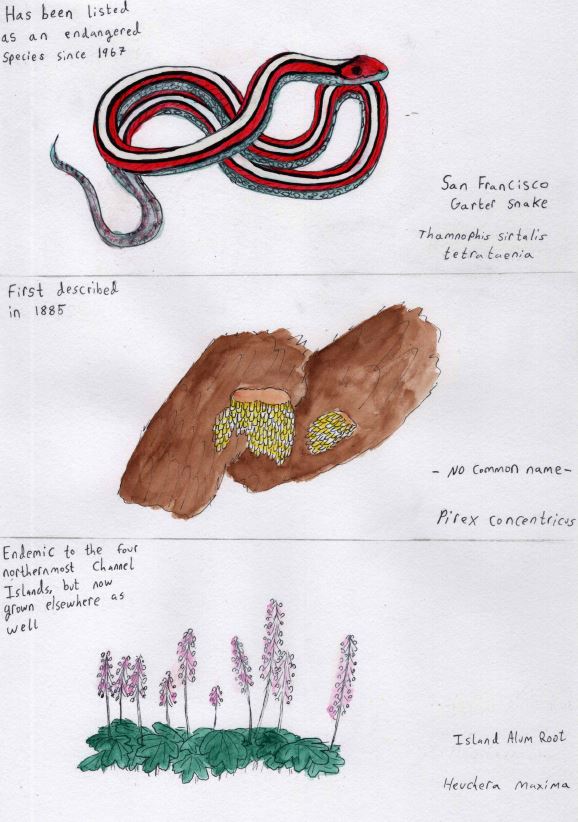
Every installment is researched and illustrated by me and will feature a native Californian animal, fungus, and plant. I will include the scientific name and the common name if there is one. I will also note something special about them. Feel free to look them up for more about them!